
If you’ve ever searched for what is a good marketing ROI, you’ve probably seen the same answer repeated everywhere. Five-to-one. Spend a dollar, earn five back. Some sites push it up to 10:1 if you want to sound ambitious.
That number is almost useless. Not because the math is wrong, but because the question is wrong.
We’ve managed marketing for service businesses for the better part of a decade. Plumbers, dentists, personal injury firms, med spas, HVAC companies. The “good” ROI for one of them might be a “you’re losing money, please stop” number for another. The honest answer to what counts as a good marketing ROI depends on four things most articles skip over.
This post is what we wish more service business owners read before they sat down with a marketing agency.
The 5:1 rule is a marketing meme, not a benchmark
The 5:1 number traces back to a Nielsen study years ago. It was a rough industry average across hundreds of brands, most of them consumer packaged goods companies running TV and print. It is not a benchmark for a roofing company in Tulsa or a personal injury lawyer in Tampa.
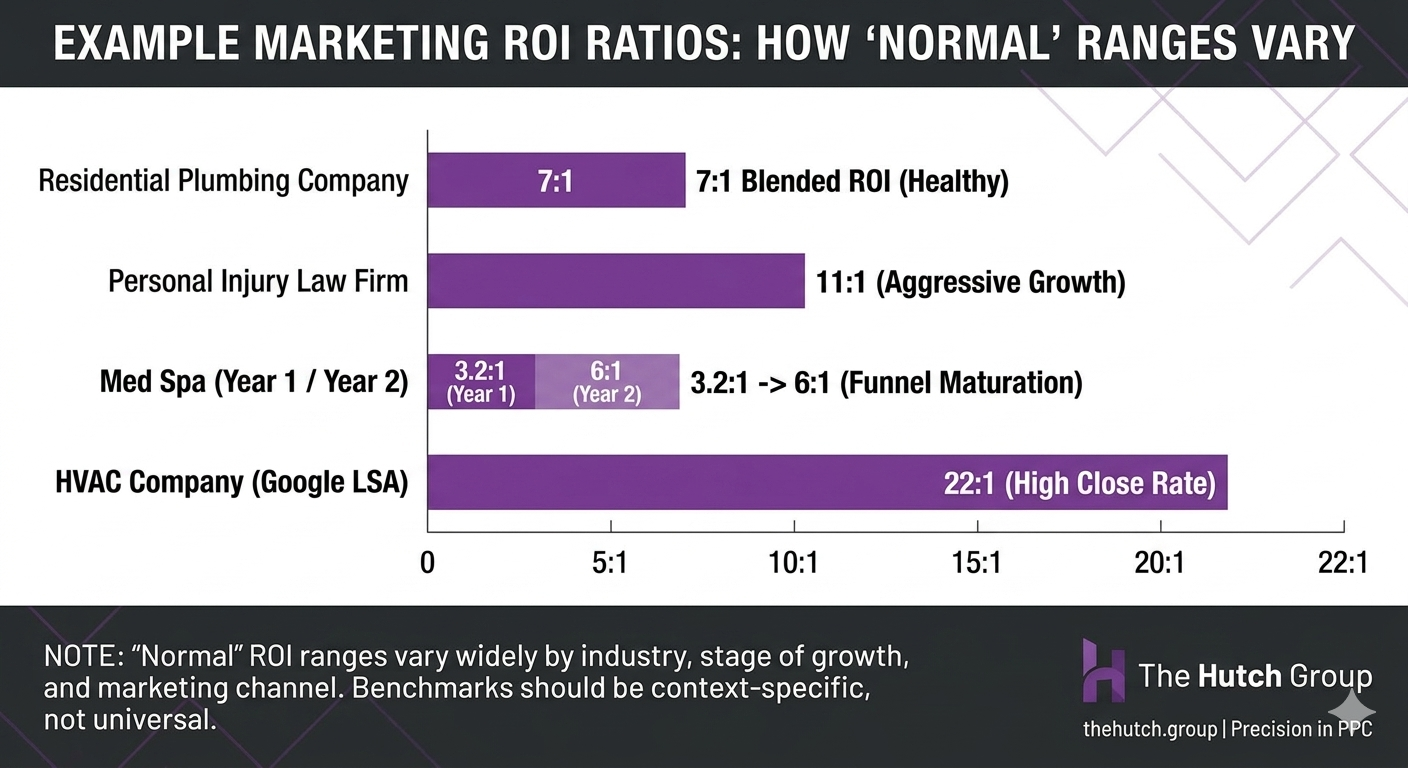
For service businesses, the meaningful ROI number can range from 3:1 (still healthy in some industries) to 25:1 (totally normal in others). A few examples from accounts we’ve managed or audited:
- A residential plumbing company at 7:1 blended marketing ROI. Comfortably profitable.
- A personal injury law firm at 11:1. Aggressive growth phase, still scaling spend.
- A med spa at 3.2:1 in year one of paid ads, climbing to 6:1 in year two as their funnel matured.
- An HVAC company at 22:1 on Google Local Services Ads alone, because the cost per click is irrelevant on LSA and the close rate is high.
Same metric. Wildly different “good” numbers. So before you can tell whether your ROI is good, you have to be honest about the four variables that change the answer.
What a good marketing ROI actually depends on
1. Your gross margin
ROI is calculated against revenue, but revenue isn’t profit. A general contractor at 22% gross margin and a financial advisor at 75% gross margin can both report a 5:1 marketing ROI, and only one of them is making real money.
Here’s a quick way to ground yourself. Take your marketing ROI ratio and multiply by your gross margin to get your true return on marketing spend. A 5:1 ROI at 25% margin is really 1.25:1 in profit terms. A 5:1 ROI at 70% margin is 3.5:1. Same headline number, very different reality.
This is why most cookie-cutter benchmarks fail service businesses. Service margins range from below 20% (some home services, before owner pay) to above 80% (legal, consulting, some healthcare). Generic ROI guidance ignores that completely.
2. Your customer lifetime value
A first-time HVAC tune-up customer worth $89 on the first invoice might be worth $4,000 over the next eight years if they convert to a maintenance plan. A bankruptcy attorney case is mostly one-and-done. A dental practice patient might generate $12,000 in lifetime billings.
If your marketing ROI calculation only counts the first transaction, the ratio you’re looking at is artificially low. We worked with a med spa that thought their Google Ads were “barely breaking even” at 2:1 first-purchase ROI. When we ran a 12-month customer cohort analysis, the real number was closer to 8:1. Their ads were excellent. Their measurement was the problem.
If your CRM or scheduling system tracks repeat business, calculate ROI on a rolling 12-month or 24-month customer value, not just the first sale.
3. Your business stage
A brand-new service business should expect lower marketing ROI for the first 6 to 12 months. You’re paying to learn what works. You’re paying to build a reputation that compounds. You’re paying for reviews, brand searches, and the kind of repeat customer base that makes ROI climb later.
Compare two scenarios.
A year-one plumbing company hitting 4:1 ROI is winning. No review base, no brand recognition, no past customer database. Every lead costs full price. A year-five plumbing company at the same 4:1 is mediocre. By that point, reviews, organic SEO traffic, and word of mouth should be driving a meaningful share of leads at near-zero marginal cost, pulling the blended ROI up.
If you’re early stage, a “good” ROI is whatever lets you survive long enough to compound. If you’re mature, “good” should be much higher because earned channels are subsidizing the paid ones.
4. What you’re counting as “marketing”
This is the one nobody talks about, and it’s the biggest source of fake ROI numbers in our industry.
Are you including your website hosting in marketing spend? Your CRM? Your call answering service? The hourly wage of the office manager who follows up on leads? Most owners don’t, which inflates the ROI on paper. Other owners include everything down to the cost of business cards, which depresses it.
Here’s a clean definition we use with clients. Marketing spend includes ad costs, marketing software (CRM, call tracking, landing page tools), agency or freelancer fees, and any creative production specifically for marketing. It does not include sales labor, fulfillment, or general overhead. Pick a definition and apply it consistently. The absolute number matters less than knowing it’s apples to apples month over month.
Marketing ROI vs ROAS, and why the difference matters
These get used interchangeably, and they shouldn’t.
ROAS (Return on Ad Spend) is revenue divided by ad spend, full stop. A 5:1 ROAS means the campaign generated $5 for every $1 in ad cost. It does not include your agency fee, your landing page build, your tracking software, or anything else.
Marketing ROI is revenue (or profit) divided by total marketing investment. That’s a more honest number for the business owner because it includes everything the marketing function costs you.
Why does the distinction matter? Because a campaign with a 6:1 ROAS can have a 3:1 marketing ROI once you factor in the agency retainer, the call tracking, the landing page work, and the CRM. Both numbers are real. They answer different questions. ROAS tells you whether the ads themselves are pulling weight. ROI tells you whether the whole marketing operation is.
For most service businesses, watch both. ROAS at the campaign level, ROI at the business level. If your ROAS is strong but your ROI is weak, you’re paying too much for the people running your marketing. If your ROAS is weak, the campaigns themselves need work.
How to actually calculate your marketing ROI
Skip the textbook marketing ROI formula you’ll find on most blogs. They look something like (Revenue minus Marketing Cost) divided by Marketing Cost. Technically correct. Practically useless if your tracking is broken, which it probably is.
Here’s the real-world version we use with clients.
Pick your time window. Quarterly is the right cadence for most service businesses. Monthly is too noisy. Annual hides everything.
Tag your revenue sources. Every closed job, signed retainer, or paid appointment should be tagged with how the customer found you. Phone call from Google Ads. Form fill from organic. Referral from existing client. Walk-in. If your team can’t answer “how did this customer find us?” on 80% of new business, the ROI number you’re calculating is fiction. Fix this first, then come back to the ROI math.
Sum revenue by source. Add up the closed revenue (not the leads, not the form fills, the closed paying customers) attributable to each marketing channel for the quarter.
Sum marketing spend by source. Ad spend on each platform, plus tools and fees that map to each channel. For shared costs like your agency retainer, allocate them proportionally to ad spend.
Divide and compare. Run ROI per channel and a blended ROI. The per-channel view tells you where to invest more or pull back. The blended view tells you whether the whole machine is working.
The number you get won’t be perfect. Attribution is messier than this. But a directionally correct number that you actually compute every quarter beats a perfect formula you never run.
The honest benchmarks (if you really want a number)
Fine, here are our rough cuts. Use these as starting reference points, then adjust against the four variables above.
For home services (HVAC, plumbing, electrical, roofing), blended marketing ROI in the 5:1 to 12:1 range is normal and healthy. Above 12:1 usually means you’re under-spending and leaving demand on the table. Below 4:1 means something is broken, often attribution or ad targeting.
For legal practices, 4:1 to 10:1 is the working range, with practice area driving most of the variance. Personal injury can hit 15:1+ on a big case but average down across smaller matters. Estate planning and family law tend to land 5:1 to 8:1.
For healthcare and dental practices, expect 4:1 to 9:1 on first-purchase ROI. The lifetime-value-adjusted number can hit 15:1+ for practices that retain patients well.
For med spas and aesthetics, 3:1 to 5:1 in year one is realistic. Year two and beyond climbs to 6:1 to 10:1 once the patient base and review flywheel kick in.
These are starting points, not goalposts. If your numbers are below the low end, dig into attribution and ad waste before assuming the channel is broken. If you’re at the top end and not scaling spend, you’re probably under-investing relative to market opportunity.
The mistake most owners make
The biggest ROI mistake we see has nothing to do with the math. It’s that owners try to evaluate marketing ROI before they’ve fixed their tracking. They look at a 3:1 ratio, decide marketing isn’t working, and slash spend. Six months later, revenue is down 30% and they’re more confused.
If you don’t know which channel produced which job, you cannot trust your ROI number. Period. Before you change your budget based on an ROI calculation, make sure you can answer four basic questions.
Every phone call gets tagged to a source (call tracking, like CallRail). Every form submission gets tagged (UTMs, hidden form fields, GA4). Closed jobs in your CRM or invoicing system get back-tagged to the original lead source. And the team responsible for closing leads is logging this consistently, not “when they remember.”
Get those four things right and the ROI number you calculate next quarter will actually mean something. The number itself is the easy part. The infrastructure underneath it is the work.
What to do next
Pull your last full quarter. Add up what you spent on marketing, including ads, tools, and any agency or freelancer costs. Pull every closed paying customer from the same quarter and tag each one to a source. Do the math. Don’t worry about precision yet, just get a number.
If the answer surprises you in either direction (much higher or much lower than you expected), the explanation probably lives in your tracking, not your campaigns. That’s where to look first.
If you want a second set of eyes on the calculation, we run free 30-minute attribution reviews for service businesses. No deck, no pitch, just a look at whether your numbers can be trusted.
