
Most marketing attribution model articles read like vendor brochures. Six models, six neat definitions, one suspiciously enthusiastic recommendation for the platform whose blog you happen to be reading. We’ve sat through that pitch a hundred times. Here’s the version we actually give clients.
The right attribution model for your business depends on four things. How long your sales cycle runs, how many marketing channels you’re using at once, what you can actually track, and whether anyone on your team will look at the data after we set it up. Get those four answers right and the model picks itself.
The fastest way to think about attribution
An attribution model is a rule for splitting credit when more than one marketing touchpoint is involved in a conversion. That’s it. If a homeowner clicks your Google Ad, then a week later searches your business name and clicks the Maps result, then a week after that fills out the contact form on your site, three touchpoints contributed to the lead. Attribution decides who gets credit.
Here’s why that matters. Every dollar you spend next month gets allocated based on what you think worked last month. Pick a bad model and you’ll cut the channels that actually drove revenue and double down on the ones that just happened to be near the finish line.
(If you’re new to all of this, our Martketing Attribution Guide covers the basics before you get to model selection.)
The six attribution models you’ll see in every dashboard
These six models have historically shown up in Google Ads, GA4, Meta Ads Manager, and most CRMs. However, as of 2026, Google has significantly narrowed its options.
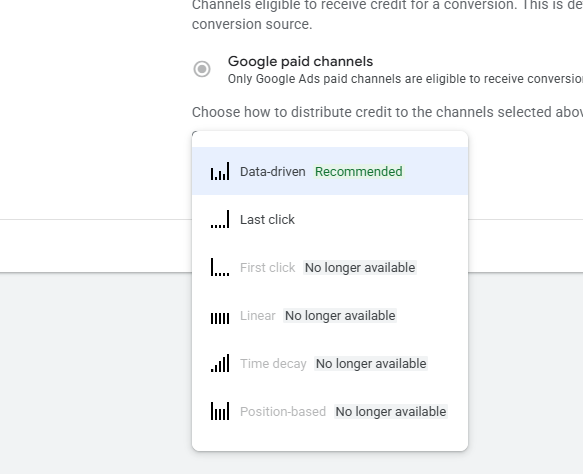
2026 Google platform update: Google Ads and GA4 now only offer two attribution models: Data-driven (recommended) and Last click. First click, Linear, Time decay, and Position-based are all marked “No longer available” inside Google’s conversion settings. The six-model breakdown below reflects the full landscape you’ll encounter across all platforms but if you’re working exclusively inside Google’s ecosystem, skip ahead to the Google platform note after this section.
First-touch attribution gives 100% of the credit to the first interaction. It treats marketing like a discovery problem. The lead found you through a Facebook ad, so Facebook gets the win even if they later searched your business name and called. Still available in some CRMs and third-party attribution platforms, but no longer available natively in Google Ads or GA4.
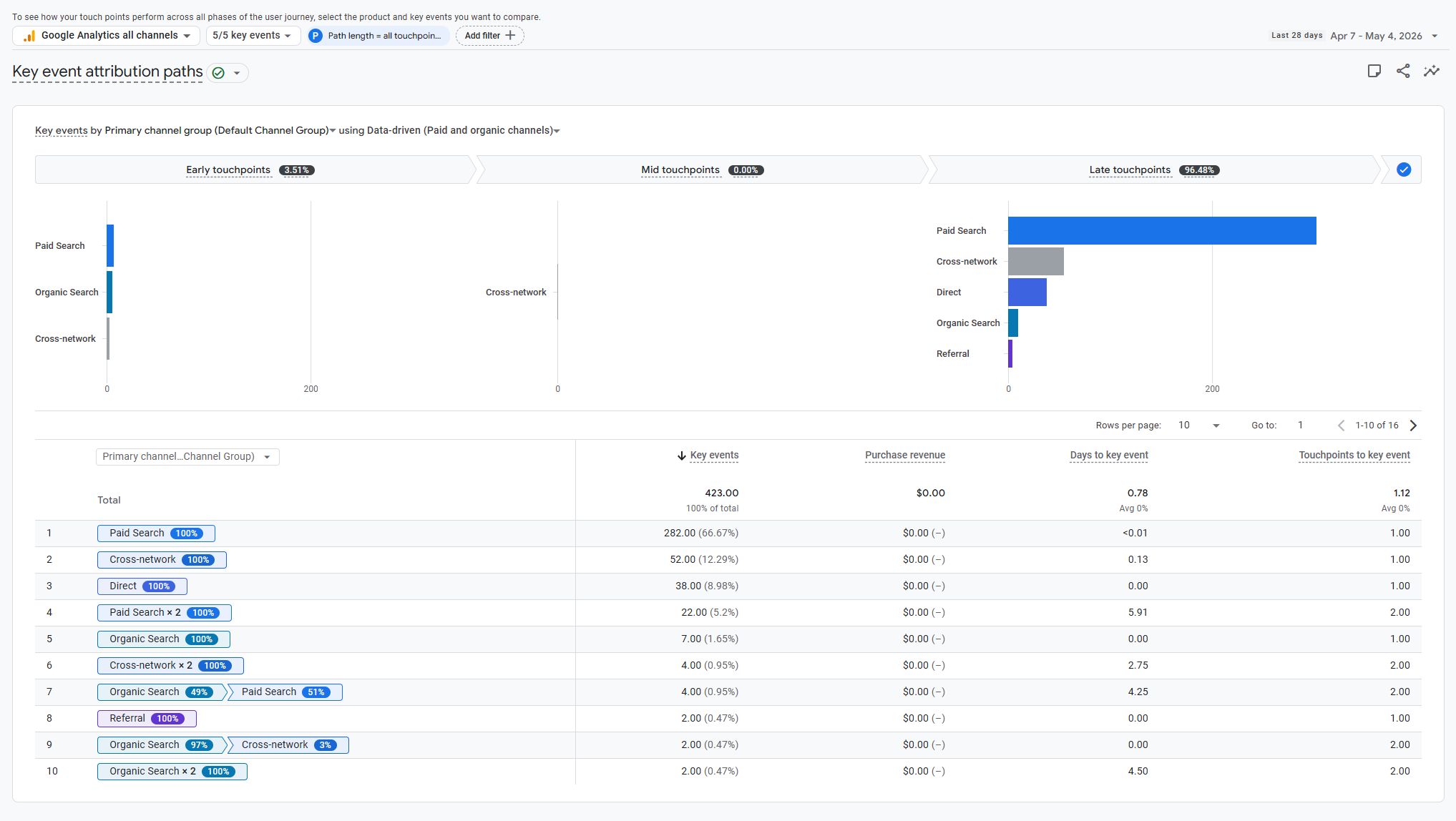
Last-touch attribution gives 100% of the credit to the last interaction before the conversion. This remains available in Google Ads and GA4, and is the fallback when data-driven attribution lacks sufficient volume. It’s almost always wrong for medium or long sales cycles as it systematically over-credits branded search and direct traffic, because that’s how people finally come back to convert after seeing you somewhere else first.
Linear attribution spreads credit evenly across every touchpoint. Three touches means each gets 33%. Fair in a kindergarten sense, useless in a business sense. Every channel looks vaguely successful, which means nothing actually does.
Time-decay attribution gives more credit to touchpoints closer to the conversion. A touch from 30 days ago might count for 5%, a touch from yesterday might count for 60%. It rewards bottom-funnel activity, which is appropriate for businesses with shorter sales cycles.
Position-based attribution (also called U-shaped) gives 40% to the first touch, 40% to the last, and splits the remaining 20% among everything in the middle. The logic is that introduction and closing matter most. It’s a defensible compromise that almost nobody actually picks because it feels arbitrary.
Data-driven attribution uses your account’s own conversion data to figure out which touches actually moved the needle. This is now Google’s recommended and default model. It requires a minimum data threshold (usually around 300 conversions and 3,000 ad interactions in 30 days) before it activates. When it works, it’s the most honest model on the list. When you don’t have the volume, it quietly falls back to last-click so check your conversion settings to confirm what’s actually being applied.
Google platform users (Google Ads and GA4): Your practical choice in 2026 is binary. Data-driven if you have the conversion volume to power it honestly, Last click if you don’t. The other four models are no longer available natively. If your strategy depends on Linear, Time-decay, or Position-based attribution, you’ll need a third-party attribution platform.
Sales cycle decides almost everything
If you take only one thing from this post, take this. The length of your sales cycle should be the first thing that narrows your model choice.
Same-day or short cycle (under a week). E-commerce, restaurants, urgent home services like emergency plumbing. The customer searched, clicked, and bought within hours. Last-touch attribution actually works fine here, because there usually isn’t a meaningful upstream journey to reward. The Google Ad was clicked at 2pm and the booking happened at 3pm. Last-touch gets it right.
Medium cycle (one to four weeks). Most home services, dental practices, optometrists, med spas, financial planners. The customer is researching, comparing, asking around. Last-touch will systematically over-credit your branded search and direct traffic. Time-decay or position-based models will give you a more honest read, especially if you’re running awareness-stage Meta Ads alongside intent-stage Google Ads.
Long cycle (one to six months). Personal injury law, family law, custom remodeling, large medical practices, B2B services. Last-touch attribution is actively dangerous here. It will tell you Google Ads brand campaigns and direct traffic produced 80% of your cases, when in reality your Meta retargeting and SEO content did the upstream work and your brand campaigns just collected the credit at the end. We’ve watched law firms cut their entire awareness spend based on a last-touch report and then wonder why their pipeline dried up six months later.
Then layer in how many channels you’re running
Sales cycle is the first filter. Channel mix is the second.
One paid channel only. If you’re only running Google Ads, the model debate is mostly academic. Your attribution lives inside the Google Ads conversion column. Pick “data-driven” if you have the volume, “last click” if you don’t. Done.
Paid plus organic. Once you add SEO, Google Business Profile, or email into the mix, last-touch starts breaking down. Branded search and direct traffic eat the credit that organic content actually earned. At minimum, look at GA4’s Model Comparison report (Advertising, then Attribution, then Model comparison) to see how the same conversions get distributed under different rules. You’ll be surprised.
Two or more paid channels. If you’re running Google Ads and Meta together, you have a real attribution problem. Google’s reports will claim Google did the work. Meta’s reports will claim Meta did. They can’t both be right, and if you sum them you’ll double-count conversions you only earned once. This is where you need to pick a single source of truth, ideally GA4 with a consistent attribution model applied across all channels.
Three or more channels including offline. Now you’re in the territory where call tracking, CRM-side stitching, and a real attribution platform start paying for themselves. Below that, the platform is overkill.
What you can actually track matters more than the model
Attribution is only as good as the data you feed it. Two questions matter here.
First, are your conversions actually firing? We audit somewhere around eight or nine accounts a month, and roughly half have at least one tracking gap. Forms that don’t fire on the thank-you page. Phone calls from Google Business Profile that never make it back to your conversion data. Meta conversions counting page views as leads. The fanciest attribution model in the world is useless if your raw data is broken.
Second, are you uploading offline conversions? A homeowner clicks a Google Ad, calls your office, and books an estimate three days later. Without offline conversion uploads or call tracking integration, that conversion never makes it back to Google Ads, so the model has nothing to attribute. For service businesses, this is the single biggest reason attribution looks worse than it actually is.
Will anyone actually use the data?
This is the question almost nobody asks before picking a model, and it’s the one that decides whether the work was worth doing.
A multi-touch attribution platform that produces a beautiful weekly report nobody opens is worth less than a basic GA4 setup that the marketing manager glances at every Monday. Pick the model that fits how the team actually works.
If your only marketing reviewer is the business owner and they get five minutes a week, go simpler than your gut tells you. Set up GA4 with last-touch reporting, layer in Google Ads’ data-driven model inside its own dashboard, and call it a day. The owner will look at one number, leads this month versus last, and make decisions accordingly.
If you have a marketing manager who actually opens reports and tweaks budgets, a position-based or time-decay model in GA4, paired with platform-specific data-driven models inside Google Ads and Meta, gives you enough nuance to make budget decisions without drowning in data.
How to set this up without buying a platform
We watch businesses spend $30,000 to $100,000 a year on attribution platforms before they’ve even nailed the basics. Here’s the order we run with new clients.
Start with GA4 set up correctly. Every conversion event needs to be mapped to a real business outcome, your channel groupings should be cleaned up so paid social isn’t bucketed as “unassigned,” and your UTM tags need to be consistent across all paid campaigns. That alone solves about 70% of attribution confusion.
Add proper conversion tracking inside each ad platform. Google Ads should track form submissions, calls of meaningful duration (we use 60 seconds as a default), and any offline conversions you can upload. Meta should track lead form submissions and on-site conversions through a properly configured pixel and Conversions API.
Connect a call tracking tool. CallRail is our usual default for service businesses. For legal and healthcare we’ve used CallTrackingMetrics where HIPAA matters. Calls are usually 40 to 70% of total leads for service businesses, and without tracking them by source you’re attributing blind.
Layer in offline conversion imports for closed leads. This is the step most agencies skip. When a lead becomes a paying customer in your CRM, push that signal back to Google Ads and Meta so the algorithms can optimize for closed-won, not just form fills. This is also where data-driven attribution starts actually earning its keep.
Only after all of that is in place does a dedicated attribution platform make sense. If you’re at that stage, the budget and complexity justify it. If you’re not, save the money.
A few things we still get asked
What are the four types of attribution? Most articles use “four” as a tidy number, but in practice you’ll see six in the dashboards. First-touch, last-touch, linear, time-decay, position-based, and data-driven. The “four types” framing usually refers to single-touch (first or last), multi-touch (linear, time-decay, position-based grouped together), data-driven, and custom. Pick whichever framing you like. The underlying models are what matter.
What is the best marketing attribution model? The best one is the one that matches your sales cycle, your channel mix, and your team’s ability to act on the data. For service businesses with a sales cycle in the one-to-four-week range running paid plus organic, position-based or time-decay almost always beats last-touch. If you have the conversion volume to power data-driven attribution honestly, that’s the most accurate answer.
What about Google’s data-driven attribution model? Is it good? When you have the data volume to power it, yes. Below the threshold Google quietly falls back to last-click and you don’t always realize it. Check inside the conversion settings to confirm what’s actually being applied to each conversion action.
What is the 3-3-3 rule in marketing? This one comes up in People Also Ask and isn’t really an attribution concept. It’s a budgeting framework (one third on customer acquisition, one third on retention, one third on brand) sometimes attributed to seasoned CMOs. Useful as a heuristic, unrelated to attribution model selection.
The decision in one line
Match the attribution model to the length of your sales cycle, then refine it based on how many channels you’re running and what your tracking can actually capture. Last-touch is fine for short-cycle, single-channel businesses. Position-based or time-decay is the safer default for everyone else. Data-driven is the gold standard once you have the volume to power it honestly.
If your current attribution setup is “whatever the platform gave us by default,” that’s worth an afternoon of work to fix. The budget you’re allocating next month is built on whatever number the dashboard shows you this month, and if that number is wrong, the budget is wrong.
