
A therapist came to us last year with eight open slots and a waitlist of zero. She’d been in private practice for two years, had a Psychology Today profile, a website a friend built, and a quiet dread about anything that felt like selling. Six months later she was full and had started a small waitlist of her own. We didn’t run a single flashy campaign to get there. Most of what worked was unglamorous, cheap, and already half-built before we showed up.
That’s the thing about marketing for therapists. The bar is low because so few practices do the basics well, and the basics are exactly the kind of trust-building work clinicians are already good at. You don’t have to become a marketer. You have to stop leaving the easy wins on the table.
Here’s what we changed, in roughly the order we did it, and what you can copy.
Start with the clients you already turn away
Before we touched ads or SEO, we looked at where her existing inquiries came from and what happened to them. Two things jumped out. She was getting maybe five contact-form messages a month, and she was replying to about half of them within a day. The other half waited two or three days, by which point the person had already booked with someone else.
Speed to response is the most underrated lever in this whole business. People reaching out to a therapist are often in a rough stretch. They email three or four practices at once and go with whoever feels human first. We set up a simple auto-reply that acknowledged the message, set expectations (“I’ll get back to you within one business day”), and pointed to a short scheduling link for a free 15-minute consult. Her booked-consult rate roughly doubled in a month. Same traffic. Better follow-through.
So before you spend a dollar getting more people to find you, fix what happens when they do. Count your inquiries. Time your responses. If you’re slow, that’s the cheapest fix you’ll ever make.
[IMAGE: Side-by-side of a slow generic email reply vs. a warm same-day auto-reply with a consult booking link | Alt text: Comparison of a delayed therapist inquiry response versus a fast automated reply with scheduling link]
Your Google Business Profile is doing more than you think
Most of the therapists we talk to have a Google Business Profile they claimed once and never touched. That profile is quietly deciding whether you show up when someone in your city searches “therapist near me” or “anxiety counseling [your town].” For a local practice, the map pack is prime real estate, and it’s free.
We filled hers out completely. Real categories (not just “Psychologist” but the specific service types Google offers), service area, hours, a few photos of the actual office, and the specialties she works with written in plain language. Then we asked her to request a Google review from a handful of clients who’d recently wrapped up successful work. Reviews are delicate in this field, and we’ll get to that, but even a slow trickle of honest ones moves you up the local rankings.
Within about ten weeks she’d gone from invisible on the map to showing up in the top three for a couple of her core search terms. That’s the single highest-ROI move in local healthcare marketing, and it costs nothing but an afternoon. We’ve written a full walkthrough of this if you want the checklist version.
If you serve a specific city, local SEO works a little differently than it does for other industries, and trust signals matter more
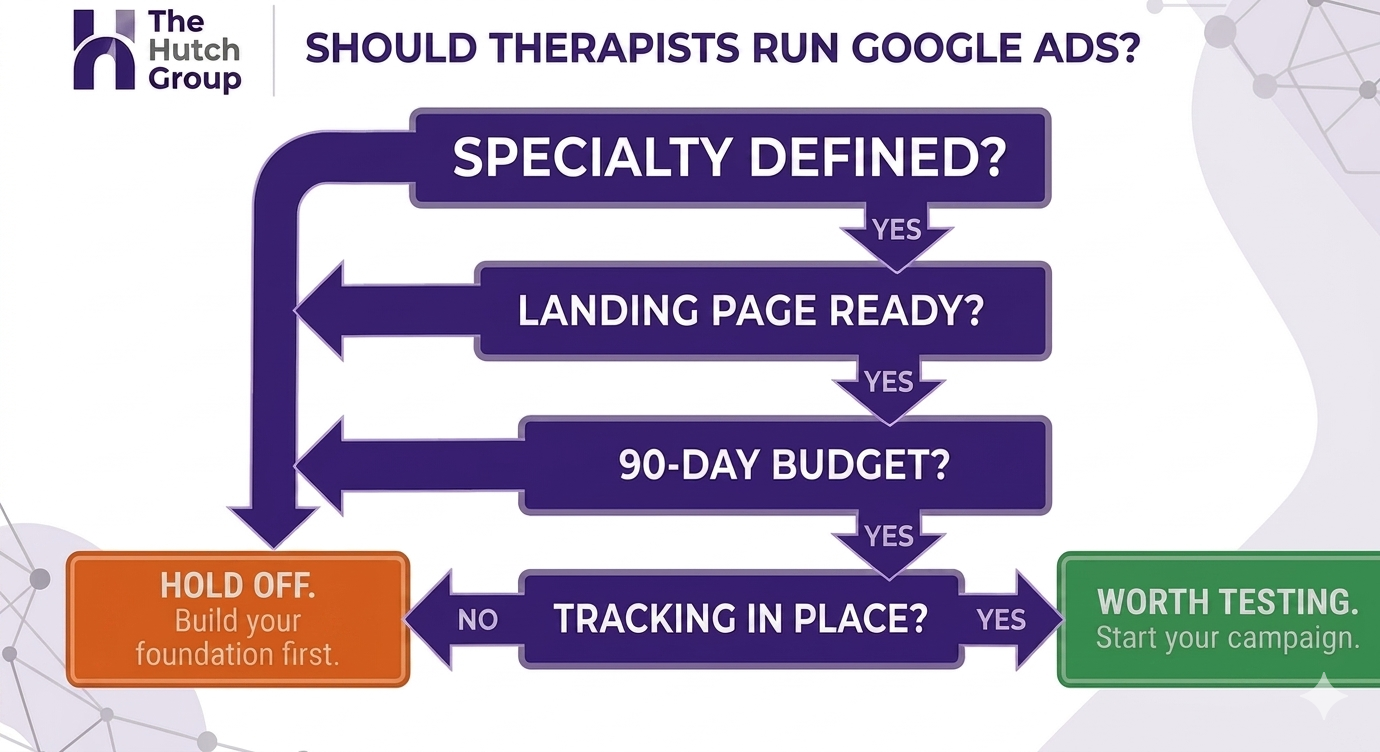
Should therapists run Google Ads?
Sometimes. Not always, and not first.
Google Ads for therapists can work well, especially for cash-pay or specialized services where a single new client is worth thousands over the course of treatment. The catch is that the keywords are competitive and the cost per click in some metros runs higher than people expect. We’ve seen “therapist near me” style terms in big cities push past five or six dollars a click, and broad terms burn budget fast on people who are price-shopping insurance copays.
Where paid search earns its keep is on intent-heavy, specific searches. “EMDR therapist for trauma” or “couples counseling [neighborhood]” or “ADHD assessment adults” pull people who know what they want and are ready to book. Those clicks cost more per visit but convert far better, and they tend to attract the cash-pay clients a lot of practices are actually trying to reach.
Our rule of thumb. If you have a defined specialty, a landing page that speaks to that specialty, and at least a small monthly budget you can run consistently for 90 days, ads are worth testing. If you’re brand new with no website to send people to and no way to track what happens after the click, hold off. Build the foundation first, then buy traffic for it. Spending on ads before the rest is ready is how practices conclude “marketing doesn’t work” when really they just skipped steps. For a sense of how paid platforms price out, our breakdown of ad costs for service businesses applies pretty directly here.
The HIPAA question everyone asks wrong
“Can I even do digital marketing as a therapist? Isn’t it a HIPAA nightmare?”
We hear this constantly, and the worry is usually pointed at the wrong thing. Marketing your practice, your specialties, and your approach is completely fine. You’re advertising a service, not disclosing anyone’s health information. What gets practices into trouble is the tracking, not the promoting.
Here’s the real issue. Standard tools like the Meta pixel and some default Google Analytics setups can, in certain configurations, send identifiable visitor data tied to health-related pages back to a third party. That’s the part regulators have flagged. The fix isn’t to avoid marketing. It’s to set up tracking carefully. Server-side configurations, IP anonymization, being thoughtful about what fires on which pages, and using call tracking that’s set up for healthcare rather than the consumer-grade version.
You can absolutely measure your marketing as a therapist. You just can’t bolt on the same off-the-shelf tracking an e-commerce store uses and assume you’re covered. If you take insurance, this matters even more, because the line between “marketing data” and “protected health information” gets blurry fast. When in doubt, the safe default is to collect less, anonymize more, and keep identifiable health context out of your analytics entirely.
Content is slow, and it’s still the best bet for cash-pay
If you want to attract clients who pay out of pocket for specialized work, content marketing is the most durable thing you can do. It’s also the slowest, which is why most practices quit before it pays off. Both of those things are true at once.
The therapist we worked with specialized in perinatal mental health. We had her write a handful of genuinely useful pages, one on postpartum anxiety versus the “baby blues,” one on what a first session actually looks like, one answering the questions partners ask. Not keyword-stuffed filler. Real answers to the things her ideal clients were typing into Google at 2 a.m. Over about eight months, those pages started ranking, and they brought in exactly the kind of person she wanted to work with. People who’d already read her explanation of a tough topic showed up to the consult half-sold.
This is the move hospital systems are too slow and too generic to beat you on. They have bigger budgets. They don’t have your voice or your specificity. A solo clinician who writes clearly about one condition can out-rank a giant health system on that condition, because the giant’s page is bland and yours is human.
One more thing worth knowing. The way people search is shifting, and a chunk of these answers now surface inside AI summaries and chat tools rather than the old blue links. Writing clear, genuinely helpful pages is also how you show up there.
A quick word on reviews and referrals
Reviews are tricky in mental health, and you should treat them that way. You can’t incentivize them, you shouldn’t pressure anyone, and a client agreeing to leave one is itself a small disclosure of the relationship. So go gentle. Ask only people who’ve clearly had a good outcome and are comfortable, make it easy with a direct link, and never offer anything in exchange. A slow, honest trickle beats a campaign every time, both ethically and for your rankings.
Referrals deserve the same care and more attention than they usually get. Other clinicians, physicians, OB practices, school counselors, and the like send some of the best-fit clients you’ll ever get. Most therapists let these relationships go cold. A short, warm note to a few referral sources a couple times a year, with a clear reminder of who you’re a good fit for, does more than any ad. It’s marketing. It just doesn’t feel like it, which is exactly why it works for people who hate marketing.
Track what fills the caseload, not what feels busy
The trap we see practices fall into is measuring activity instead of clients. They watch website visits and social media followers and feel productive while the schedule stays half empty. None of those numbers pay rent.
The number that matters is where your new clients actually came from. So we asked her to do one small thing on every consult call. Ask, “How did you find me?” and write the answer down. That’s it. No fancy software required to start. After a couple months, the pattern was obvious. Most of her new clients came from Google, split between the map pack and her content. Almost none came from the Instagram account she’d been agonizing over. So she stopped agonizing over Instagram. We doubled down on what was working.
If you want to get more precise later, set up proper tracking so you’re not relying on memory, and use call tracking built for healthcare so you can see which marketing drives the phone calls without stepping on HIPAA. But honestly, “how did you find me” plus a notebook will get a small practice most of the way there.
The point isn’t to track everything. It’s to know which two or three things are actually filling your caseload so you can do more of those and quit feeling guilty about the rest.
What we’d do first with a 90-day window
If you’re a therapist staring at open slots and you only want to do a few things, here’s the order we’d run it.
Week one, fix your response time and add a same-day auto-reply with a consult link. Week two, fully complete and optimize your Google Business Profile and start a gentle, ethical review trickle. Weeks three and four, write two or three real pages about the specific work you do best. Then start asking every single inquiry how they found you, and give it a season. Only after all of that, if you have a defined specialty and a budget you can sustain, test a small Google Ads campaign aimed at high-intent searches.
That’s most of what filled the caseload of the therapist we started with, and the expensive parts came last, if at all.
One question to sit with before you spend anything. Of the people who reached out to you in the last month, how many did you reply to within a few hours? Start there. It’s free, and it’s probably costing you more clients than your search ranking is.
If you’d like a second set of eyes on where your practice is leaking inquiries, we’re glad to take a look.
