
A remodeling contractor came to us last spring frustrated. He was spending real money on a website redesign, he had 11 years of solid work behind him, and he was still sitting on page two of Google when someone in his own city searched “kitchen remodeler near me.” His phone rang maybe eight times a month from organic searches. Nine months later, same service area, same crew, the phone was ringing closer to thirty times a month, and most of those calls were people ready to book an estimate. The thing that moved the needle wasn’t the new website. It was local SEO for contractors done right.
That’s the part most guides skip. They hand you a list of 15 tactics and let you guess which three actually matter. So here’s what we changed for that contractor, in the order we changed it, and why each step earned its place.
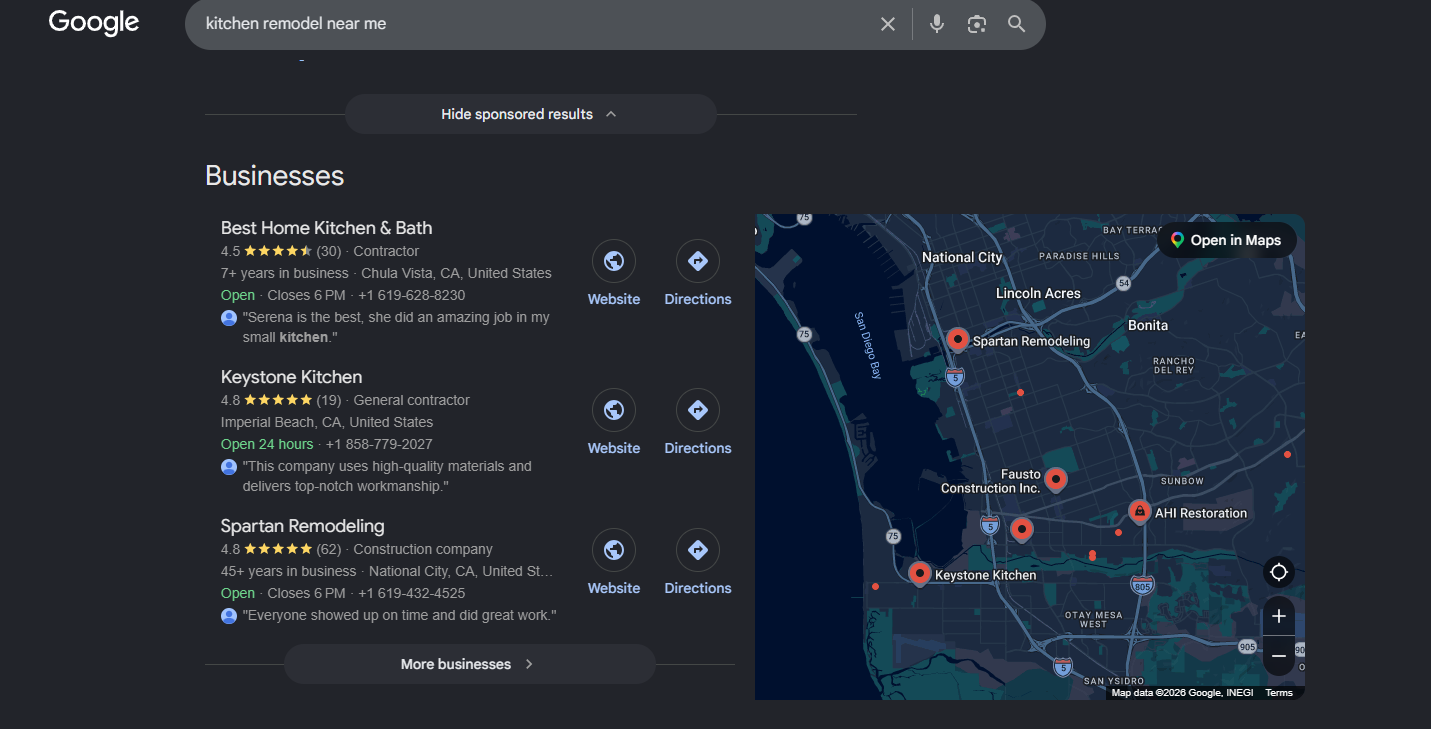
First, we fixed the Google Business Profile, because that’s where the jobs hide
When a homeowner types “bathroom remodel” plus a city name, the first thing they see isn’t a website. It’s the map and the three business listings underneath it. That block is the local pack, and for contractors it’s the single most valuable piece of real estate in search. Our remodeler had a profile, but it was the kind most contractors have. Claimed years ago, half filled out, wrong primary category, no recent photos, and a service area that didn’t match where he actually worked.
We rebuilt it from the category up. His primary category was set to “Construction company,” which is technically true and competitively useless. We switched it to “Remodeler” and added secondary categories for the specific work he wanted more of, like “Kitchen remodeler” and “Bathroom remodeler.” Categories are the strongest ranking lever you have on the profile, and most contractors get them wrong on day one.
Then the boring stuff. Real photos of finished projects, not stock images. Service areas set to the actual towns he serves. Hours, service descriptions, and the services list filled out completely. We added a few Google Posts about recent jobs. None of this is clever. It’s just complete, and complete beats clever in local search more often than people expect.
If you do one thing this week, open your profile and check your primary category against what your best customers actually search for. We’ve seen that one change alone bump a contractor into the local pack within a month.
The reviews problem nobody wants to deal with
Here’s the uncomfortable truth about contractor SEO. You can do everything right on the profile and still lose to the guy down the road who has 140 reviews to your 19. Review count and review recency are a big part of how Google decides who shows up in the pack, and they’re a big part of how a homeowner decides who to call once they see the options.
Our remodeler hated asking for reviews. Most good contractors do. They feel like they’re begging, or they assume happy customers will leave one on their own. They won’t. Left to chance, maybe one in twenty customers reviews you, and it’s usually the angry one.
So we built him a system that took the asking out of his hands. Every time a job wrapped, the office manager sent a short text with a direct link to the review form. Not an email that gets buried. A text, the same afternoon, while the customer is still standing in their finished kitchen feeling good about it. That one change took him from roughly one new review a month to eight or nine. Within four months he’d passed two of his local competitors on total review count, and his pack rankings climbed right along with it.
One honest caveat. Don’t gate reviews, don’t offer discounts for them, and don’t write them yourself. Google catches review manipulation, and the penalty is worse than the slow honest version.
Your website still matters, just not the way you thought
A lot of contractors think a prettier website ranks better. It doesn’t, at least not directly. What ranks is a site that clearly tells Google what you do and where you do it, and that loads fast enough that people don’t bounce before it opens.
The big win for our remodeler was structure. He had one “Services” page that listed everything in a single block of text. We broke that into individual pages, one for each service in each major city he targets. A page for kitchen remodeling in his home city. Another for bathroom remodeling. Another for the next town over. Each page spoke to that specific service and that specific area, with real project photos and real detail about the work.
This is the part of seo for contractors that takes patience. You’re not writing thin “we do kitchens in Springfield” filler. You’re building genuinely useful pages that answer what a homeowner in Springfield actually wants to know before they hire someone. Cost ranges. Timelines. What the process looks like. Photos of jobs in that area. Those pages started ranking for the long-tail searches the local pack doesn’t always cover, and they pulled in a steady trickle of organic leads on top of the map traffic.
We also cut his load time roughly in half by compressing a pile of oversized project photos. Site speed is a ranking factor, but more than that, it’s a leak. Every extra second before your page opens, a chunk of people hit the back button and call the next contractor instead.
If you want the deeper version of the on-page side, we wrote about it for one trade specifically in what we learned auditing electrician sites. The patterns repeat across every contractor vertical.
Citations and the consistency work that feels pointless
Citations are mentions of your business name, address, and phone number on other sites. Directories like Yelp, Angi, BBB, HomeAdvisor, and a long tail of smaller ones. For years this was treated as the holy grail of local SEO. It’s not anymore. But here’s why it still matters for contractors specifically.
Inconsistency confuses Google. If your business shows up as “Smith Remodeling LLC” on one directory, “Smith Remodeling” on another, and an old phone number on a third, Google isn’t sure which information to trust. That uncertainty can quietly hold you back in the rankings even when everything else is dialed in.
We ran an audit, found about two dozen listings with mismatched info (an old address from a move three years earlier was the main culprit), and cleaned them up. It’s tedious work and it won’t fire off fireworks in your analytics. Think of it as fixing the foundation, you don’t notice it’s working but you would absolutely notice if it weren’t.
You don’t need to be on 200 directories. Get the big ones right, make sure your name, address, and phone match exactly everywhere, and move on. Anyone selling you a 300-citation package is selling you busywork.
What we deliberately stopped doing
This is where contractor SEO advice usually goes quiet, because admitting you wasted effort isn’t a great look. We’ll say it anyway. A few things we used to spend time on barely move the needle.
Blogging for the sake of blogging is one. A contractor doesn’t need a weekly post about “5 signs you need a new roof” unless it’s tied to a real search someone makes before hiring. Most of those posts attract readers who will never become customers. We’d rather build out one strong service page than ten blog posts nobody searches for.
Chasing every new directory is another. And obsessing over keyword density on the page, which stopped mattering years ago. The contractor who writes naturally about the work, on a well-structured site, with a strong profile and steady reviews, beats the one gaming a 2014 checklist every time.
How long before any of this pays back?
This is the question every contractor asks, and the honest answer is annoying, so here’s the simple version first. Local SEO is slower than ads and faster than people fear. Profile changes can show up in two to four weeks. The reviews flywheel takes a couple of months to build momentum. The website and citation work tends to compound over three to six months.
For the remodeler, the profile and review work drove most of the early gains, and we saw the call volume climb within the first eight weeks. The website pages were the slow burn, picking up organic rankings through months three to six and still climbing after that.
One thing we track that a lot of agencies don’t bother with. Not just calls, but qualified calls. Early on, more rings doesn’t help if half of them are tire-kickers or out-of-area requests. We attribute leads back to which page or search drove them, so we can tell the difference between traffic that books estimates and traffic that just wastes the office manager’s afternoon. For a contractor, a booked estimate is the only metric that pays the bills.
If you’re running paid alongside this, and a lot of contractors should, it’s worth understanding how AI search is starting to surface local businesses too. We covered that shift in how to rank on ChatGPT, and it’s becoming a real channel faster than most contractors realize.
Try this first
If you read all of that and feel like it’s a lot, it is. So don’t do all of it this week. Do this instead.
Open your Google Business Profile. Check three things. Is your primary category the most specific match for the work you want more of? Are there at least a few real, recent project photos? When was your last review, and how many do you have compared to the contractor currently sitting above you in the map pack? Fix the category today, set up a dead-simple way to text customers a review link, and you’ll have done more for your local seo for contractors than most of your competitors will do all year.
The full playbook of profile, reviews, site structure, and citations is what separates the contractor who shows up when someone needs them from the one who’s still wondering why the phone’s quiet. Start with the profile and the rest compounds from there.
If you want a second set of eyes on where your local presence is leaking jobs, we’re happy to take a look.
