
Almost every “SEO for electricians” guide on the first page of Google reads the same way. Write blog posts about wiring tips, build backlinks, target long-tail keywords, the end. Then you scroll over to Reddit and find threads of electricians asking whether SEO is even worth bothering with, because the last agency that sold them on it produced a slow trickle of leads that mostly weren’t real.
We’ve audited a fair number of electrician sites over the years. Both ends of the result spectrum are familiar to us. Here’s the honest version of what works, what doesn’t, and what the agencies pitching you on “complete SEO solutions” tend to skip.
Most SEO advice for electricians is written for SaaS companies
This is the first thing to understand. Most general SEO advice is built around the idea that you publish content, attract organic traffic from across the country, and convert some percentage of that traffic into customers. That model works for a software company. It does not work for an electrician.
You don’t need traffic from California if you’re in Charlotte. You need to show up when someone within a twenty-mile radius of your truck searches “panel upgrade near me” or “electrician open Saturday.” That’s a local SEO problem, not a content SEO problem.
The reason so many electrician sites publish forty blog posts and see nothing happen is that the publishing isn’t connected to the way searchers in their service area actually find electricians. Blog posts have a role here, but they’re maybe item six on the list. Treating them as item one is why the work feels wasted.
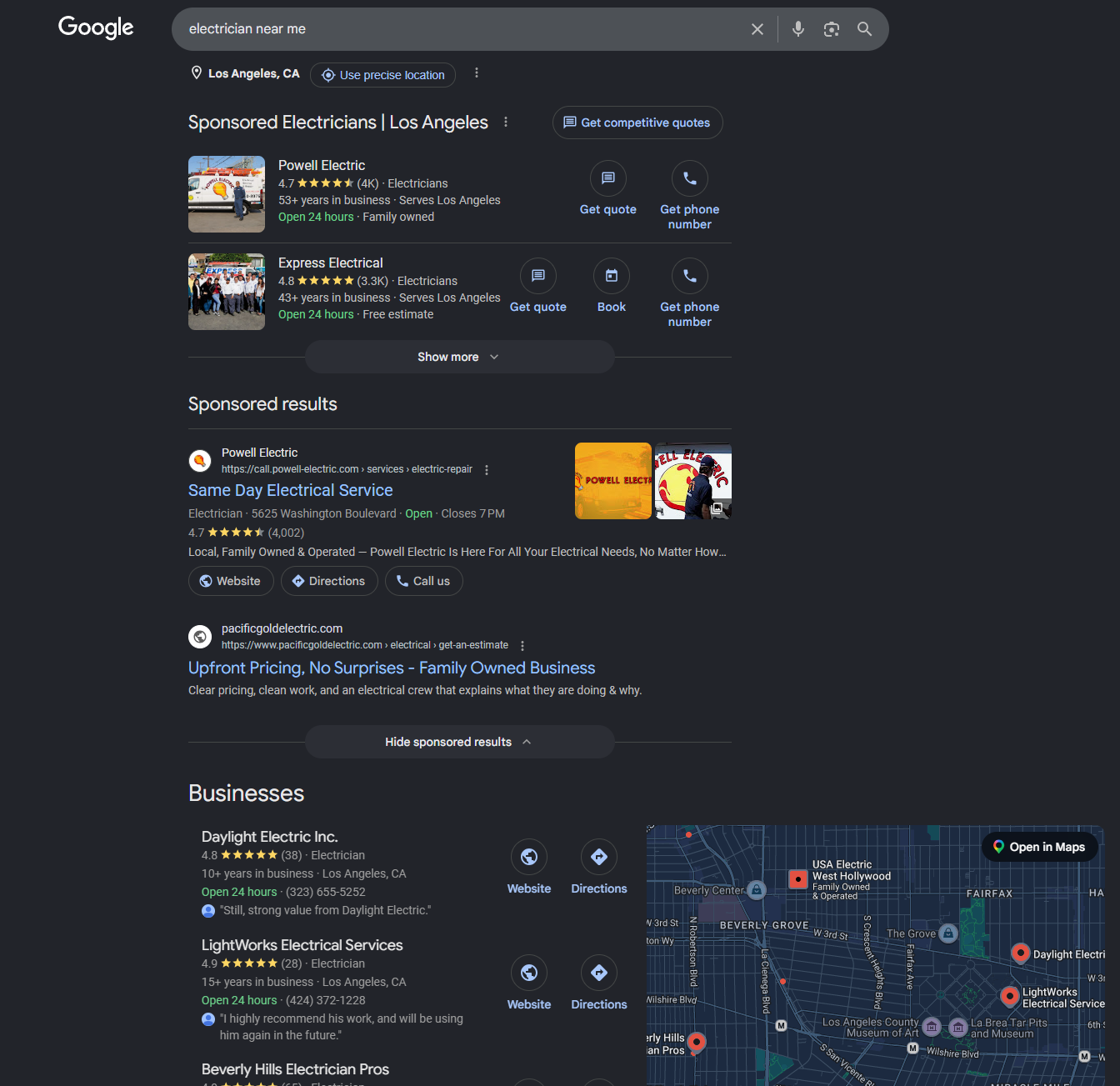
Start with your Google Business Profile, because that’s where the money lives
If you skim this whole post and only do one thing, do this one. The Google Business Profile (formerly Google My Business) is the single highest-leverage asset for an electrical contractor’s online visibility. It’s free, it shows up above the organic results, and most electricians have profiles that are half-set-up at best.
A profile that performs has all of the following dialed in. Primary category set to “Electrician” (not “Electrical Contractor”, which is a separate category and gets less search traffic for the queries that matter). Service area set correctly, with each city you actually serve listed individually rather than a single radius. Services filled out completely, including the unsexy ones like outlet replacement and EV charger install. Real photos uploaded monthly, not the stock images your web designer dropped in three years ago. Posts published every week or two using the “What’s New” or “Offer” types. Q&A populated proactively (you can ask and answer your own questions, and most electricians have no idea).
When we audit a profile and it has nine reviews, three blurry photos, and no services listed, we already know why the phone isn’t ringing. Fixing the profile is the first thirty days of work, and you can do it yourself in an afternoon if you’ve got the patience.
Service area pages do the heavy lifting on your website
Once the GBP is in shape, the next move is service area pages. These are individual pages on your website built for the specific combination of (service) plus (city or neighborhood). “EV Charger Installation in Plano, TX.” “Panel Upgrades in West Asheville.” Not generic catchall pages. Specific ones.
Here’s why this works. When someone in Plano searches “EV charger installation Plano,” Google has two ways to figure out which result to show. The local pack pulls from your GBP and the businesses Google believes serve that area. The organic results pull from web pages that are specifically about that service in that area. If you have a strong GBP and a service-area page that names the city in the title, the URL, and the body, you get two shots at the search instead of one.
The mistake we see almost universally is electricians having one page called “Services” that lists everything they do in one giant block, plus one “Areas We Serve” page that lists fifteen cities. That’s two pages competing for hundreds of (service plus city) queries, and it loses to a competitor with a page built specifically for each combination.
You don’t need a page for every possible combination on day one. Start with your top three or four services and your top three or four service areas. That’s twelve pages. Write each one with real content, not the same template with the city name swapped. Mention local landmarks, reference the kinds of homes in that area (older homes with knob-and-tube, newer subdivisions with EV adoption), and link back to the GBP. Twelve pages done right will beat sixty pages done lazy.
“Do I need a blog?” is the wrong question
This is the question we get asked most often by electricians who’ve been pitched by an SEO company. The answer is “not at first, and even then probably not the way they’re describing it.”
Here’s the calculus. A blog post takes time and money to produce. Each post needs to either rank for a search term that brings in qualified people, or support your site’s topical relevance in ways that help your service-area pages rank better. Most of the blog posts agencies write for electricians do neither. “5 Signs Your Outlet Needs Replacing” might get a click from someone in Iowa who’s never going to hire you. “What to Expect When Upgrading Your Electrical Panel to 200 Amps” might actually pull in homeowners researching a job they’re about to hire someone for.
If you’re going to blog, write fewer posts about higher-intent topics. Posts that answer the questions homeowners ask right before they call an electrician. “How much does a panel upgrade cost in [your state].” “Do I need an electrician for a hot tub install.” “What permits do I need to add a sub-panel.” The kinds of searches where someone is actively considering hiring.
We’d rather see a site with eight strong service-area pages and four high-intent blog posts than a site with fifty thin posts on outlet safety tips. The first one ranks and converts. The second one just exists.
Reviews are an SEO channel, not just a reputation play
Most electricians think of reviews as a “what shows up next to my business when someone Googles me” issue. They are that, but they’re also a direct ranking signal for the local pack. Google has been clear about this in multiple statements over the past few years. The quantity, recency, and quality of your reviews affects where you show up.
The practical implication is that asking for reviews has to be a system, not a sometimes-thing. Your review count matters, and so does how recent and how detailed those reviews are. The electricians who rank well in their markets have between four and eight times the review count of the ones who don’t. They also have reviews that mention specific services (“Rewired our 1950s kitchen, did beautiful work”) because those service mentions feed Google’s understanding of what you actually do.
The simplest review system that works is a text message sent from the office (not the field) thirty minutes after a job closes out, with a direct link to your GBP review form. Not “please leave us a review.” Try “If you’ve got a second, here’s the link.” Conversion on the first format is usually under five percent. Conversion on the second format is often double that, and the reviews tend to be more specific because the customer isn’t filling out a generic template prompt.
If you’re feeling overwhelmed, this is item three on the priority list after GBP and service-area pages, and it’s the one with the most compounding return.
What the top-ranking electrician sites quietly have in common
We audited the websites of the top three local-pack-ranking electricians in eight different metros last year. A few patterns showed up so consistently they’re worth naming.
Their sites load fast on mobile. Almost all of them score above eighty on PageSpeed Insights for mobile. The ones that didn’t were exceptions held in place by an unusually strong review profile.
They use schema markup, specifically LocalBusiness and Service schema. Most electrician sites don’t. Schema doesn’t directly rank you higher, but it helps Google understand what you do and where, and it can earn you rich results in the SERP that increase your click-through rate.
They have a phone number in the header that’s clickable on mobile, and they don’t bury it. You’d be amazed how many electrician sites we audit where the phone number is in the footer in tiny gray text.
They have at least one piece of content that’s genuinely useful, not a sales page. A pricing guide for their region, a “what to look for in an electrician” article, a clear breakdown of their service areas. Something a homeowner would actually finish reading.
None of these are revolutionary. They’re the things that get skipped when you hire the wrong SEO company, because the wrong SEO company is selling you the things that are easy to invoice for (monthly blog posts, generic backlinks) rather than the things that move the needle.
When SEO is the wrong investment
We try not to pitch every business we talk to on SEO. It isn’t always the right move. A few situations where we’d tell an electrician to put the money somewhere else.
If you’re brand new with fewer than ten reviews and no real online presence, the fastest path to a ringing phone is Local Services Ads (Google’s pay-per-lead product for trades) and a basic Google Ads search campaign. SEO will work for you, but it takes four to nine months to compound. Ads work this week. Start there, layer SEO on later.
If you’re in a market with extreme competition and a budget under a thousand a month for marketing, SEO alone won’t get you above the existing top-ranked competitors fast enough to matter. You’ll need paid ads to bridge the gap while the SEO compounds.
If your service is highly specialized and your customer base is mostly commercial general contractors rather than homeowners, the SEO playbook shifts entirely. The keyword volume and search behavior is different. Some of what’s in this post still applies, but the service-area-pages-plus-reviews engine is less of the equation than direct outreach and LinkedIn.
The honest answer in any of these cases is “SEO is part of the long game, but it’s not the first thing to fix.” Any SEO company that tells you it’s always the answer is selling, not advising.
If you’re starting from zero, here’s the order
Do these in sequence and the work compounds. Skipping ahead almost never speeds things up.
First, fix your Google Business Profile completely. Photos, services, posts, Q&A, primary category. One afternoon. Do this even if you do nothing else.
Second, build a review-collection system that sends a text with a direct link to your GBP within an hour of job completion. Aim for at least one new review per week.
Third, build out service-area pages for your top three services in your top three service areas. Nine pages, real content on each, links between them.
Fourth, fix your site’s mobile speed and add basic schema markup. This is technical work but it’s a one-time fix, not an ongoing cost.
Fifth, if and only if the first four are dialed in, start publishing one high-intent blog post a month. Tie each one to a real question homeowners ask before they hire.
That’s the playbook. None of it is glamorous, none of it makes a great pitch slide, and almost all of it is what the top-ranking electricians in your market quietly have done.
If you want a second set of eyes on where your site stands today, we audit electrician sites and tell you what we’d fix first.
