
LLM SEO is the practice of making your business visible to large language models, so when someone asks ChatGPT, Gemini, or Perplexity for a recommendation, your name shows up in the answer. It matters because a growing slice of your customers have stopped scrolling through ten blue links and started asking one question and taking the first answer they get. We’ve watched this shift happen inside our own clients’ analytics over the past year. Traffic from AI assistants is still small, usually 2-5% of what organic search sends, but it converts like a warm referral, because that’s essentially what it is. This post covers how LLMs actually decide what to recommend, what to change on your site this quarter, and where most businesses waste their effort.
How LLMs Decide Which Businesses to Mention
There are two ways your business ends up in an AI answer, and they work very differently.
The first is training data. The model read a huge chunk of the internet months ago, and if your business was mentioned often enough in enough places, it may “know” you. You have almost no short-term control over this. Training cutoffs are long, and you can’t email OpenAI and ask for a re-crawl.
The second is retrieval, and this is where the real opportunity sits. When you ask ChatGPT for “a good HVAC company in Franklin” or ask Perplexity to compare CRM tools, the model runs a live web search behind the scenes, reads the top results, and writes its answer from what it just read. Google’s AI Overviews work the same way. The answer is assembled from pages that already rank.
Read that again, because it’s the whole strategy in one sentence. AI assistants recommend whatever the retrievable web says about you.
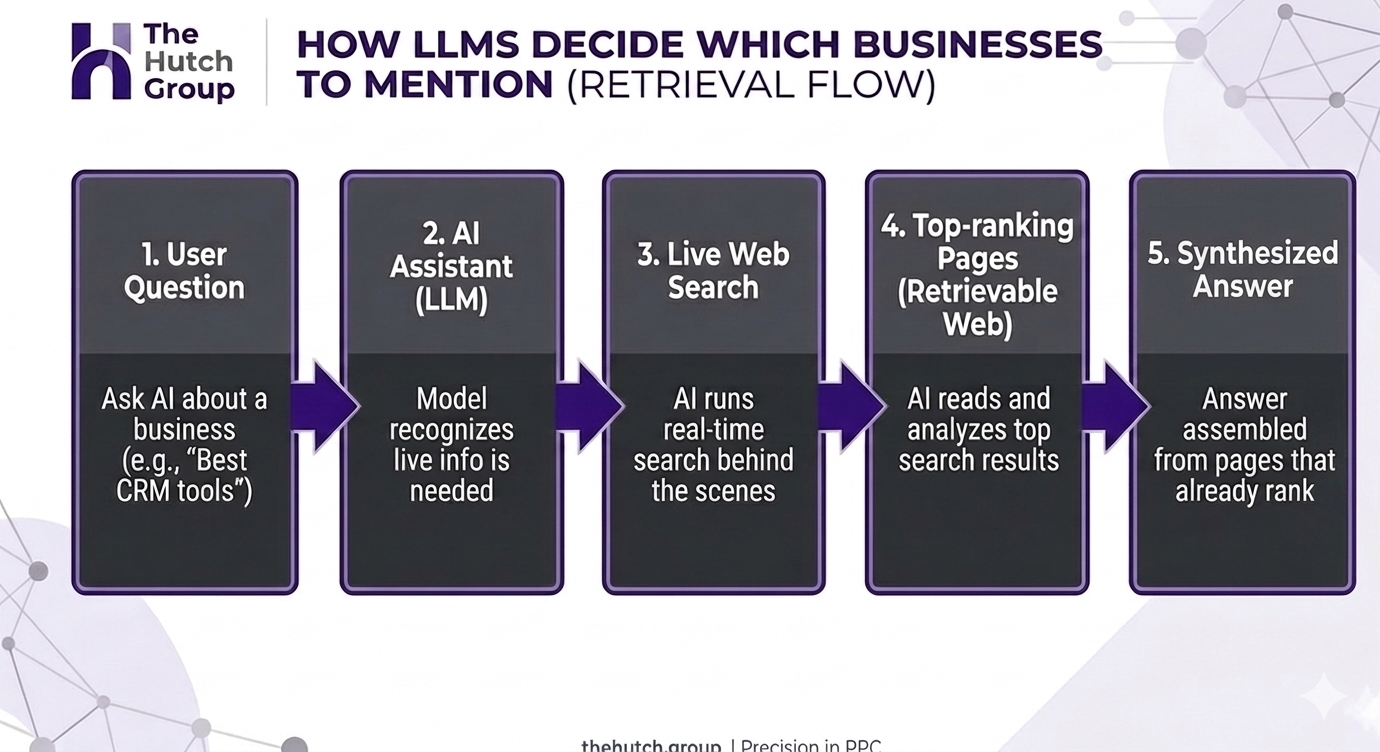
So the job isn’t to somehow persuade a neural network. The job is to make sure that when the model pulls the top pages for questions your customers ask, those pages say your name, describe what you do accurately, and give the model something concrete to quote.
LLM SEO, GEO, AEO: Same Idea, Different Acronyms
You’ll see this discipline called LLM SEO, generative engine optimization (GEO), answer engine optimization (AEO), and AI search optimization. Marketers love an acronym land grab.
They all describe the same work, optimizing your content and your presence across the web so AI-generated answers cite you or recommend you. We wrote a full comparison of how this differs from traditional SEO in our GEO vs SEO post [INTERNAL LINK: GEO vs SEO → /blog/geo-vs-seo], so the short version here. Traditional SEO earns you a ranking. LLM SEO earns you a mention in the answer written on top of those rankings. The first is now the raw material for the second.
Don’t burn energy picking the “right” term. Pick the work.
Start With Content a Machine Can Quote
LLMs are lazy readers in one specific way. When they retrieve a page, they favor passages that answer a question directly, in plain declarative sentences, near a clear heading. Buried answers get skipped.
We rewrote a home services client’s service pages with this in mind last fall. Same information, restructured. Each page now opens with a two-sentence answer to the question the page exists for (“How much does a furnace replacement cost in middle Tennessee? Most homeowners pay between $4,800 and $9,200 installed…”), then earns the detail below it. Within about ten weeks, that client started appearing in AI Overviews for a handful of cost-related queries, and their pages were cited by Perplexity for the same questions.
Here’s what makes content quotable:
- Answer-first sections. Put the direct answer in the first two sentences under each heading, then expand. If the heading is a question, the next line should resolve it.
- Specifics over adjectives. “We answer calls in under 90 seconds” gets quoted. “Fast, friendly service” never will. Models pull numbers, ranges, and concrete claims.
- Headings that match real questions. Pull them from People Also Ask boxes and your own sales calls. One question per section.
- Schema markup. FAQPage, Organization, and LocalBusiness schema make your content and your entity easier to parse. It’s not magic, but it removes ambiguity about who you are and what you do.
- A consistent entity. Same business name, same description of services, same service area, everywhere the business appears. Models get confused by inconsistency faster than humans do.
One honest caveat. None of this rescues thin content. A quotable structure wrapped around nothing gets you nothing.
The Off-Page Signals That Matter More Than You Think
Ask ChatGPT for “the best personal injury firm in Nashville” and watch what it cites. It’s rarely the firms’ own websites. It’s directories, “best of” listicles, local news mentions, and Reddit threads.
That’s uncomfortable if you’ve spent years optimizing only your own site, but it’s actionable. The model trusts third-party consensus more than self-description, which is a reasonable instinct. So your off-page checklist looks like this. Get listed accurately in the directories that already rank for your category. Pitch your way into the local and industry roundups that show up for “best [service] in [city]” searches. Keep your review volume and recency healthy on Google, because review snippets feed both AI Overviews and the local pack. And keep your Google Business Profile complete, since local AI answers lean heavily on it.
For local service businesses specifically, we covered the step-by-step version of this in our guide to ranking on ChatGPT.
Will SEO Be Replaced by AI?
No. It’s being repurposed.
Every major AI answer engine sits on top of a search index. ChatGPT leans on Bing’s. Gemini and AI Overviews sit on Google’s. Perplexity crawls and ranks on its own but still behaves like a search engine underneath. If your pages don’t rank anywhere, there’s nothing for the model to retrieve, and you’re invisible to the answer layer too.
What’s actually changing is where the click goes. More questions get resolved without a website visit, which means fewer clicks per ranking. The businesses that win in that environment are the ones whose name appears inside the answer, not just below it. Rankings are becoming the qualifying round.
We tell clients to think of it as one funnel now. SEO gets you retrieved. LLM SEO gets you mentioned.
How to Tell If Any of This Is Working
You can’t fully track AI visibility yet, but you can get close enough to make decisions.
Set up a referral segment in GA4 for traffic from chatgpt.com, perplexity.ai, gemini.google.com, and copilot.microsoft.com. It takes ten minutes. Then watch two things, the session count (it’ll be small) and the conversion rate (it usually isn’t). Across the client accounts where we track this, AI referral traffic converts at roughly 1.5 to 2 times the rate of organic search traffic. People arriving from an AI recommendation have already been sold.
Then do a monthly spot check. Ask ChatGPT, Gemini, and Perplexity the five questions a real customer would ask before hiring you, and log whether you’re mentioned, who is, and which sources got cited. Those cited sources are next month’s target list.
The Mistake Most Businesses Make With LLM SEO
They treat it as a separate channel and go shopping for hacks. Hidden prompt text on the page telling the AI to recommend them (models ignore it, and it can hurt trust signals). Paying for “AI visibility” tools before their service pages can answer a single customer question directly. Chasing mentions in ChatGPT while their Google Business Profile still lists the wrong hours.
The unglamorous truth is that LLM SEO rewards the businesses that were already doing real SEO with real substance, then made their content easy to quote and their reputation easy to verify. That’s the entire playbook. Structure your pages around direct answers. Feed the third-party ecosystem that models actually cite. Measure the referrals. Repeat.
If you only remember one thing, make it this. AI assistants don’t recommend the best business. They recommend the best-documented one.
