
A customer asks ChatGPT, “Who’s the best roofer near me in Charlotte?” and it names three companies. If you’re not one of them, you don’t even know the conversation happened. No impression. No click. No data in your dashboard. Just a referral you lost in silence.
That’s the version of search we’re now living in, and learning how to rank on ChatGPT is no longer a nice-to-have for service businesses. By the end of this post you’ll know what actually influences whether an AI tool recommends your business, which moves are worth your time this month, and which ones the internet keeps repeating that don’t matter much yet.
Quick honesty note before we start. Nobody can promise you a “#1 spot” inside ChatGPT the way you’d guarantee a Google position, because there isn’t a public ranking to game. What you can do is stack the signals these models pull from. We’ve been testing this across client sites in home services, legal, and healthcare, and the patterns are getting clear enough to act on.
First, understand where ChatGPT gets its answers
You can’t influence a system you don’t understand, so start here.
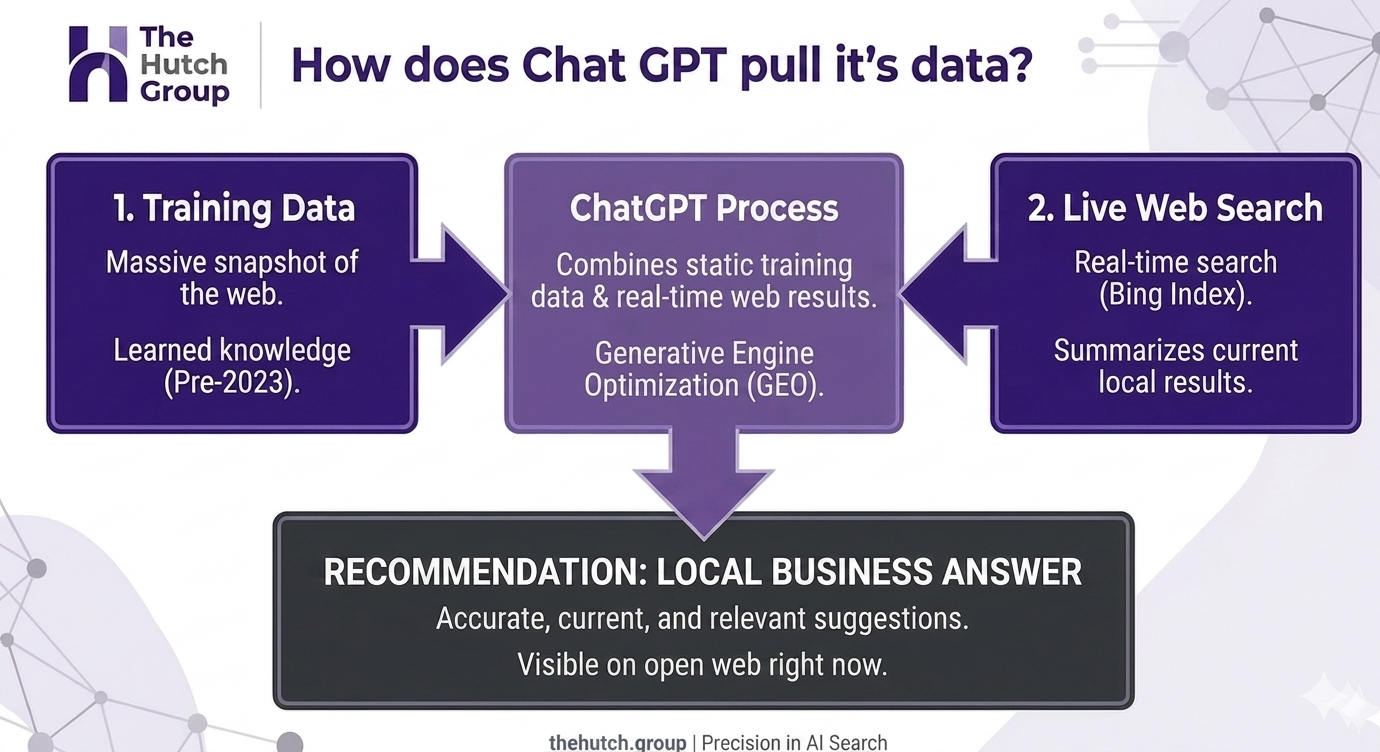
ChatGPT pulls from two places. The first is its training data, the massive snapshot of the web it learned from. The second, and the one that matters more for local businesses, is live web results. When ChatGPT answers a question about a current local service, it often runs a real-time search (through its browsing tool and its Bing-powered index) and summarizes what it finds.
So the practical takeaway is simple. If you want to show up in the live answers, you need to be visible and clearly described on the open web right now, not just mentioned somewhere in a 2023 training set. This is why people have started calling the whole discipline generative engine optimization, or GEO. It’s SEO’s younger sibling, aimed at AI answers instead of blue links.
Get your name on pages other people control
Here’s the thing most business owners get backwards. They pour energy into their own website and ignore the rest of the web. AI models do the opposite. They trust third-party sources because those are harder to fake.
When ChatGPT decides which plumbers to name, it leans on listicles (“best plumbers in Tampa”), directories, review platforms, and news mentions. Your own homepage saying you’re the best counts for very little. A roundup post on a local publication naming you counts for a lot.
So the work is to get mentioned, by name, in the places a model would consider neutral. A few that have worked for our clients:
- Local “best of” roundups and city guides, even small blogs with real readership
- Industry directories specific to your trade (not just Yelp and the big aggregators, but the niche ones)
- Press mentions, including local news features and award lists
- Reddit and forum threads where people ask for recommendations in your area
That last one surprises people. We pulled the live results for “how to rank on chatgpt” recently and half the top sources were Reddit threads. These models lean on community discussion heavily, because that’s where humans actually compare options out loud.
Clean up your Google Business Profile and your reviews
ChatGPT’s local answers borrow a lot from the same signals that power Google’s local pack. So your Google Business Profile is doing double duty now.
Make sure the basics are airtight. Correct category, accurate service area, current hours, a real phone number, and a description that says plainly what you do and where. We see businesses lose AI visibility for boring reasons, like a profile that still lists the old address or a category that’s slightly off.
Reviews matter here in a way that goes beyond star count. AI models read review content. When 40 people mention “same-day water heater repair” in their reviews, the model learns to associate your business with that exact phrase. So when someone asks ChatGPT for same-day water heater repair, you’re a stronger match. Ask happy customers to mention the specific service they got, not just “great job.” It feels small. It compounds.
Write content that answers the actual question
Now the part you do control, your own site. The rule that’s held up best in our testing is simple. Write the way people ask, and answer fast.
AI models favor content that’s structured and direct. A page that opens with a clear question and answers it in the first two sentences gets pulled into AI responses far more often than a page that buries the answer under 600 words of intro. Think about how you’d answer a customer on the phone, then write that down.
A few specifics that help:
- Use real question headers. “How much does a roof replacement cost in Atlanta?” beats “Our Roofing Services.”
- Answer in the first sentence under the header, then expand. Models often lift that first sentence verbatim.
- Add an FAQ section to your main service pages. This is the single biggest change we’ve made on client sites for AI visibility.
- Put your service area, pricing ranges, and specifics in plain text. Don’t hide them in an image or a contact form.
You’ll notice none of this is exotic. Good content for AI is mostly just clear, honest, specific content. The businesses that already write like a helpful human have a head start.
Make your site readable to machines
A model can only cite what it can parse. If your site is slow, blocks crawlers, or hides text inside graphics, you’re invisible no matter how good the writing is.
Two technical pieces are worth checking. First, your robots.txt file. Some sites accidentally block the crawlers that feed AI tools, including OAI-SearchBot and Bing’s crawler. If you’ve blocked them, unblock them. Second, structured data. Adding schema markup (LocalBusiness, FAQ, and Service types) gives machines a labeled map of who you are and what you offer. It’s not a magic switch, but it removes guesswork for the model.
If that paragraph sounded like a foreign language, this is a fair place to ask your web person or agency for help. It’s a one-time setup that keeps paying off.
How fast can you actually rank on ChatGPT?
Slower than you’d like, faster than old-school SEO. We’ve seen new mentions show up in ChatGPT’s live answers within a few weeks of getting placed in a strong third-party source, because the live search picks up fresh pages quickly. The training-data side moves on the order of months, since that only refreshes when the model gets updated.
So the honest timeline is this. The third-party mentions and Google Business Profile work can move the needle in weeks. The deeper, “the model just knows your brand” familiarity builds over quarters. There’s no shortcut that skips the work, and anyone selling you one is selling you something.
What about ranking a specific product on ChatGPT?
Same logic, narrower target. If you want ChatGPT to recommend a specific product or service line, the signal it needs is repeated, consistent association between that product and credible sources. Product pages with clear specs, third-party reviews of that exact product, and comparison articles that name it all feed the same machine. The mistake we see is businesses optimizing the brand broadly while their flagship service has almost no specific, citable content behind it.
Where to start this week
If the full list feels like a lot, do these three things first and ignore the rest for now. Audit your Google Business Profile and fix anything stale. Add a real FAQ section to your top two service pages, written in plain question-and-answer form. Then find two local roundup posts or directories in your trade and get your business added.
That’s a week of work that moves you ahead of most of your competitors, who are still pretending this shift isn’t happening.
Here’s a question worth sitting with. If a potential customer asked ChatGPT about your industry in your city today, what would it say about you? If you don’t know, that’s the first thing worth finding out. Open it up and ask it yourself.
