
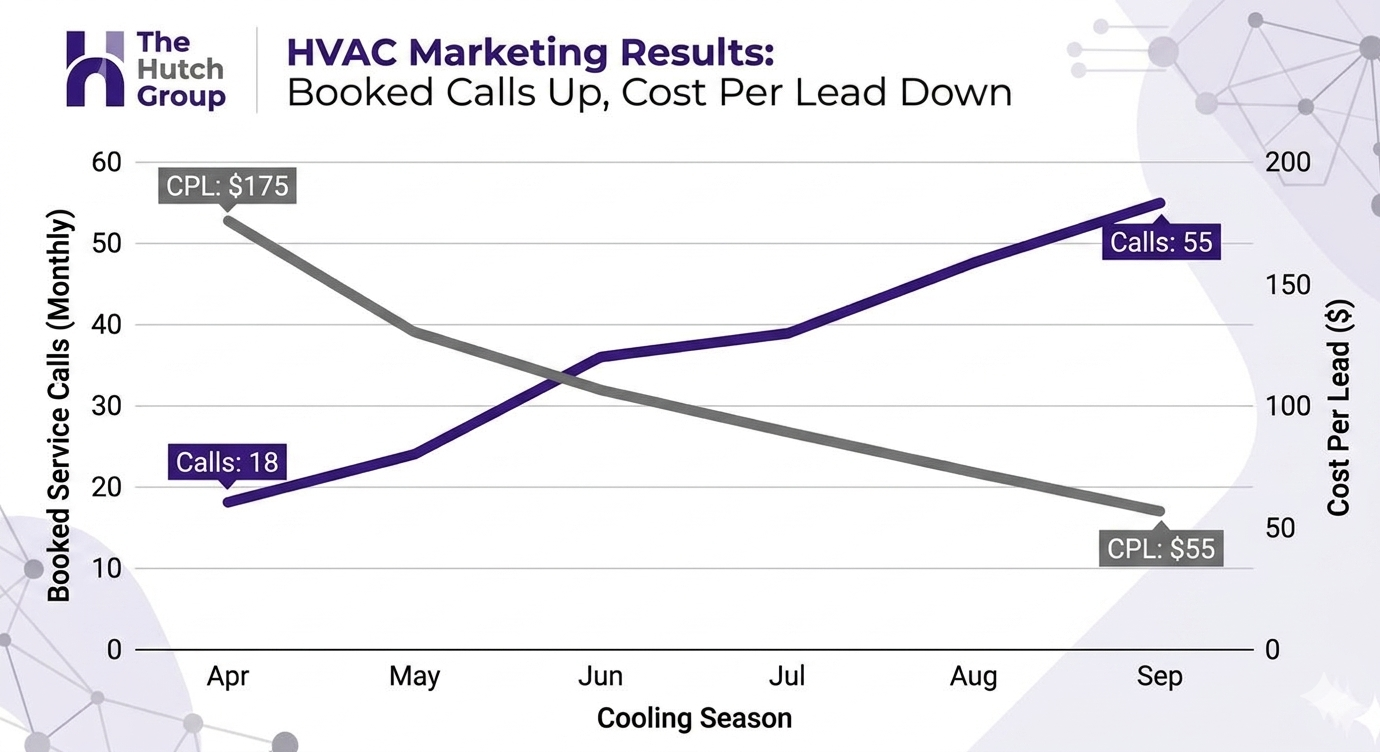
A residential HVAC company in the Southeast came to us a little over a year ago, right before cooling season. They were spending about $3,200 a month on Google Ads and getting somewhere around 18 leads out of it. Their cost per lead was sitting near $175, and maybe a third of those leads were tire-kickers or wrong numbers. By the back half of summer, same monthly budget, they were pulling 50 to 60 booked calls a month and the junk had mostly dried up.
We didn’t do anything magic. We just spent the money in a different order than they had been. That order is the whole game in HVAC marketing, and it’s the thing almost nobody writes about. So that’s what this post is about. Not 17 tactics, but the sequence we’d actually follow if we were handed an HVAC marketing budget tomorrow.
First, capture the people already looking for you
Here’s the uncomfortable truth about marketing for HVAC companies. Most of your near-term revenue is going to come from people whose AC just died, not from people you charmed with a clever Facebook video. When it’s 96 degrees and the upstairs won’t cool, that homeowner is on their phone within minutes, and they’re calling whoever shows up first and looks trustworthy.
So the first dollar goes to high-intent search. For HVAC specifically, that means two things working together.
Google Local Services Ads (the ones with the green “Google Guaranteed” badge that sit at the very top) are usually the best money an HVAC contractor can spend. You pay per lead, not per click, and the badge does a lot of trust-building before the homeowner ever calls. We’ve seen LSA cost per lead land anywhere from $30 to $90 in residential HVAC, which is often half of what the same lead costs through standard search ads.
Then standard Google Search Ads pick up everything LSA misses. “AC repair near me,” “furnace not turning on,” “emergency HVAC [city].” This is where a tight negative keyword list earns its keep, because HVAC search is full of expensive junk. Think people searching for jobs, parts, DIY fixes, and warranty claims. Cutting those out is frequently the single fastest way to lower a cost per lead.
If you only have a budget for one channel, this is it. Everything below makes this channel work harder, but nothing replaces being in front of someone whose system is down right now.
Your Google Business Profile is the lead source you’re underusing
Once the paid search is capturing demand, the next dollar (or really, the next few hours of attention) goes somewhere that costs nothing per click.
When someone searches “AC repair near me,” Google shows a map with three businesses in the local pack before the regular results even start. Ranking in those three spots drives a stunning amount of phone calls, and it’s driven mostly by your Google Business Profile, your review count and recency, and how close you are to the searcher.
We audited a batch of home service profiles last year and the pattern was depressing and predictable. Half of them had the wrong service area, no service list filled out, photos from 2019, and a review count that hadn’t moved in months.
For HVAC, the fixes that move the needle most:
- Fill out every service as a separate entry (AC repair, AC installation, furnace repair, heat pump service, and so on). Google reads these.
- Get the review flywheel going. A simple text-message ask after every completed job, with a direct link, beats any clever campaign. Recency matters as much as total count.
- Post seasonal updates and real job photos. A unit you just installed, a before-and-after on a nasty filter, a tech at a customer’s door.
This is slower than paid ads. It also compounds. Six months of steady reviews and a complete profile will quietly lower your blended cost per lead because more of your calls start coming in for free.
Don’t send paid traffic to a slow homepage
You can do everything above right and still light money on fire if the page people land on is bad.
We watched an HVAC account run solid search ads straight to a homepage that took seven seconds to load on mobile and buried the phone number below a giant hero slider. The clicks were fine. The calls were not. We pointed the same ads at a stripped-down landing page (phone number at the top, one clear “Book a repair” button, a few reviews, a service-area line) and the conversion rate roughly doubled with the same traffic and same budget.
A few things matter more for HVAC than people expect.
The phone number has to be tappable and visible without scrolling, because a panicked homeowner with no AC is not going to fill out a form. Page speed matters, especially on mobile, where most of these emergency searches happen.
One more thing nobody enjoys hearing. If you can’t see which ads, keywords, and pages produce actual booked calls, you’re guessing. Call tracking is not optional for HVAC, where the majority of conversions are phone calls, not form fills. Without it, you’ll keep funding the campaigns that look busy instead of the ones that book jobs.
Spend with the seasons, not in a flat line
This is the HVAC-specific piece that generic marketing advice always misses, and it’s where a lot of contractors quietly waste money.
HVAC demand is not a flat line. It spikes hard in the first heat wave and the first cold snap, drops in the shoulder seasons, and the searches change with it. Running the same budget and the same message in April that you run in mid-July is leaving money on the table in both directions.
Here’s roughly how we pace it.
In peak cooling and heating season, push hard on emergency repair and “near me” search. Demand is there and intent is high. You want to win the auction when it counts. Raise budgets, widen to capture overflow, and make sure you never run out of daily budget at 2pm on a 99-degree day.
In the shoulder seasons (spring and fall), shift the message toward tune-ups, maintenance plans, and “get ready before the season hits.” This is when the cost per click is cheaper and the homeowner is calmer. It’s also the best time to sell maintenance agreements, which are the closest thing the HVAC business has to recurring revenue.
In the true off-season, that’s when the slower-burn channels (which we’ll get to) earn their place, and when you fix everything you didn’t have time for during the rush.
If you take one HVAC marketing idea from this whole post, take this one. Match your spend and your offer to the calendar. A maintenance-plan push in October will outperform the exact same dollars thrown at emergency-repair ads when nothing’s breaking.
Where Facebook and Instagram actually fit
We get asked about social ads constantly, usually with a hopeful “should we be doing Facebook?” And the honest answer for most HVAC companies is yes, but not first, and not for what you think.
Meta ads are interruption, not capture. Nobody scrolling Instagram is thinking about their furnace. So using Facebook to chase emergency repair leads is mostly a waste. What it’s genuinely good at for HVAC is three jobs that search can’t do.
Retargeting people who visited your site but didn’t call. That’s cheap and it works, because they already had intent.
Selling maintenance plans and seasonal tune-ups to a warm audience, especially in the shoulder seasons when search demand dips. A $89 spring AC check-up is an easy yes for the right homeowner, and it gets a tech in the door for the upsell.
And building local brand presence so that when the system does fail, yours is the name they already recognize. This one’s hard to measure and easy to overspend on, so we keep it modest until the capture channels are maxed out.
Digital marketing for HVAC companies works best when these channels play their actual positions. Search captures the people in crisis. Social warms up everyone else and keeps your existing customers from forgetting you.
The cheapest leads you already own
Your customer list is the most underused asset in most HVAC contractor marketing.
Every system you’ve ever installed or serviced is a future repair down the line. Eventually a replacement. Almost always a maintenance renewal in between. A homeowner whose 16-year-old unit you serviced last summer is a far better prospect than a stranger off a cold ad. Most contractors do nothing with this list except an occasional invoice.
A simple email and text rhythm changes that. Seasonal reminders (“time to book your AC tune-up before the heat hits”), maintenance-plan renewals, and the occasional honest note about an aging system are not spammy if they’re useful and well-timed. We’ve seen a quiet reactivation email to a neglected customer list book a week’s worth of tune-ups for basically the cost of the send.
This isn’t glamorous and it won’t show up in a “best HVAC marketing strategies” listicle. It’s also one of the highest-return things you can do, and it costs almost nothing.
A note on AI search, because it’s coming faster than you’d think
One newer wrinkle worth a paragraph. More homeowners are starting their search by asking an AI assistant or hitting a Google AI Overview before they ever see the normal results. “Who’s the best HVAC company in [city]” is increasingly answered by a summary, not a list of ten blue links.
The early signal is that the same things that win local search (a strong, complete Google Business Profile, lots of recent reviews, and clear, genuinely helpful content on your site) are also what get you mentioned in those AI answers. So you’re not chasing a separate strategy yet. You’re just doing the local SEO fundamentals well enough that the machines quote you too.
So where does your HVAC marketing budget go next?
If you’re starting from scratch, the order is pretty clear. Get Local Services Ads and tight search campaigns capturing the people who need you right now. Fix the Google Business Profile and start the review engine so more of your calls come in free. Make sure the page they land on is fast and the phone number is impossible to miss, with call tracking behind it so you know what’s working. Then pace your spend to the season, and only after all that, layer in social and email to warm up the people who aren’t in crisis yet.
We’ve run a version of this for HVAC companies doing $20K a month and ones doing $2M a year, and the sequence holds.
If you want a second set of eyes on where your HVAC marketing budget is actually going (and which channel is quietly underperforming), we’re happy to take a look.
One question to sit with before you spend another dollar. Do you actually know how many of last month’s leads turned into booked jobs? If the answer is fuzzy, start there.
