
Most chiropractor marketing posts read like they were written by someone who’s never actually run a campaign for a chiropractic practice. Twelve ideas. Eight strategies. The lists are technically correct and almost completely useless when you’re trying to figure out where to spend your next $1,500.
Our team works with small healthcare practices, including chiropractors, and the decision a chiropractor actually has to make isn’t “what are all the marketing channels.” It’s which one to start with, then how to know it’s working before you spend another dollar. So that’s the frame we’re going to use.
This post lays out a chiropractor marketing decision framework. Where to start based on practice stage, plus the benchmarks that signal something is working before you give up too early.
Start by being honest about which practice you actually have
Marketing advice that ignores stage is mostly noise. A solo chiropractor in their second year of practice has a completely different problem than a five-DC group with two locations. Pretending otherwise is how chiropractors end up paying for SEO when they should be running Google Ads, or vice versa.
There are three practice stages we see most often, and the channel mix should follow the stage.
Stage 1, the new or stuck practice. Open less than 18 months, or open longer but stuck under 80 patient visits a week. The problem here is volume. Brand isn’t your issue. A TikTok strategy isn’t going to help. You need patients in chairs this month.
Stage 2, the busy practice with retention leaks. 80 to 150 visits a week, decent reviews, but you’re working harder than the numbers should require. The problem is patient lifetime value and reactivation, not new patient acquisition.
Stage 3, the multi-DC or multi-location practice. Real overhead, real payroll. The growth target is in writing. The problem is consistent acquisition at a known cost.
Where you are dictates everything below.
The five chiropractor marketing channels, ranked by what they actually do
There are more than five marketing channels available to a chiropractor. There are not more than five that are worth your attention in the first 12 months of a serious effort. Here they are in the order we’d defend in a room full of skeptical practice owners.
1. Your Google Business Profile (this is the one)
If you only do one thing, do this. Roughly two-thirds of new patient calls to a local chiropractor start in the Google map pack. Your GBP is a higher-value asset than your website on day one.
What “doing it” actually means is more than checking the categories box. The category needs to be set correctly, with Chiropractor as the primary and secondaries that match your real services. The service list needs to be filled in with descriptions, not just names. Posts go up every week, yes weekly, even when you don’t feel like it. Photos get refreshed monthly. A review request workflow runs in the background and produces three to six new reviews a month. The Q&A section gets populated with the questions patients actually ask, answered by you.
We’ve seen chiropractor practices double their map pack visibility in 90 days from this work alone. No new ads. No new website. Just the GBP cleaned up and worked consistently.
2. Local SEO and the practice website
This is the long game. SEO won’t fill your schedule next month. It’s how you stop renting acquisition channels and start owning the results page for the searches that matter.
For most chiropractors, the SEO work that pays back fastest is straightforward. A real “Locations” or “Service Area” page for each town or neighborhood you serve. Service-specific pages (sports injury, auto accident, prenatal, low back pain) instead of one generic “services” page. Reviews schema markup so your stars show up in the SERP. Internal linking from blog posts back to the service and location pages. Page speed under 3 seconds on mobile.
3. Google Ads (when you have budget and intent matters)
Google Ads is where Stage 1 and Stage 3 practices win quickly. The reason is intent. Someone searching “chiropractor near me at 7pm” is not browsing. They have a stiff neck. They want an appointment.
What we’d start with is one Search campaign on exact and phrase match keywords only. Bidding set to Maximize Conversions, never Maximize Clicks (that one’s a budget shredder for healthcare). A landing page that loads in under three seconds with a working form and a click-to-call button above the fold. A negative keyword list that gets pruned weekly for the first two months (school, jobs, salary, free, “wrong city” variations).
Realistic benchmarks for a single-location chiropractor in 2026 land in a narrow band. Cost per click usually runs $4 to $12 depending on metro. Cost per qualified lead lands somewhere between $35 and $90. New patient conversion rate from lead to booked appointment averages 60 to 75 percent.
If you’re seeing a $200 cost per lead, something is wrong. Usually it’s the keyword list. Sometimes it’s the landing page. Occasionally it’s the call answer rate. Almost never the budget itself.
4. Meta ads, mostly for reactivation and awareness
Meta ads work for chiropractors. Just not the way most chiropractors expect.
Cold prospecting on Facebook to “people interested in wellness” is a lottery ticket. Sometimes you win. Most of the time you spend money explaining what a chiropractor does to people who weren’t looking for one.
Where Meta actually earns its keep for a chiropractic practice is reactivation and retargeting. Reactivation ads served to a custom audience built from past patients lapsed more than six months. Retargeting ads to website visitors who didn’t book the first time around. Local awareness ads tied to a seasonal angle, like back-to-school posture campaigns or marathon training season.
A practice with a strong patient list of 1,500-plus past patients can usually generate 8 to 15 reactivation visits a month from a $300 to $500 monthly Meta spend. That math is unbeatable.
5. Referral systems (most practices skip this and it’s the cheapest channel)
The cheapest new patient is the one your existing patient brings. The reason most practices fail at referrals isn’t that patients don’t refer. It’s that there’s no system, so referrals only happen when a patient happens to remember.
Practical referral systems we’ve seen work for chiropractors come in a few shapes. A printed “bring a friend” two-card handout the front desk gives at the second visit. A monthly email to active patients with a friend-referral offer (often a free initial consult or a massage upgrade). A reciprocal referral arrangement with a local primary care, OB, or PT practice (these take six months to build and are worth every minute). A simple “who else should we be helping?” question worked into the rebooking conversation.
This is the lowest-cost, highest-trust acquisition channel a chiropractor has, and it’s the one that’s almost always sitting unused.
So where should the first $2,000 a month go?
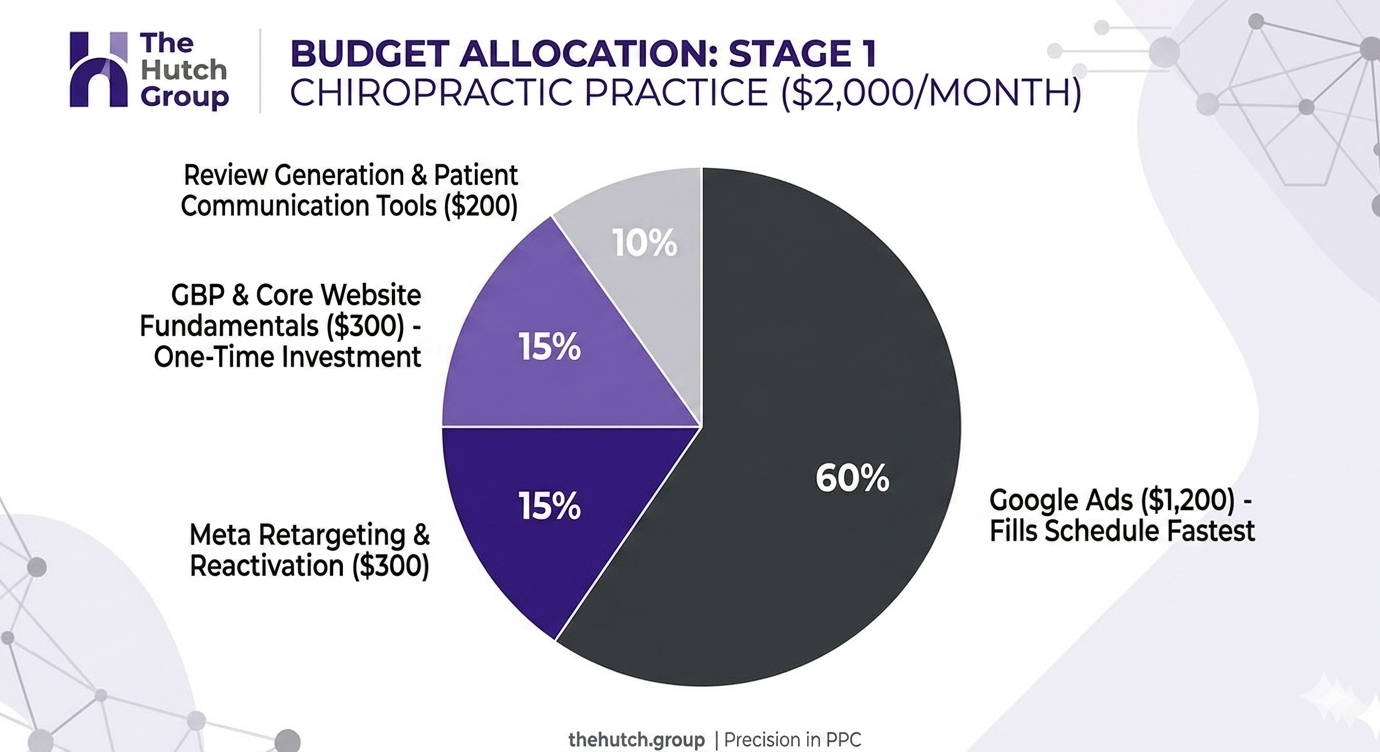
If you’re a Stage 1 practice and you have $2,000 a month to spend on marketing, here’s a defensible split. This is what we’d recommend in a discovery call, not a generic best-practice line item.
- $300 on getting the GBP and core website fundamentals fixed (often a one-time investment that lasts a year or more)
- $1,200 on Google Ads (this is the lever that fills the schedule fastest)
- $300 on Meta retargeting and reactivation
- $200 on review generation tools and patient communication
A Stage 2 practice should shift the budget. Less ad spend, more on retention systems and reactivation. The acquisition channels are already working. The leak is in the back of the bucket.
A Stage 3 practice should be running all of the above with a real attribution system underneath. If you can’t tell which channel produced last week’s new patients, you can’t manage what you’re spending.
The two mistakes we see chiropractors make over and over
We’ve audited a lot of chiropractor marketing setups in the last two years. These two come up almost every time.
Mistake one, no working tracking. The form is on the site. The phone number is on the site. Neither one fires a conversion event. So Google Ads is “optimizing” toward clicks instead of leads, and the practice owner has no idea what’s working. We’ve seen practices waste $30,000 in a year on this single problem.
Mistake two, picking the wrong agency for the stage. A Stage 1 practice signing a 12-month SEO retainer is a financial mistake. SEO won’t help in time. They needed paid acquisition. A Stage 3 practice buying a Google Ads-only package from a generalist marketing freelancer is also a mistake, in the other direction. The right help looks different at each stage.
If your current marketing partner can’t articulate which stage your practice is in and why their plan fits that stage, that’s a flag.
How to tell if your chiropractor marketing is actually working
Marketing dashboards are full of numbers that don’t matter. These four numbers do, for a chiropractic practice.
- New patient appointments booked per month, by source
- Cost per new patient appointment, by source
- Reactivation appointments per month, by source
- Patient lifetime value (or at least average revenue per patient over 12 months)
If you can answer those four questions for last month, you have a marketing program. If you can’t, you don’t yet, regardless of how many channels you’re paying for.
A 30-day starting point
If today is day one, here’s the order. Don’t try to do all of this at once. Do it in sequence.
Week 1. Fix the Google Business Profile. Get a single, working review request workflow live.
Week 2. Confirm conversion tracking on the website (calls, forms, appointment requests). If it’s broken or missing, fix this before you spend a dollar on ads.
Week 3. Launch a small Google Ads search campaign. If your monthly budget is under $500, double down on GBP and reviews instead and revisit ads next quarter.
Week 4. Build the reactivation list and send a first reactivation email or text. Even if your list is small, it’s the cheapest pipeline you have.
That’s the plan. It’s not exciting. It will outperform most of the multi-channel “strategies” being sold to chiropractors right now.
If you want a second set of eyes on what you’re already running, our team is happy to take a look. No pitch on the first call. We’ll tell you which of the four numbers above we can already see, and which ones are missing.
