
Everyone in marketing is suddenly telling business owners that SEO is dead and GEO (generative engine optimization) is the future. We’ve spent the last year optimizing clients for both Google and AI search, and here’s our honest read. The “GEO vs SEO” framing is mostly wrong. They’re not competing channels. About 80% of the work is identical, and the loudest people pushing the split are usually selling a GEO package.
That said, the 20% that’s different matters. And it matters more every quarter.
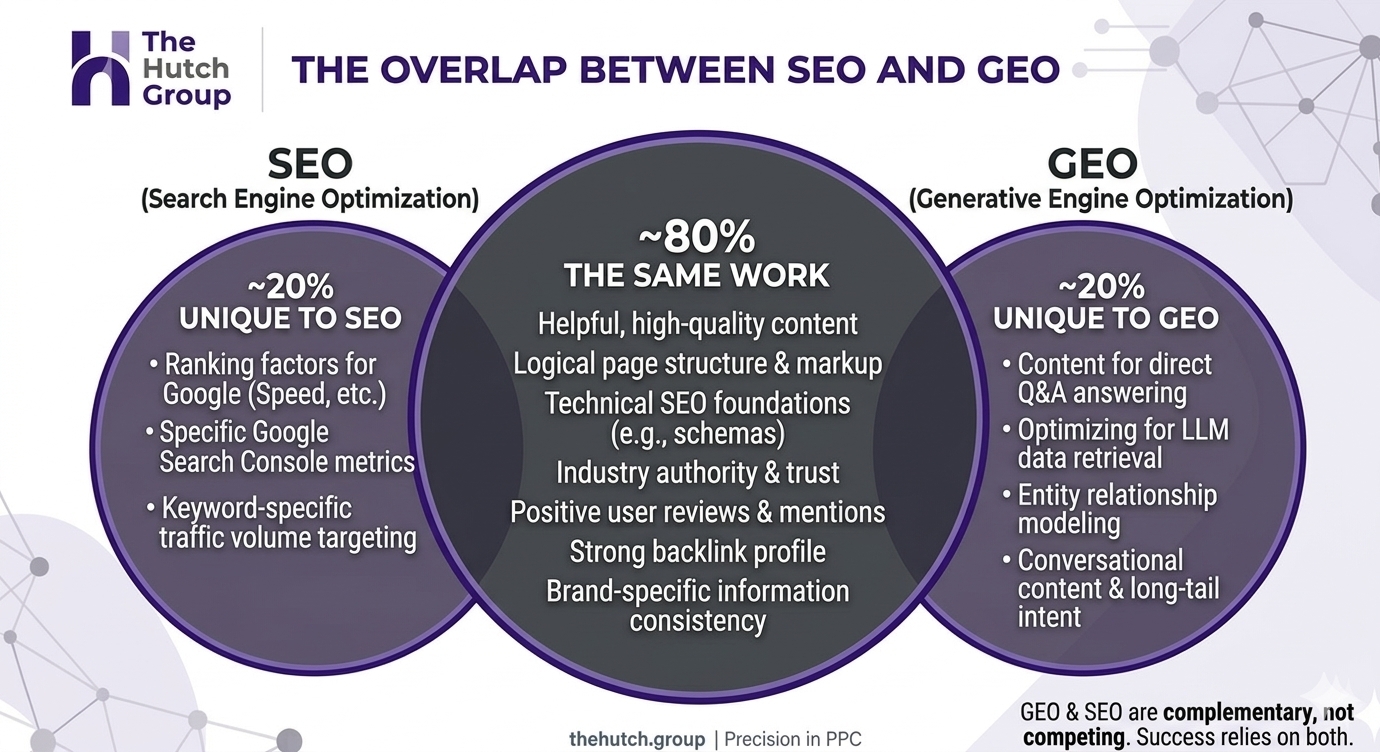
What GEO actually is (minus the hype)
GEO is the practice of getting your business mentioned, cited, or recommended inside AI-generated answers. That includes Google’s AI Overviews, ChatGPT, Perplexity, Gemini, and whatever ships next quarter.
Traditional SEO gets you a ranking. A blue link on a results page that someone clicks. GEO gets you a mention. When a homeowner asks ChatGPT “who should I call for a slab leak in my area” or Google’s AI Overview answers “how much does a DUI lawyer cost,” the AI composes an answer from sources it trusts. GEO is the work of becoming one of those sources.
The name is new. Most of the work isn’t.
The overlap is bigger than the difference
Here’s the part the “SEO is dead” crowd skips. AI search engines learn about your business from the same places Google always has. Your website. Your Google Business Profile. Your reviews. Directory listings. Articles that mention you.
Ask Perplexity a local service question and look at the citations. You’ll see Yelp, Angi, local news sites, and the websites of businesses with strong content. Those citations aren’t random. They map closely to what already ranks in traditional search, because most AI search tools ground their answers in conventional search indexes before generating a word.
So a business with clean local SEO (solid Google Business Profile, consistent citations, real reviews, pages that actually answer questions) is already most of the way to being GEO-ready. A business with none of that can’t shortcut its way into AI answers with schema markup and wishful thinking.
We saw this directly with a roofing client. We never did a single “GEO tactic” for them in 2025. But their service pages were written the way we always write them, direct answers to real questions with local specifics. When we started tracking AI mentions this spring, they were already showing up in AI Overviews for a dozen repair-related queries. The SEO work was the GEO work.
Where GEO and SEO genuinely differ
The overlap is real, but so are the differences. Four of them actually change how you work.
Answers get assembled, not ranked. In classic search, position 1 takes the click. In an AI answer, the engine pulls from several sources and blends them. You can be “in” an answer without any click at all. That changes the goal from winning a position to being quotable.
Structure matters more than polish. LLMs lift passages that stand on their own. A clear question-and-answer block, a pricing table, a short paragraph that defines a term cleanly. Pages written as one long unstructured sales pitch rarely get quoted, even when they rank.
Third-party mentions carry more weight. AI engines cross-reference. If your business shows up on directories, review platforms, and a local news story, you look like a consensus answer. If the only source that says you’re great is you, you don’t. Reviews were always important for local SEO. For GEO they’re closer to mandatory.
Measurement is messier. Rankings are trackable. AI mentions are inconsistent, personalized, and change between sessions. Tools are catching up, but today the honest answer is that GEO measurement is part data, part spot-checking prompts by hand.
Is anyone actually finding businesses through AI search?
Fair question, and the data says yes, with a caveat about scale.
AI Overviews now show on a large share of informational searches, which means your customers see AI-generated answers whether they went looking for them or not. And the visitors who do click through from tools like ChatGPT tend to be much further along. They’ve already asked their follow-up questions inside the chat. In client accounts where we’ve tagged AI referral traffic, those sessions are small in volume, low single digits as a percentage, but they convert noticeably better than the average organic visitor.
That pattern (small but growing volume, high intent) is exactly what early Google traffic looked like to businesses in the 2000s. The businesses that showed up early got compounding returns.
For a deeper look at the ChatGPT side specifically, we wrote a full guide on it.
What to actually do this year
If you run a service business, skip the agencies selling standalone “AI optimization” retainers. Do this instead, roughly in order.
Fix the local SEO foundation first. Google Business Profile filled out completely, categories right, photos current. Reviews coming in steadily with responses. Consistent name, address, and phone across directories. None of this is new advice. It’s just doing double duty now.
Rewrite key pages so a machine can quote them. Take your top service pages and lead each section with a direct answer. What it costs, how long it takes, what’s included, when it’s needed. If a stranger could read one paragraph aloud and it would work as an answer to a customer’s question, it’s quotable.
Add FAQ and service schema. Structured data won’t rescue thin content, but it removes ambiguity about what your pages say. Ten minutes per page in most WordPress setups.
Get mentioned somewhere you don’t control. A local news piece, a supplier’s dealer page, a chamber listing, an industry association directory. One good third-party mention does more for AI visibility than another round of on-page tweaks.
Spot-check monthly. Ask ChatGPT and Perplexity the five questions your customers actually ask, including “who’s the best [your trade] near [your city].” Note who gets named. That’s your GEO competitor list, and it’s often different from your SEO one.
When to ignore GEO entirely
Honesty time. If your website has no service pages, your Google Business Profile is unclaimed, or you have four reviews, GEO is not your problem. Fix the basics. You’ll be covering 80% of GEO by accident anyway.
Same if you’re in a trade where nearly every job comes from referrals and repeat customers. AI search rewards businesses that already have digital surface area. Build the surface area first.
The one group that shouldn’t wait? Businesses in competitive metros where the map pack is a knife fight. AI answers are a second front, and right now most of your competitors aren’t fighting on it.
So, next time someone tells you SEO is dead, ask them where they think the AI engines get their answers. The businesses winning AI search in 2026 are, almost without exception, the ones that were doing search fundamentals well in 2024. Different scoreboard. Same game.
