
“How do I know if this agency is any good before I’ve given them money?”
That’s the real question buried underneath every search for how to choose a digital marketing agency. Most of the advice you’ll find on it was written by agencies, for agencies, and it shows. I own one, and I’m going to answer the question anyway, including the parts that make my own industry look bad.
Why the portfolio is the least useful thing they’ll show you
Every agency has one account that worked beautifully. That’s the case study you’re going to see. It tells you almost nothing about what your account will look like in month seven.
Ask for something harder instead. Ask to see a live reporting dashboard from a current client with the name blacked out. Not a PDF, not a slide. The actual thing they send every month.
What you’re checking for is whether they can connect ad spend to revenue at all, or whether the whole report stops at “conversions.” That word does a lot of hiding. In most accounts we inherit, “conversion” means a form submission, and nobody has ever checked what happened to those submissions afterward. We took over a home services account last year that was reporting 214 conversions a month at a very respectable cost per conversion. When we ran the form fills against the client’s CRM, 38 of them were real people who wanted a quote. The rest were spam, wrong-number leads, and existing customers using the contact form to ask about a bill.
The cost per lead wasn’t $22. It was closer to $124.
That gap is the whole ballgame. An agency that has never gone looking for it is not managing your marketing, they’re managing a dashboard.
The six questions to ask a marketing agency on the first call
You don’t need a long list. You need six questions and the discipline to listen to how they answer, not just what they say.
“How do you define a lead?” The answer you want involves a human being and a phone call or a qualified form. The answer that should worry you is any version of “we track conversions in the platform.” Push once more and ask who checks the leads for quality, and how often.
“Who is actually doing the work on my account?” Small agencies will tell you a name. Big ones will describe a team. Either can be fine. The follow-up matters more, so ask how many other accounts that person carries. Above roughly 20 accounts per manager, your campaign is getting a checklist, not attention.
“Tell me about a client relationship that ended badly.” This one is my favorite, because it’s almost impossible to fake. Anyone who has run accounts for a decade has lost a client, misjudged a budget, or stuck with a losing strategy too long. If they can’t produce a single example, they either haven’t done this long or they aren’t being straight with you.
“What would you do in the first 30 days, before you know anything about my business?” Good answers sound boring. Audit the tracking, clean up the account structure, fix the obvious leaks, get baseline numbers. Bad answers sound exciting and involve launching six new campaigns immediately.
“Who owns the ad account, the pixel, and the tracking?” It should be you. Always you. If the agency builds your Google Ads account under their own MCC in a way you can’t take with you, they’re holding your data hostage on purpose. Same goes for your Google Business Profile and your GA4 property.
“What’s the smallest budget where this works?” An honest agency will tell you there’s a floor. In competitive home services markets, Google Ads under about $2,000 a month tends to produce data too thin to optimize against. In legal, where clicks routinely run $50 to $200, that floor is a lot higher. An agency that says any budget works is selling you something.
How much does a marketing agency cost?
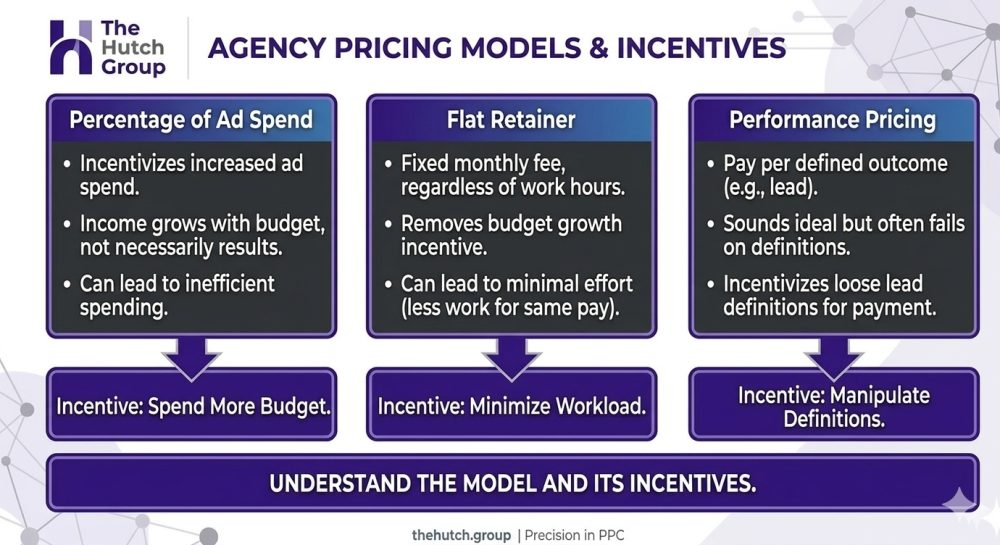
Pricing in this industry falls into three rough models, and the model matters more than the number.
Percentage of ad spend is the most common, usually landing somewhere between 10% and 20% of what you spend on the platforms. It’s simple, and it has an obvious flaw. The agency’s income goes up when your budget goes up, whether or not the extra spend earns its keep.
Flat retainers are the second model. For a local service business running one or two channels, monthly management fees commonly sit in the $1,500 to $5,000 range, separate from ad spend. Retainers remove the budget incentive problem but introduce a different one, since a flat fee pays the same whether the account gets an hour of work or fifteen.
Then there’s performance pricing, which sounds great and is rarely structured well. Paying per lead only works if both sides agree in advance on what counts as a lead, and that definition is exactly where these deals fall apart.
None of these is automatically right. What matters is that you understand which one you’re in and what it incentivizes.
Digital marketing agency vs in house: the honest split
I’m supposed to argue for the agency here. I’d rather give you the actual dividing line, because hiring the wrong way costs a lot more than either option.
In-house tends to win when you’re running one channel at real volume. If you’re spending $40,000 a month on Google Ads and nothing else, a good in-house manager at $80,000 to $95,000 plus tools will almost certainly beat paying a percentage on that spend. You get someone who lives inside your business and knows why September looks weird every year.
An agency tends to win when you need three or four specialties and can’t afford three or four salaries. Paid search, paid social, local SEO, and tracking are genuinely different skill sets, and the person who is excellent at all four is rare and expensive. Seasonality is the other big one. Businesses whose demand swings hard across the year struggle to keep an in-house hire busy in the trough and sane in the peak.
The hybrid that works best, honestly, is one internal person who owns strategy and holds the agency accountable. The hybrid that fails is hiring a junior marketing coordinator to “manage the agency” and hoping the relationship supervises itself.
Marketing agency red flags worth ending a call over
Some of these are obvious and some aren’t. All of them are disqualifying.
- Guaranteed rankings. Nobody controls Google’s results. Anyone promising a #1 position is either lying or planning to rank you for a keyword nobody searches.
- Guaranteed lead volume with no conditions. Lead counts depend on your budget, your market, your pricing, and your close rate. A guarantee that ignores all four is a sales tactic.
- Reporting that only ever goes up. Real accounts have bad months. A year of reports where every metric improved means someone is choosing which metrics to show you.
- A 12-month contract with no exit. Long terms aren’t inherently bad, but there should be a performance-based way out after 90 days.
- They agree with everything you suggest. You’re paying for judgment. If you propose something questionable in the sales call and they nod along, they’ll nod along for a year.
- They found you through a cold email about “issues with your website.” Those are almost always automated, and the “issues” are boilerplate.
The subtler red flag is an agency that can’t explain what it would stop doing. Marketing plans that only add channels tend to belong to agencies billing by the channel.
How long until you know if it’s working?
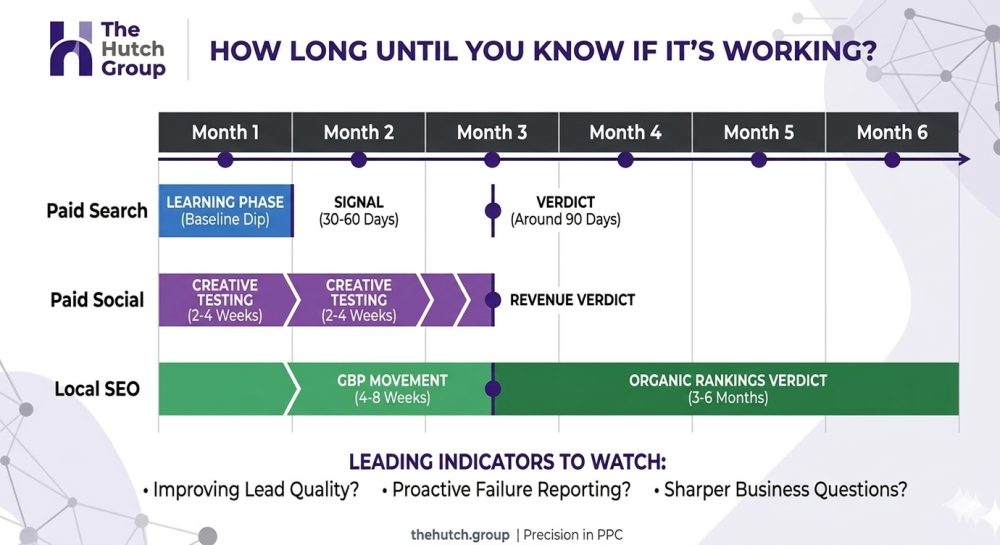
Different channels resolve on different clocks, and mixing them up is how good agencies get fired in month two.
Paid search gives you a signal in 30 to 60 days and a verdict around 90. The first month is usually worse than your baseline, because the account is being rebuilt and the learning phase resets. Paid social moves faster on creative testing, roughly two to four weeks per round, but takes just as long to prove out on revenue. Local SEO is the slow one. Google Business Profile work can show movement in four to eight weeks, while broader organic rankings realistically need three to six months before you can judge them fairly.
Here’s what to watch in the meantime, before results arrive. Is the lead quality improving even when volume is flat? Is the agency showing you things that didn’t work without being asked? Are the questions they bring you getting sharper about your business? Those are the leading indicators. A team headed somewhere good sounds curious in month two. A team headed nowhere sounds reassuring.
If you only remember one thing
Ask to see how they’d tie your spend to your revenue, and ask it on the first call. Not clicks. Not conversions. Revenue, or at least qualified leads that a human being has looked at.
The agencies that can answer that question clearly are a much smaller group than the ones with a nice portfolio, and the answer takes about four minutes to evaluate. It’s the cheapest filter you have.
