
“How much should a small business spend on marketing?” We get some version of this question from almost every owner who calls us for the first time. They want a number. A clean percentage they can plug into a budget and stop thinking about.
The honest answer is that the number matters less than what you do with it. But that’s a frustrating thing to hear when you’re trying to plan next quarter, so let’s start with the actual figures people use, then get into why the figure is the easy part.
So what’s the actual number?
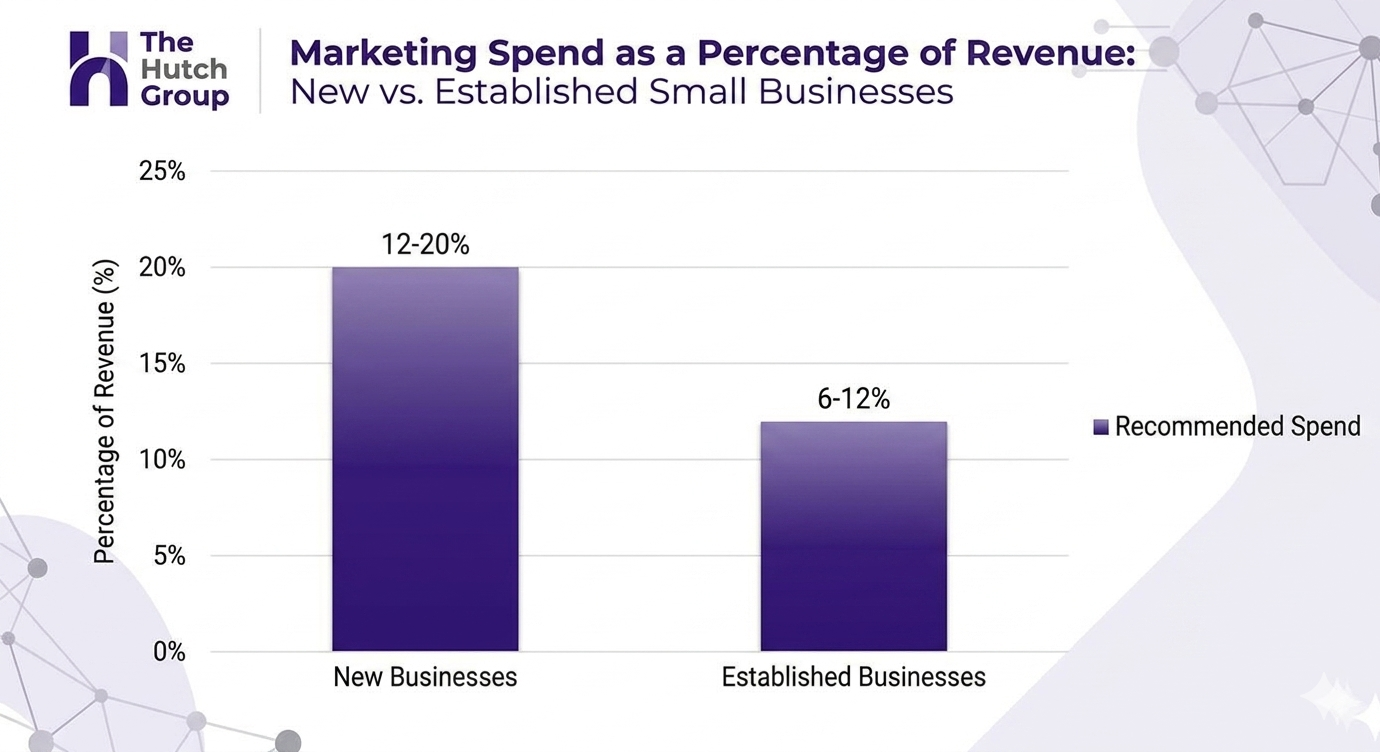
Here’s the range most sources land on. Established small businesses tend to spend somewhere between 5% and 10% of gross revenue on marketing. Newer businesses, or ones trying to grab market share, often push to 12% or higher because they’re building awareness from zero.
The U.S. Small Business Administration has floated 7-8% of revenue for companies doing less than $5 million a year, assuming margins in the 10-12% range. That’s the number you’ll see repeated across most guides on the average marketing budget for a small business, and it’s a fine place to anchor.
So if you’re a plumbing company doing $800,000 a year, a 7% marketing budget is about $56,000 annually, or a little under $4,700 a month. A three-attorney law firm doing $1.5 million might sit closer to 10% because legal is brutally competitive and the cost per lead is high.
That’s the easy math. Now the hard part.
Is the percentage-of-revenue rule even right?
Mostly, no. It’s a starting point, not an answer.
The percentage rule treats marketing like a fixed cost, the way you’d budget for rent or insurance. But good marketing isn’t a cost. It’s an engine. If you put a dollar in and reliably get four back, why would you cap that at 7% of revenue? You’d feed it as much as it could profitably take.
We’ve watched this play out with clients. One home services company came to us spending about 4% of revenue on marketing, well under the “recommended” range, and convinced they were being disciplined. The problem was their spend was actually profitable. Every $1,000 in ad spend was generating around $6,000 in booked work. They weren’t being disciplined. They were leaving money on the table. We scaled them up over two quarters, and revenue followed.
The flip side is just as common. Plenty of businesses spend 10% of revenue and light most of it on fire because nothing is tracked. So the percentage tells you almost nothing on its own. What matters is the return, and whether you can see it.
What about the 70/20/10 rule?
This one comes up a lot, so it’s worth a plain explanation. The 70/20/10 rule is about how you split your marketing budget by risk, not how much you spend total.
Put 70% of your budget into what already works. For most local service businesses that’s Google Ads, Local Services Ads, and a solid Google Business Profile, because that’s where people with real intent are searching. Put 20% into things that are working but that you’re still scaling, maybe Meta Ads or a content and SEO push. Keep the last 10% for experiments. New channels, a new offer, a landing page test you’re not sure about.
The logic holds up. It stops you from betting the whole budget on an unproven idea, and it stops you from getting so conservative that you never test anything new. If you’re just starting out and 70/20/10 feels too fiddly, don’t overthink it. Put the bulk of your money where intent is highest and protect a small slice for testing.
How much should a brand-new business spend?
Different question, different answer. When you have no revenue to take a percentage of, the percentage rule is useless.
New businesses have to budget from goals instead. Work backward. If you need 20 new customers a month to hit your number, and your average cost per lead in your market is $60, and roughly one in four leads becomes a customer, then you need about 80 leads a month. Eighty leads at $60 is $4,800 a month in ad spend just to hit the target, before you count the cost of whoever manages the campaigns.
That kind of math is uncomfortable, and it should be. It’s a lot more honest than “spend 10% of revenue” when your revenue is still close to zero. The numbers will be rough at first because you’re estimating cost per lead before you have your own data. After 60 to 90 days of real spend, you replace the estimates with actuals and the whole plan gets sharper.
One caution. If you can’t fund at least a few months of consistent spend, hold off until you can. Marketing that starts and stops every time cash gets tight never gets the runway it needs to work. Two months of real budget beats six months of on-again, off-again dribbles.
Where should the money actually go?
For the home services, legal, and healthcare businesses we work with, the allocation usually looks something like this before you customize it.
The largest share goes to paid search and Local Services Ads, because someone typing “emergency plumber near me” or “car accident lawyer” is a buyer, not a browser. That intent is worth paying for. A meaningful chunk goes to your website and conversion tracking, which sounds boring until you realize a slow or confusing site quietly wastes every other dollar you spend driving traffic to it. Then SEO and your Google Business Profile for the long game, Meta Ads if your service has a visual or awareness angle, and a small reserve for testing.
Notice what’s near the top of that list. Tracking. Not a channel, but the thing that tells you whether any channel is working. Which brings us to the question that actually matters.
How do you know if the budget is working?
This is the whole ballgame, and it’s the part most businesses skip.
Most marketing reports are full of numbers that feel like progress and mean nothing. Impressions. Clicks. Click-through rate. A dashboard showing 40,000 impressions looks great in a meeting and tells you nothing about whether the phone rang. We’ve taken over accounts where the previous agency reported 300 “conversions” a month, and when we dug in, most of those were form fills from spam bots and people who bounced in four seconds.
The number you want is cost per acquired customer, and after that, return on ad spend tied to actual revenue. To get there you need call tracking, form tracking with spam filtering, and conversion tracking wired into Google Ads and GA4 so a closed job traces back to the exact campaign that produced it. It’s not glamorous work. It’s the difference between managing a budget and guessing at one.
This is the part we’re a little obsessive about, honestly. We tie every marketing dollar we manage back to revenue generated, down to the cent, because a marketing budget you can’t measure isn’t a budget. It’s a donation. Once you can see which campaigns produce paying customers and which ones just produce activity, the question “how much should I spend” mostly answers itself. You spend more on what pays and cut what doesn’t.
When does it make sense to hire help?
Short version. If your monthly ad budget is under roughly $1,500 to $2,000, you’re often better off keeping things simple and running lean yourself or with a freelancer, because agency fees eat too much of a small budget to make sense.
Once you’re spending a few thousand a month, the math shifts. At that level, a 10-15% improvement in cost per lead from someone who does this all day usually covers the management cost and then some. The real value isn’t that an agency runs the ads. It’s that a good one builds the tracking so you finally know what your money is doing. If you take one thing from a conversation with any agency, including us, let it be whether they can show you revenue, not just clicks.
If you remember one thing
Stop asking what percentage you should spend and start asking what a customer is worth to you and what it costs to get one. Get those two numbers, wire up the tracking to keep them honest, and your marketing budget stops being a guess. The businesses that grow aren’t the ones that spend the most. They’re the ones that can see clearly what their spend is doing, and feed the parts that work.
If you want a second set of eyes on your tracking setup or your current spend, we’re glad to take a look. No pitch.
