
By the end of this post you’ll have a dental practice marketing plan sequenced in the order that actually pays back, plus a rough number for what each piece should cost. No 22-item idea list. Five things, in order.
Most dental practice marketing doesn’t fail because the tactics are wrong. It fails because everything launches the same month. New website, Google Ads, a Facebook page refresh, a postcard drop, an Instagram account somebody’s front desk person now runs. Ninety days later collections look about the same, nobody can say which piece did anything, and the whole program gets scrapped and rebuilt by the next agency in line.
Sequence beats volume. Here’s the order we use.
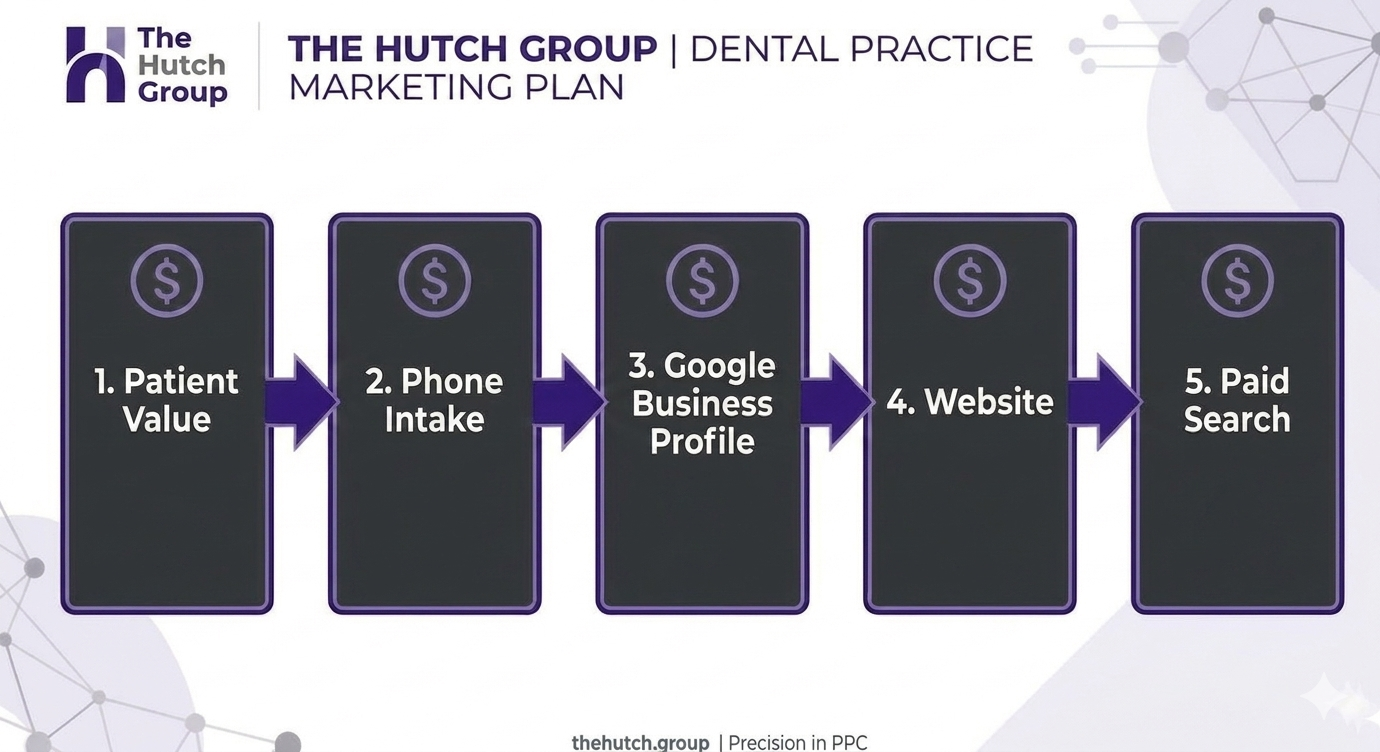
Every dental practice marketing plan starts with one number
You cannot decide whether $2,400 a month in ads is expensive until you know what it buys.
Pull your practice management software and look at first-year production per new patient, not lifetime value. Lifetime value is a great number for a pitch deck and a terrible number for a budget, because you’re spending real dollars this month against revenue that may show up in 2031. For most general practices we work with, first-year production per new patient lands somewhere between $700 and $1,400. Specialty practices run higher. A perio or implant-heavy practice can clear several thousand.
Then figure out what you keep. If your overhead runs 65%, a $1,100 patient leaves you roughly $385. That’s your ceiling. Spend $400 to acquire that patient and you’ve done a lot of work for free.
Most practice owners we talk to have never run this number. They know their collections and their chair count and their hygiene reappointment rate cold, and they have no idea what a new patient costs them. It’s the single most useful hour you’ll spend on marketing all year.
Fix the phone before you spend a dollar on ads
This is the step everyone wants to skip, and it’s the one that quietly eats the most money.
Put call tracking on your main line and listen to two weeks of recordings. We do this on every new dental account and the pattern almost never changes. Somewhere between a quarter and a third of new patient calls during business hours go to voicemail or get put on hold long enough that the caller hangs up. Of the ones that do get answered, a good chunk end without anybody offering a specific appointment time.
Think about what that does to your math. If you’re paying $250 a call and you’re converting 45% of them into booked appointments, your real cost per new patient is $555. Get that conversion to 70% and the same ad spend produces patients at $357. You didn’t touch the ad account. You changed who answers the phone and what they say.
Before any client of ours spends on paid media, we want to see the answer rate above 90% during posted hours and a booking script that offers two specific times. That’s it. It isn’t glamorous work.
Your Google Business Profile earns more per hour of effort than anything else you own
For a single-location practice, the map pack is usually the largest source of new patient calls. Not the website. Not ads. The three-result box that shows up when somebody searches “dentist near me” from a parking lot.
Claim it, then actually work it. Categories set correctly (Dentist as primary, plus the secondaries that match services you really provide). Hours accurate, including the half-day Fridays. Photos of the actual office, not stock. Services listed individually so they can be matched to searches. And reviews, which is where practices either win or lose this channel outright.
The review gap between the top map result and the fourth one in most suburban markets is wide enough that closing it is the whole strategy. If the practice above you has 340 reviews and you have 61, no amount of ad spend fixes that. You need a request going out after every appointment, automatically, from your practice management system.
One caveat worth naming. Never respond to a review in a way that confirms someone was a patient or references their treatment. That’s a HIPAA problem, and it’s a mistake we see practices make in public every week. Thank them generically or take it offline.
Then the website, and only the pages that do work
Practices spend $12,000 on a redesign and get a slower version of what they had. The pages that actually matter for new patients are few.
Your homepage needs to answer three questions above the fold. Where are you, what insurance do you take, and how do I book. Insurance is the one that gets buried, and it’s the first thing a prospective patient checks. Put it on the homepage and give it its own page.
Then a page per high-value service you actually want more of. Implants, Invisalign, sedation, whatever your production goals point at. One page each, written like a person talking, not like a textbook definition of periodontal disease. These pages are what rank and what your ads point to.
Then booking. Online scheduling if your software supports it, a click-to-call button that works on mobile, and a form that doesn’t ask for insurance member ID before it asks for a name.
Everything else on the site is optional. The staff bios are nice. They don’t book patients.
Paid search comes fourth, not first
Google Ads works well for dental. It works much better when the three things above it are already handled, which is why it sits here instead of at the top.
A few things that consistently matter in dental accounts:
- Run separate campaigns per service line. “Emergency dentist” and “Invisalign” are different patients with different budgets and different urgency. Bundling them into one campaign hands your budget to whichever one Google finds cheapest, which is rarely the one you want.
- Negative keywords are half the job. Dental search terms are full of “dental assistant jobs,” “dental hygienist salary,” “free dental clinic,” and “dental school.” Left unchecked, those can eat 20% of a budget.
- Track calls as conversions, and only the ones over 60 seconds. A 12-second call is a wrong number. If it counts as a conversion, Google’s bidding algorithm will happily buy you more of them.
- Watch your geography tightly. Radius targeting around the practice, not the metro. Nobody drives 40 minutes past nine other dentists to see you.
Cost per new patient from paid search runs wide by market. We generally see $180 to $250 in less competitive suburban markets and $400 plus in dense metros where three DSOs are bidding against you. Compare that against the number you calculated in step one before you decide it’s too expensive.
How much should a dental practice spend on marketing?
The usual answer is 3% to 5% of collections for an established practice and 8% to 12% for a startup or a practice trying to add a provider. Those benchmarks are directionally fine, and they’re also how a lot of practices end up spending money on nothing in particular.
Work backward instead. If you want 25 new patients a month and your all-in cost per new patient is $300, your budget is $7,500. If that number is more than you’re willing to spend, the fix is lowering the cost per patient (better phone conversion, better reviews, tighter targeting), not lowering the goal and hoping.
One honest limit. Below about $1,500 a month in total marketing spend, paid search struggles to gather enough data to optimize, and you’re usually better off putting everything into the profile, the reviews, and the phone. That’s not us talking anyone out of a budget. It’s just where the math sits.
What about social, direct mail, and the other twenty ideas?
They can work. They’re just not where you start, and most of the lists you’ll find don’t tell you that.
Direct mail still performs in specific situations, mainly new-mover lists and practices opening in a growing area. It’s expensive per patient and slow to read, so don’t run it as your only channel and don’t judge it after one drop.
Organic social is a retention and referral tool for dental, not an acquisition channel. Nobody picks a dentist off Instagram. Patients do check that you exist and look normal, which is a real job, just a smaller one than people sell it as.
Paid social is different and can work for elective, high-ticket cases where you’re creating demand rather than catching it. Implants and clear aligners, mostly. Be careful with the pixel setup. Health-related audience targeting is restricted, and conversion events that fire on a page tied to a specific condition can get you into HIPAA territory fast.
You’re done when you can answer this question
Here’s the test. Ask yourself where your last ten new patients came from.
If the honest answer is “the website, I think,” the plan isn’t finished, no matter how many channels are running. Attribution is the difference between a marketing budget and a marketing expense. You want call tracking numbers on each channel, conversion tracking wired into Google Ads properly, and a field in your practice management software that your front desk actually fills in.
Get that, and every decision after it gets easier. You’ll know which service line ads to expand, which zip codes to cut, and whether the postcard was worth it. Most practices never get there, which is exactly why the ones that do tend to pull away from the practice down the street.
Start with the new patient value number. It’s one report and an hour, and it makes every other number in this post mean something.
