
Search “facebook ads cost” and you’ll get a tidy number back. Something like 97 cents a click, or 11 dollars per thousand impressions. We’ve run Meta campaigns for home services companies, law firms, and medical practices for years, and that number has almost never been the one that mattered. The cost that decides whether Facebook ads pay off for you isn’t the cost per click. It’s the cost per qualified lead, and after that, the cost per booked job or signed case.
So if you’re trying to budget around a CPC benchmark you found in a blog post, you’re solving the wrong math problem. Let’s fix that.
The number everyone quotes, and why it misleads you
Most “how much do Facebook ads cost” articles hand you platform-wide averages. Average cost per click around a dollar. Average CPM somewhere between 7 and 15 dollars. Average cost per thousand impressions, average click-through rate, the whole benchmark buffet.
Here’s the problem. Those averages blend a dropshipping store selling 12-dollar phone cases with a personal injury firm chasing cases worth tens of thousands. Those two businesses live in completely different auctions, with different audiences, different competition, and wildly different economics. Mashing them into one average gives you a number that describes nobody.
We had a pest control client who fixated on the dollar-a-click figure he’d read somewhere. His actual cost per click ran closer to two dollars. He thought he was overpaying by double. He wasn’t. His clicks turned into booked services at a rate that made each one worth far more than two dollars, and the leads were closing. The benchmark told him he was losing. The revenue report told him the opposite.
That gap is the whole point of this post.
Okay, but what does a click actually cost in 2026?
Fair. You came here for a number, so here’s an honest range instead of a fake-precise one.
For most local service businesses we manage, cost per click on Meta lands somewhere between 50 cents and 2.50. Cost per thousand impressions usually sits in the 8-to-18-dollar band. Lead-generation campaigns tend to run pricier clicks than awareness or traffic campaigns, because you’re asking the platform to find people who’ll actually fill something out, not just scroll.
Three things move your cost per click more than anything else. Your audience size and how much competition is bidding for it. Your creative, because Meta rewards ads people stop on and punishes the ones they skip. And your offer, since “free inspection” and “schedule a consult” pull very different click costs.
But notice what I just did. I gave you the average cost per click, and it still doesn’t tell you whether Facebook ads are a good investment for your business. A 50-cent click is expensive if it never converts. A three-dollar click is cheap if one in eight books a job. Cost per click is an input. It is not the answer.
Stop budgeting around clicks. Budget around leads.
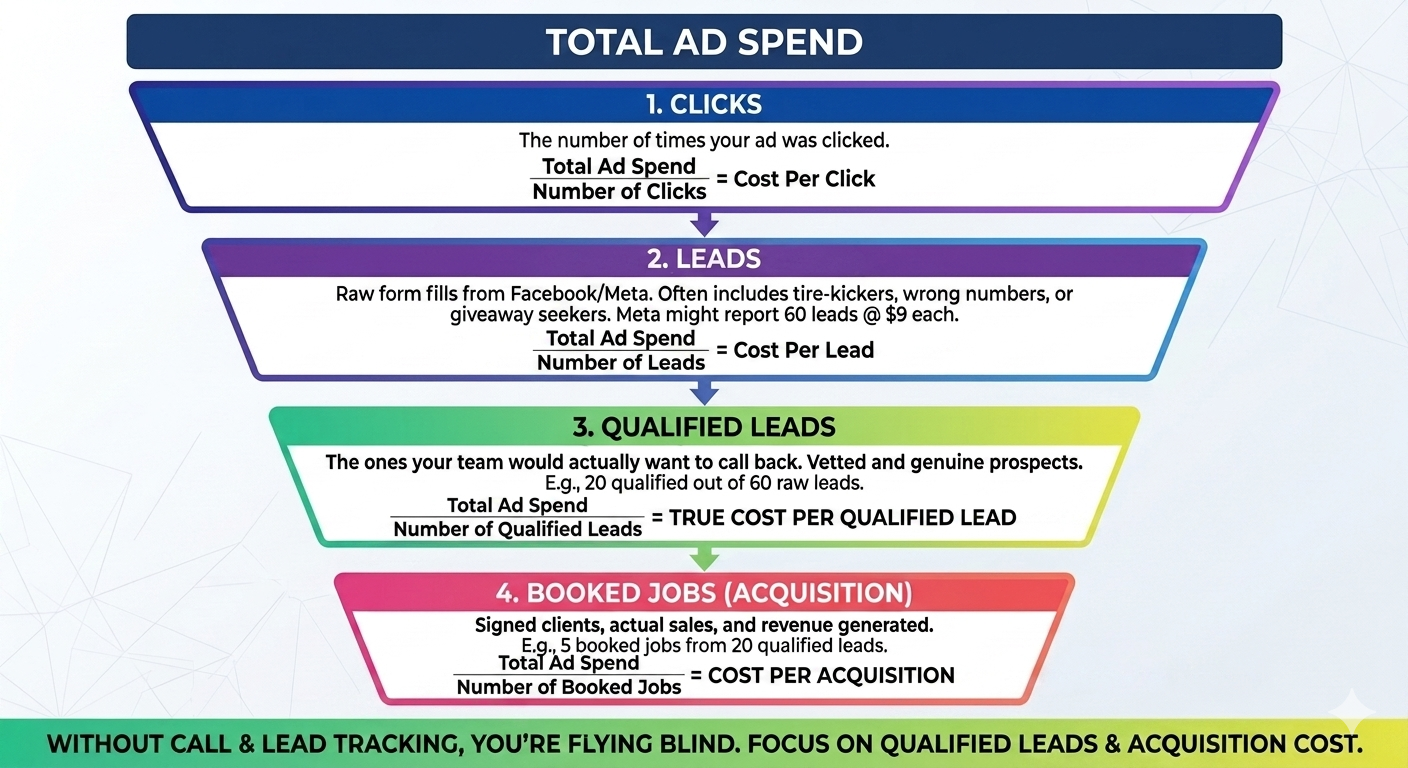
The number that should run your Facebook ads budget is cost per qualified lead. Not cost per click, not cost per form fill, not cost per “lead” the way Ads Manager loosely counts it. Cost per qualified lead. The ones a human on your team would actually want to call back.
This distinction matters because Meta will happily report 60 leads at 9 dollars each and make you feel great, while 40 of those 60 are tire-kickers, wrong numbers, or people who thought they were entering a giveaway. We’ve seen lead forms that looked phenomenal on the dashboard and fell apart the second the front desk started dialing. (Frustrating, and more common than you’d think.)
So the real cost equation looks like this. Take your total spend. Divide by the number of leads your team would call qualified. That’s your true Facebook ads cost per lead. Then go one step further and divide spend by booked jobs or signed clients. Now you have cost per acquisition, the number your bank account actually cares about.
If you don’t have call tracking and proper lead tracking in place, you can’t see any of this, and you’re flying blind on the one metric that decides everything.
What a lead actually costs, by industry
This is where the platform averages fall apart completely, so let me give you ranges we genuinely see across the verticals we work in. Treat these as starting expectations, not promises. Your market, your offer, and your follow-up speed all swing them.
Home services (HVAC, plumbing, roofing, pest control). Qualified lead costs often land between 20 and 80 dollars on Meta, depending on the service and season. Emergency and high-ticket work like roof replacement runs higher. Recurring or lower-ticket services run cheaper. A roofing lead in storm season behaves nothing like a gutter-cleaning lead in October.
Legal. Brace yourself. Facebook leads for personal injury or other high-value practice areas can run well past 100 dollars, sometimes several hundred for a qualified intake. Sounds brutal until you remember a single signed case can be worth tens of thousands. The cost per lead is high because the case value is high, and the auction reflects it.
Healthcare and dental. Med spas, dental practices, and specialty clinics usually see qualified lead costs from the low 20s up past 100, depending on the procedure. A teeth-whitening promo pulls cheap leads. Dental implants or cosmetic work pull pricier ones, but each booked patient is worth far more.
The throughline across all of these. Cheap leads are not the goal. Profitable leads are. A 30-dollar lead that never closes is more expensive than a 120-dollar lead that signs, every single time.
How much do you need to start?
People want a magic minimum, and I get why. Here’s our honest take after running a lot of these.
Below about 1,000 dollars a month in ad spend, Meta struggles to gather enough conversion data to optimize well, and you’ll mostly be buying education rather than results. It can still work for a tight local audience with a sharp offer, but expect it to be bumpy. The 1,500-to-3,000-a-month range is where most local service businesses we work with start seeing the algorithm settle in and cost per lead stabilize. Above that, you’re usually scaling something that already works, not testing whether it works at all.
And budget isn’t only the media spend. If you hand Meta money but send the clicks to a slow, generic page, you’ll pay more per lead to make up for the lousy conversion rate. The ad cost and the landing page are the same problem wearing two hats.
One more thing on budget. Give it time. The first two or three weeks of a new campaign are the most expensive leads you’ll ever buy, because the system is still learning. Judge the cost after the learning phase, not during it. Pulling the plug at day 10 because the cost per lead looks scary is the most common, most expensive mistake we see owners make.
Where the money quietly leaks
Two campaigns with the identical budget can produce double the cost per lead, and the difference usually isn’t the budget at all. It’s the leaks.
Weak creative is the big one. Meta’s auction rewards ads that hold attention, so a tired stock photo with generic copy gets throttled and your costs climb to compensate. Fresh, native-feeling creative that looks like it belongs in the feed almost always lowers cost per lead more than any bid tweak. We refresh creative far more often than most owners expect, because ad fatigue is real and it shows up as rising costs.
Broad, sloppy targeting leaks money too, though the fix isn’t always “narrow it down.” Meta’s targeting has gotten good enough that over-narrow audiences can actually raise costs. The leak is usually a mismatch between who you’re reaching and what you’re asking them to do.
And then there’s retargeting, or the lack of it. Most people don’t convert on the first touch. If you’re spending to get someone to your site and then never showing up again, you’re paying full price for cold traffic every time and leaving the warm audience untouched.
Is Facebook advertising worth it for your business?
The question behind “what do Facebook ads cost” is usually “is Facebook advertising worth it for me.” So let me answer that one straight.
Facebook ads tend to work when you have a clear offer, a way to capture and follow up on leads fast, and a service worth enough to absorb the cost per lead in your market. They tend to disappoint when the offer is vague, the follow-up is slow, or the math on your average job just doesn’t leave room for paid acquisition.
Here’s the test I’d actually apply. Take your average customer value. Subtract your costs to deliver. What’s left is roughly what you can afford to spend to acquire one, and a healthy paid channel usually spends a fraction of that. If a booked job is worth 800 dollars in profit and you’re acquiring them at 120 in ad spend, that’s a strong channel. If a job nets you 90 dollars and leads cost 60, the channel is technically working and barely worth the headache.
This is the same reasoning we apply to every paid channel, not just Meta.
Next time someone quotes you a CPC
When an agency or a blog post leads with “Facebook ads cost about a dollar a click,” that’s not a lie, it’s just the least useful true thing they could tell you. Push past it. Ask what a qualified lead costs in your industry, what it costs to book one, and whether that math leaves you money. That’s the conversation that decides whether the spend is smart.
Pull up your own Ads Manager this week and find your real cost per qualified lead, not the cost per result Meta hands you by default. If you’ve never separated the two, that one number will tell you more about your campaign than any benchmark ever could. And if it’s ugly, that’s not a reason to quit. It’s usually a creative problem or a tracking problem, and both are fixable.
