
We pulled apart the search results for 20 HVAC markets this summer, everywhere from mid-size metros to towns with two stoplights. The same pattern showed up in almost every one. The companies getting the calls weren’t the biggest, the oldest, or the ones with the prettiest websites. They were the ones treating SEO for HVAC as a local visibility problem instead of a content problem. Here’s what the winners had in common, ranked by how much each piece appears to matter.
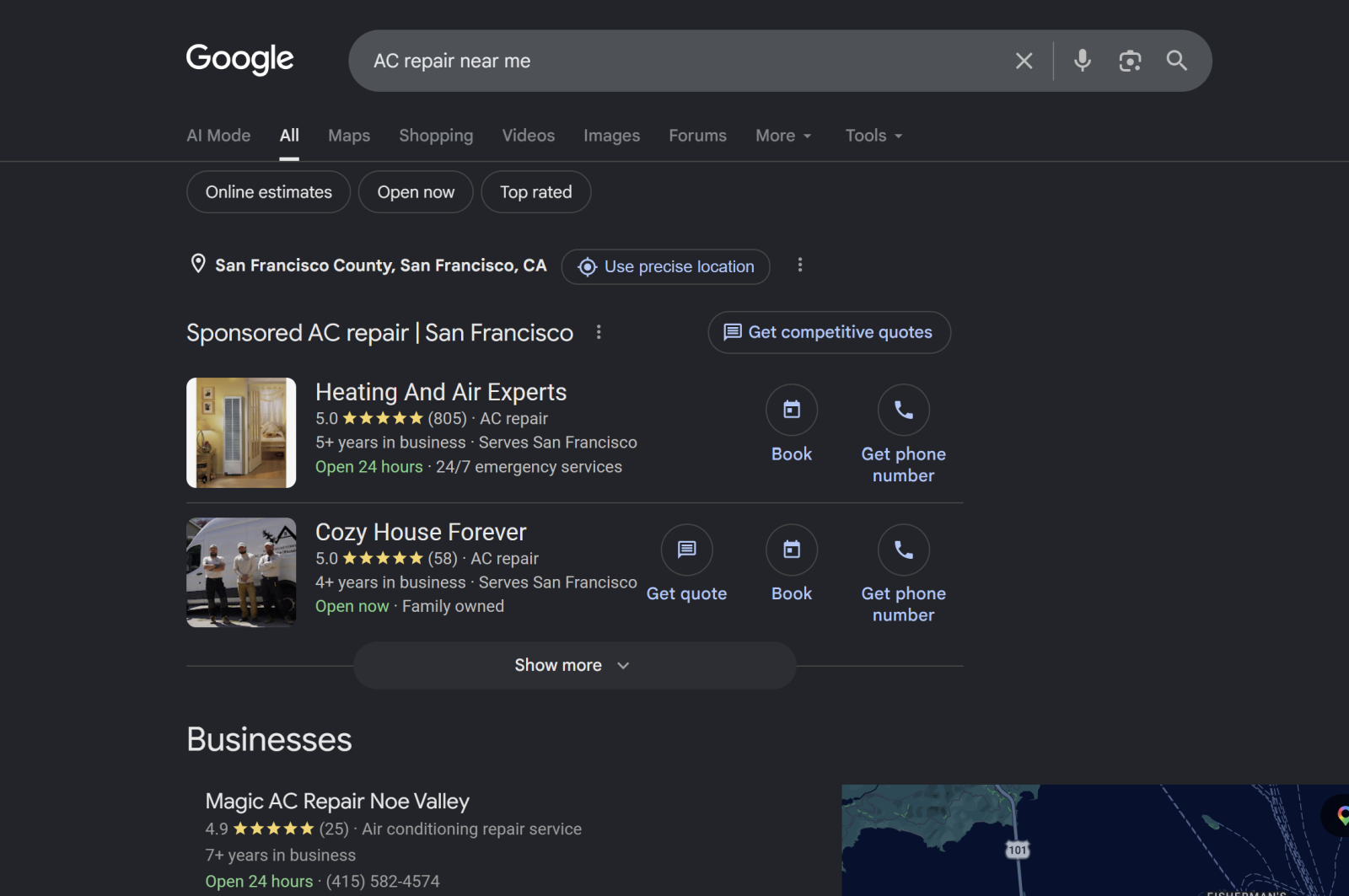
The map pack decides more than your website does
When someone’s AC dies at 9 PM in July, they don’t browse. They search “AC repair near me,” look at the three businesses in the map pack, glance at the star ratings, and call one. Your beautifully written service page never enters the conversation.
That’s why the single highest-return work in HVAC SEO is your Google Business Profile. Not your homepage. Not your blog. The profile.
We watched this play out with an HVAC company that had been in business 15 years and was invisible in Google Maps. No profile problems you’d spot at a glance, just thin categories, no services listed, sparse photos, and a few dozen missing or inconsistent citations. After optimizing the profile and building about 40 local citations, they went from not appearing in the local pack at all to position 2 within 90 days. Call volume followed.
If you do nothing else from this post, do these. Set your primary category to the service that makes you the most money (usually “HVAC contractor” or “Air conditioning repair service,” and yes, the primary category choice measurably moves rankings). Fill out every service Google lets you list. Add photos monthly, real trucks and real techs, not stock. Keep your name, address, and phone number identical everywhere they appear online.
One page per service, one page per city. No exceptions.
The second thing winning sites share is boring and structural. They have a dedicated page for every service and every meaningful location, each targeting its own keyword.
A typical losing site has one “Services” page listing AC repair, furnace installation, duct cleaning, and heat pumps in four paragraphs. A winning site has a page for each, because “furnace repair” and “AC installation” are different searches with different seasons and different buyers. Google ranks pages, not companies.
The keyword targets almost write themselves. “AC repair [city].” “Furnace installation [city].” “Emergency HVAC [city].” “Heat pump replacement cost.” Pull your service list, cross it with the cities you serve, and you have a 12-month content roadmap without a single blog post on it.
One warning from the audits. City pages only work when they’re real pages. If your “HVAC repair in Franklin” page is your Nashville page with the city name swapped, Google mostly ignores it and occasionally punishes it. Include things only true of that market. Neighborhoods you serve, local permit quirks, response times from your nearest shop, reviews from customers in that town.
Reviews are a ranking factor you can control
Review count and velocity showed up as a separator in nearly every market we looked at. The map pack winners averaged hundreds of reviews with new ones arriving weekly. The page 2 companies had 40 reviews, the newest from eight months ago.
Google has confirmed reviews influence local ranking. But the bigger effect is human. A 4.8 with 600 reviews gets the call over a 4.9 with 31, because volume reads as proof.
The fix isn’t complicated, it’s operational. The companies with review velocity ask every single customer, the same way, at the same moment (right after the job, while the tech is still there, with a direct link texted to the customer’s phone). The ones without velocity ask “when they remember.” That’s the whole difference. Reply to the negative ones too. Future customers read your responses as a preview of how you handle problems.
Is your site fast enough to matter?
Here’s the honest version of the technical SEO conversation. You don’t need perfect Core Web Vitals scores. You need a site that loads in under three seconds on a phone, because that’s where HVAC emergencies get searched.
In our audits, most HVAC sites failed on the same two things. Oversized hero images that take five seconds to paint on mobile, and pages so cluttered with badges, sliders, and popups that the phone number isn’t visible without scrolling. Both are fixable in an afternoon.
Check yours right now. Open your site on your phone, on cellular, not Wi-Fi. Count the seconds. If the click-to-call button isn’t on screen immediately, that’s costing you calls today, not eventually.
Seasonal content beats evergreen blogging
Most HVAC blogs are a waste of money. There, we said it.
The standard agency playbook says publish weekly posts like “5 Benefits of Regular HVAC Maintenance.” Nobody searches that, and nobody who lands on it is hiring. Meanwhile the searches that spike every single year go unclaimed. “AC blowing warm air” in June. “Furnace smells like burning” the first cold week of October. “How much does a new AC unit cost” all summer.
Write for the spikes, and publish 4 to 6 weeks before the season turns. A page answering “why is my AC blowing warm air” that ranks by May will feed you service calls all summer, because the last section naturally answers the reader’s next question, which is whether to fix or replace, and who to call.
This is also where paid and organic compound. HVAC clicks on Google Ads routinely run $15 to $30. Every service call that comes in organically through a seasonal page is a call you didn’t pay ad rates for.
What about AI search?
Search “seo for hvac” today and the first thing you’ll see is an AI Overview, not a blue link. That’s the direction this is heading, and HVAC companies are more insulated than most businesses but not immune.
Insulated, because “emergency AC repair near me” still resolves to a map pack and a phone call. AI can summarize advice, but it can’t come fix your compressor. Not immune, because research-stage searches (“heat pump vs AC,” “new furnace cost”) increasingly get answered by AI directly, and the AI cites sources. The companies getting cited are the ones with clear, specific, well-structured pages, which conveniently is the same thing that ranks in regular search.
So you don’t need a separate AI strategy yet. You need pages that answer real questions with real numbers, marked up with proper headings and schema, on a site Google already trusts locally. Do the work in this post and you’re most of the way there.
How much does HVAC SEO cost?
Since this question is sitting right there in the search results, here’s a straight answer. Doing it yourself costs time, roughly 5 to 10 hours a month to maintain your profile, ask for reviews, and publish one solid page. Hiring it out typically runs $1,500 to $5,000 a month depending on market size and how many locations you’re fighting for.
Whether that’s worth it depends on your average ticket. If a new system install is worth $8,000 to $12,000 to you, one extra install a month pays for aggressive SEO several times over. If you’re mostly running $150 service calls, start with the free work (profile, reviews, citations) and grow into the rest.
Be careful with anyone selling HVAC SEO at $400 a month. In our experience that buys you automated directory submissions and a monthly PDF, not rankings.
Where to start if you’re doing this yourself
You’re done reading. Here’s the order we’d work in, based on what separated winners from losers across those 20 markets.
- Fix your Google Business Profile this week. Primary category, services, photos, and a review link you can text.
- Ask every customer for a review, at the moment of service, starting tomorrow.
- Build one real page for your highest-value service in your main city. Then repeat monthly.
- Load your site on your phone and fix whatever makes you wait.
- Six weeks before your next peak season, publish one page answering the question your phone rings about most.
Track calls, not rankings, while you do it. Rankings are how you get there. The phone ringing with qualified work is the point.
