
Mental Health Practice Marketing Case Study: How Well Nourished Psychiatry went from $3K to $11K a month in Google Ads
How we grew one Mental Health Clinic to the point of hiring two new clinicians using only one channel and built the operational system to support its growth.
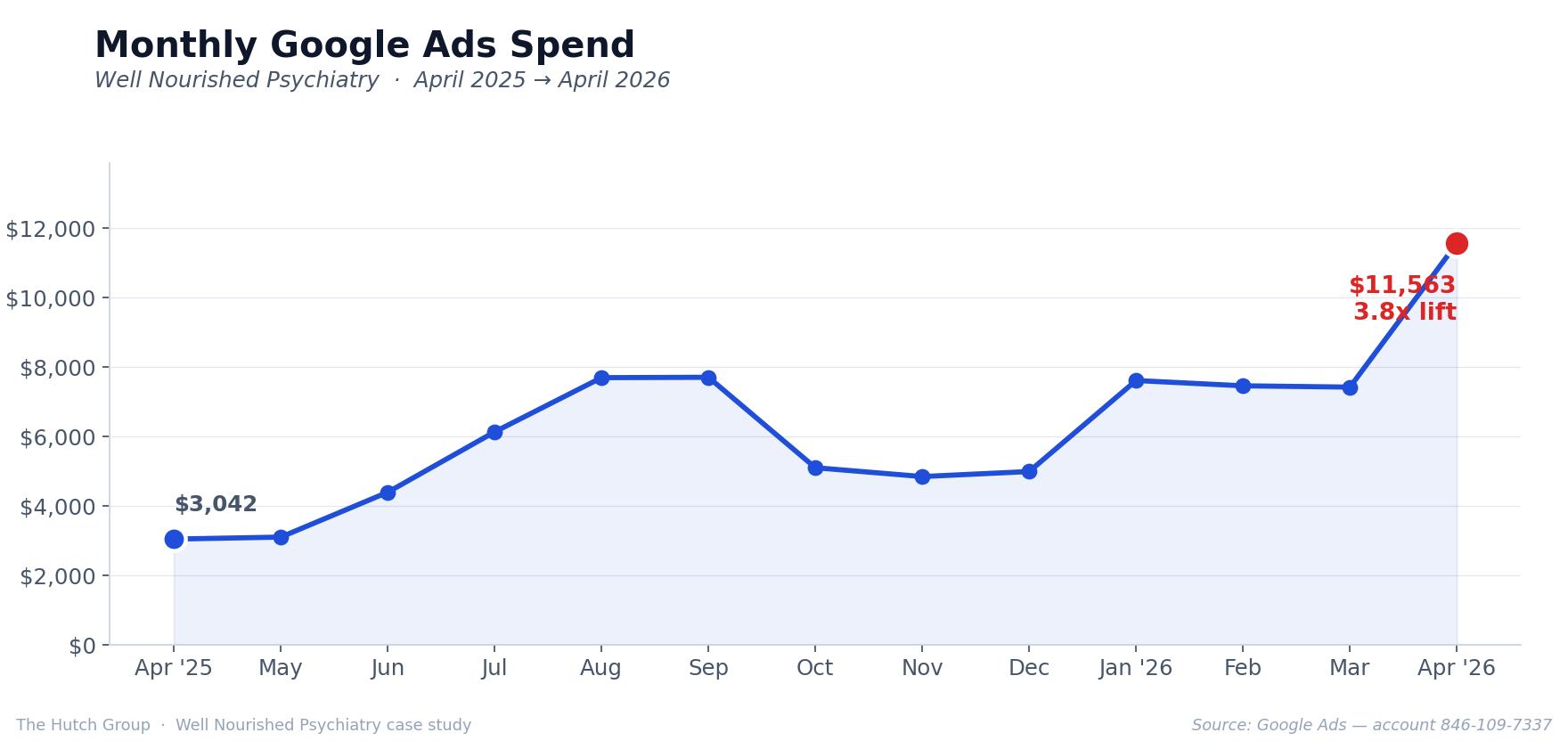
Hope Manning came to us in spring 2025 spending $3,042 a month on Google Ads with a marketing company that hadn’t shown results in three months. Her integrative psychiatry practice, Well Nourished, was running a split Facebook-and-Google budget, getting almost no measurable patient flow, and watching her clinicians’ schedules wobble between full weeks and slow ones.
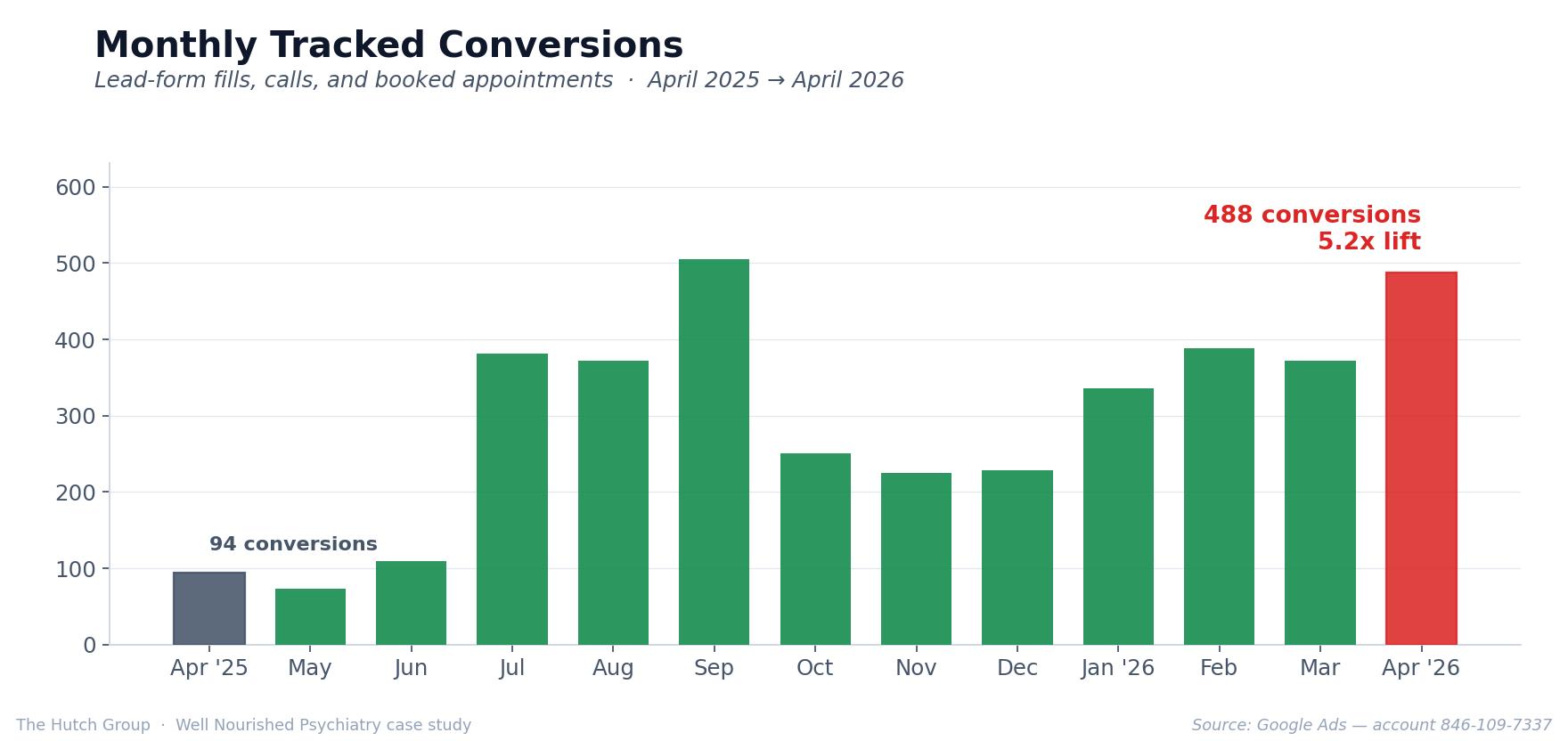
By April 2026 the same account was running $11,563 a month and producing 488 tracked conversions. She’d hired two new clinicians, the whole team was booked three weeks out continuously.
Where Well Nourished was before we started
Well Nourished isn’t a small clinic in the usual sense. It’s an integrative psychiatry practice in Golden, Colorado, run by Hope Manning, DMSc, PA-C, CAQ-Psych. The team treats depression, anxiety, ADHD, PTSD, mood disorders, peripartum issues, and substance use, with a model that combines medication management, supplementation, lab and genetic testing, and MAT for addiction recovery. As a clinic, they have amazing talent to provide the best service to all their clients.
But they had a weak point, which is usually the weak point for most clinics and that would be the marketing side of the business.
Hope put it this way.
“We weren’t doing ads well. We had been working with a company for three months that hadn’t shown results and split our spend between Facebook ads and Google. Facebook didn’t get us many leads and distracted us from doing Google well.”
As many clinics do, you outsource a specific part of the business to those who are professionals in that area to get the best ROI for your time and money. This also brings along headaches, as Hope continues in the same email.
“I didn’t understand what ROI we were getting with our prior company. Before then, we hadn’t done any Google Ads. We tried to do Facebook ads on our own without any understanding of how they were leading to patients. Unsure if any of our money ever got us a patient.”
She’d been spending money on marketing and had no idea whether any of it had ever produced a patient. If you’ve run a small medical practice, you know how that feels. If you’re not able to confidently say, “We spent X amount this month and we got X amount of new patients, with a revenue of X.” then you need to find a new marketing company.
Being able to prove ROI is the bare minimum a marketing company is supposed to provide but is seemingly rare these days.
The decision to fire one marketing company and find another
This is the moment a lot of clinic owners freeze. Past disappointments make the next decision feel risky, but Hope didn’t freeze.
“We failed a lot with hiring, and at the point of hiring your company, I didn’t have fear of taking steps to grow the practice because we had been through so much already. Provider turnover, patient turnover, and failed attempts at marketing.”
She’d decided two things before she ever called us:
- Pick one channel.
- Find a partner who could actually run it and scale
What got her over the line on choosing The Hutch Group wasn’t a pitch with all the latest buzzwords or sales tactics.
“I loved that I was able to talk with Caleb right off the bat, and he was able to answer my questions about what I should know as a business owner about ads and how he could provide transparent data. He made it very simple. I was very wary about onboarding anyone again with our failed prior company.”
People hire people, which means just providing clear answers, showing previous data with past clients and overall emit a general concern for the growth of your clients business, they don’t need to be sold. It also helps that you are just good at what you do (;
Why we killed the Facebook budget on day one
Since we at The Hutch Group listen to our clients, Hope already had in mind on focusing on one channel, so we turned the Facebook ads off. Not only on Hope’s decision but also because we agreed based on her goals and what we know about the industry.
For a mental health or specialty medical practice in a specific geography, Google Ads is where the intent lives. Someone searching “psychiatric PA near me” or “ADHD specialist Golden CO” is, in that exact moment, looking for what Well Nourished provides. Facebook can absolutely produce patients for clinics like this, but it requires creative iteration, longer time-to-break-even, and bandwidth Hope didn’t have.
We refocused her budget on a tighter, intent-driven Google Ads build.
$3K, then $7.5K, then $11K. Each jump was earned.
This is the part of the case study most owners misread. People hear “ad spend tripled” and assume the agency aggressively pushed the budget. That is not what we did here.
Hope drove every budget increase, after we showed her results that merit the budget increase. The actual monthly numbers from her Google Ads account.
- April 2025. $3,042 in spend. 94 tracked conversions.
- July 2025. $6,130 in spend. 381 conversions.
- September 2025. $7,703. 505 conversions.
- January 2026. $7,610. 336 conversions. $16,962 in tracked conversion value.
- April 2026. $11,563. 488 conversions. $31,153 in tracked conversion value.
3.8x lift in monthly spend. 5.2x lift in tracked conversions. Roughly a 400x lift in tracked conversion value over twelve months. The CPA didn’t blow out as we scaled because each budget jump was tested against demand, not forced ahead of it.
Hope’s framing on the $11K decision.
“We had seen how $7.5K had doubled our leads over several months, and going to $11K seemed straightforward to increase our leads further. All because we had the data and my meeting with Caleb that laid out facts so I could make a decision of our spending.”
That’s the right way to run a paid budget not only for a medical practice, but any business in general. Elaborate to the owner what’s happening and provide all the data so THEY can decide. Why would they increase spending if they can’t even see their ROI? Would you do that? No you wouldn’t, so why would you expect your clients to do so.
When the ads start working before you’ve hired the clinicians
A success scenario most agencies dream of is having their clients schedule fill up before they are even ready for that volume (actual volume and not spam/bad leads).
By the time Well Nourished’s existing clinicians were booked two to three weeks out, the question of whether to hire wasn’t really a question anymore.
“Before I decided to put a listing up, our current providers’ schedules were booked out two to three weeks. It was an ideal time to hire and our providers were established and didn’t need much support. We had a great flow, and ultimately we want to help as many people as possible, so hiring was the next step.”
Two clinicians joined the team during the engagement. Claire came on a few months after we started managing the ads and Paige is the most recent addition.
“When we hired Claire, it was a few months after we onboarded The Hutch Group, and if we didn’t have solid Google Ads, the people that have benefited from their care wouldn’t have been able to see them, and we wouldn’t have been able to retain them as providers.”
That is music to our ears. Marketing didn’t just bring in patients, it made the practice viable to keep clinicians in with full schedules and be able to retain them as providers.
The SEO engine compounded underneath
While the paid side scaled, we were also slowly rebuilding the organic foundation.
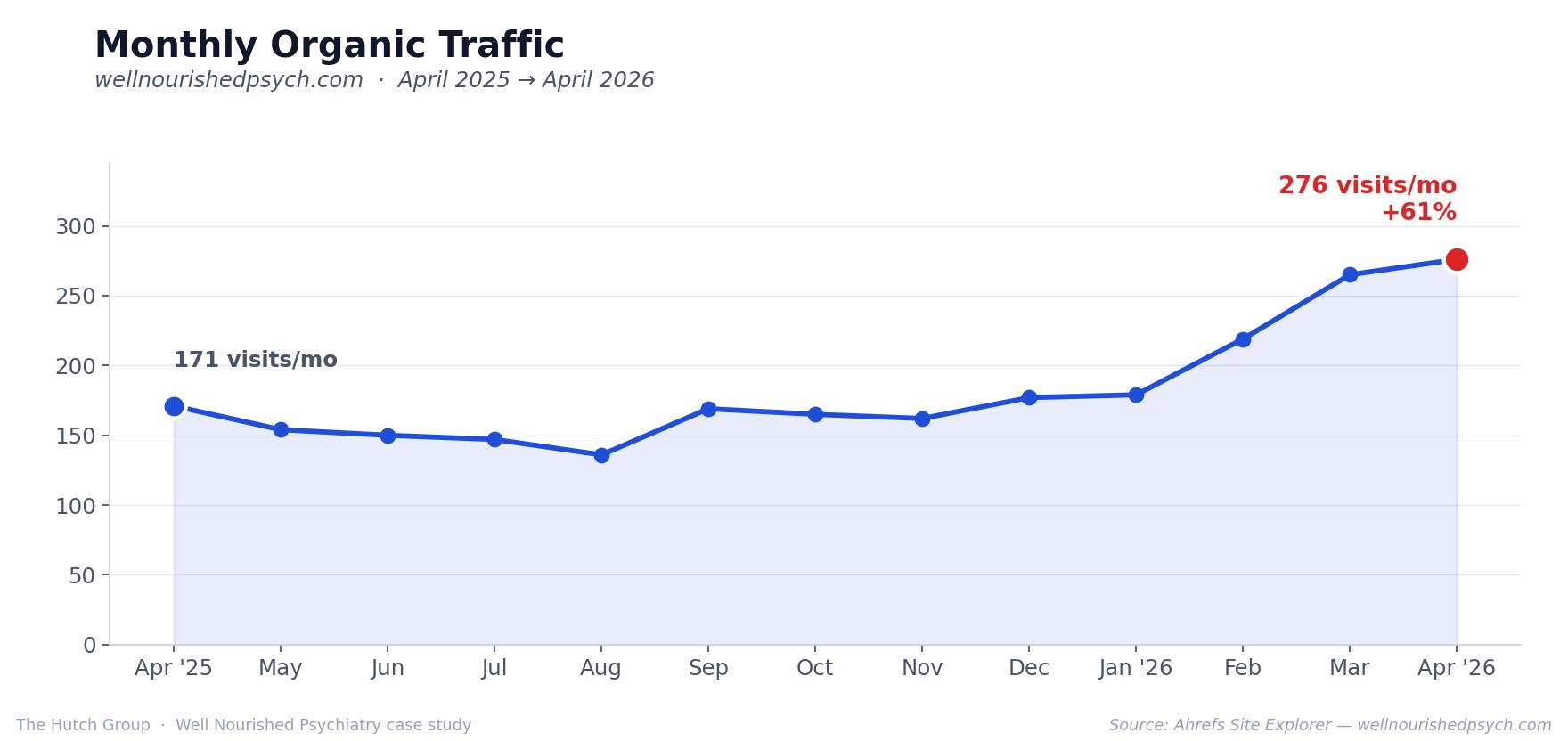
From April 2025 to April 2026, Ahrefs shows monthly organic traffic to wellnourishedpsych.com grew from 171 to 276 visits, a 61% lift. That’s not an impressive number. The impressive number is what happened to ranking quality.
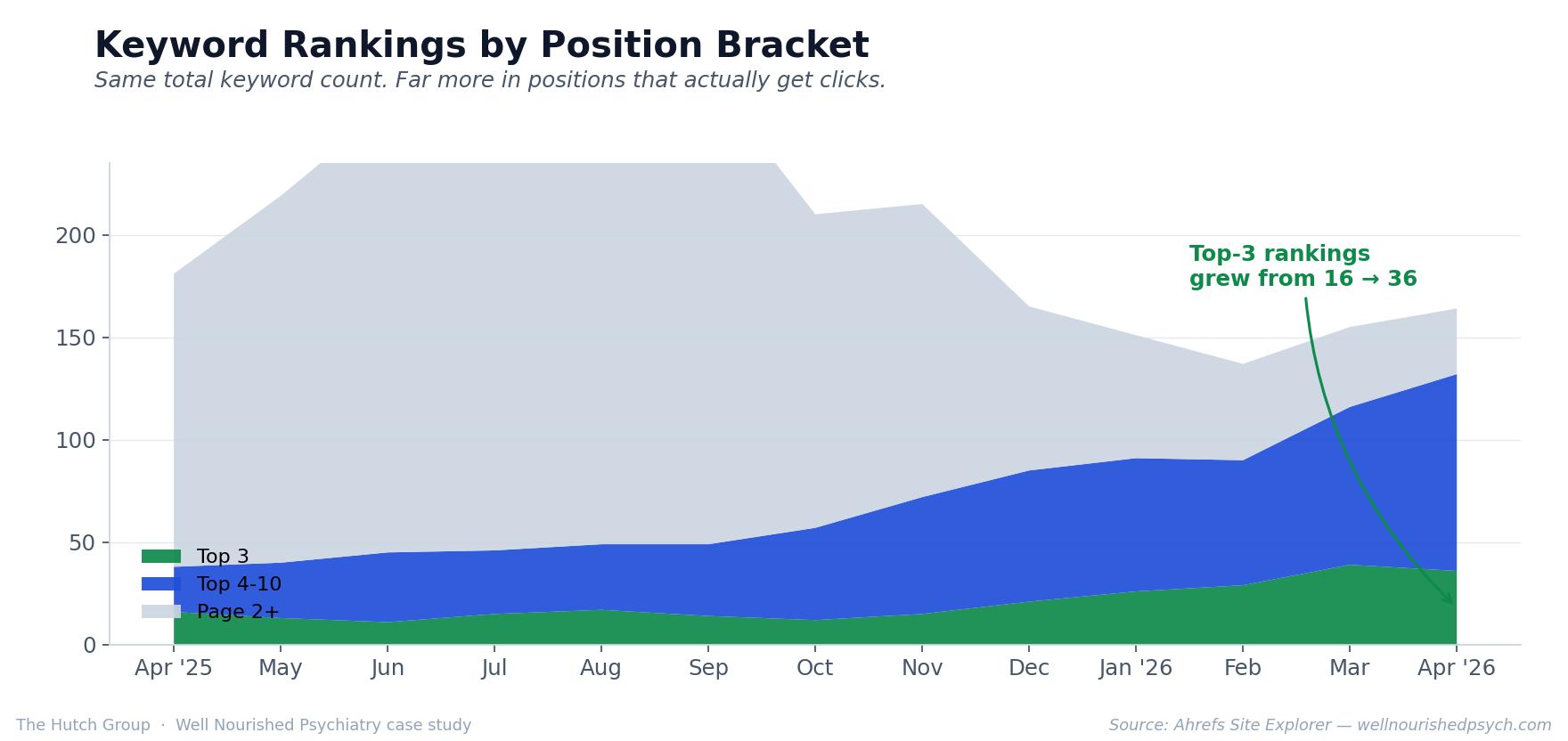
- Keywords in top-3 Google positions. 16 climbed to 36 (2.25x).
- Keywords in top-10 positions. 38 climbed to 132 (3.5x).
- Long-tail rankings (page two and below). 143 fell to 32.
Total ranking keywords actually dropped slightly, from 181 to 164. But the long-tail dropped because those keywords moved up the SERP, not because they vanished. We were optimizing the quality of the existing keyword inventory, not chasing the size of it. That’s a deliberate trade we made. Page two rankings don’t pay but the Top-10 rankings do.
The content side is doing real work too. A blog post titled “Developing Core Values, A Guide to Defining What Matters Most” ranks at position six for “core values and beliefs” and drives roughly 130 organic visits per month on its own. A second post about the difference between a psychiatric PA and a psychologist ranks at position eight for “psychiatric pa” and pulls in 57 visits a month. Both are sending Well Nourished the kind of patient the practice is actually built to serve.
Underneath the rankings, unique referring domains to wellnourishedpsych.com grew from 34 to 99 over the same window. This is also increasing their Domain Authority.
The systems we built underneath the ads
We rebuilt their website with conversion mechanics in mind. Every service page is set up so a prospective patient can find the right service, read enough to trust it, and submit a contact form or call without friction. It’s structured to turn a search click into a scheduled intake.
We set up CallRail across the practice. Every inbound call is recorded, transcribed, and attributed back to the marketing source that produced it. When a patient calls and books an appointment, we know whether the call came from a non-brand Google Ads keyword, a branded search, an organic result, or a referral. Without that data, scaling the ad budget would have been a guess. With it, every increase in spending produced numbers Hope could actually see.
We built their CRM in Go High Level. New leads land in a pipeline, get tagged by source, and move through automated stages so the front desk doesn’t have to chase anyone manually. Appointment reminders, no-show flags, cancellation list management, and follow-up sequences all run on top of the GHL build.
Behind all of that, we built a Google Sheets attribution layer that ties calls, form submissions, and booked appointments back to the campaigns that produced them. That’s the sheet Hope opens when she’s deciding whether to go from $7.5K to $11K. It isn’t a vanity dashboard but a document she uses to run the business.
Then we trained her front desk on how to use all of it. That last part is the one most agencies skip. A great CRM and a great call tracking setup are worth nothing if the person answering the phone doesn’t know how to log the call, tag the source, or move a lead through stages. We sat with the team and walked them through it.
Google Ads scaled because everything underneath the Google Ads was ready to scale with it. Most mental health practices that hire a marketing agency get an ads manager. Well Nourished got an ads manager plus the infrastructure that made the ads worth running.
Booked three weeks out, in real life
Most agency case studies stop at “look at the growth.” The reality of running a booked-out medical practice can be explained in one line, “Mo clients, mo problems” (see what I did there)
Hope was honest about both sides.
“Both. I have communicated with my team, now having metrics on our Go High Level calendar invite show rate, that even though we have these new patients scheduled, it doesn’t mean they will all show. Keeping our team on their toes and having a solid cancellation list has been helpful to meet the problem.”
Booked three weeks out means show rates start to matter in a new way. It means cancellation lists need active management. The systems we built make all of that visible and the discipline of running them still belongs to the practice. That’s where Well Nourished is investing now.
This is something we’d flag for any practice owner reading along. Lead-flow is the easy part to solve but operational discipline is the harder part, and it shows up exactly when the marketing starts working.
If you run a small medical practice and you’re on the fence about marketing
Hope’s answer to “what would you tell another mental health or medical practice owner debating this” was short and direct.
“I would strongly advise that they offload marketing to a company so they can focus on the practice. Referrals can fill your schedule for a while, but aren’t consistent. It has been an important lesson in my growth as a business owner over the past four years that if you try to do everything, you do nothing well.”
Hope Manning, DMSc, PA-C, CAQ-Psych, Founder, Well Nourished
We’d add three things to that, learned from running marketing for small medical practices across mental health, dental, optometry, and physical therapy.
- Pick a single channel first. A split paid budget across Facebook and Google rarely works for a small practice without dedicated marketing staff. Pull the dollars off the channel that isn’t intent-driven and pour them into the one that is. For most outpatient practices, that’s Google Ads.
- Ask the agency to show you exactly how every dollar maps to a tracked conversion. If they can’t, the agency isn’t ready to manage your ad spend at any scale. This is the thing Hope said made her decision. She could see the results.
- Expect your practice to break a little when the marketing starts to bring in new volume that you currently aren’t used to. That’s not a problem, we call those growing pains. You’ll start to need a cancellation list, a tool that displays show-up rates, a SOP for the front desk to do a same-day follow-up. Pick an agency that builds those systems with you, and not just the ads.
Next twelve months for Well Nourished
A new clinician joins the team in September 2026. A second location opens Fall 2027.
Those are BIG WINS.
The same Google Ads structure that took the practice from $3K to $11K in monthly spend will scale into the new market, and the SEO foundation that climbed from 16 to 36 top-3 rankings will be there when the second location’s pages go live. The CRM and attribution systems are already built to scale with them.
Hope’s closing thought on what the growth has actually unlocked, beyond the schedule and the team.
“I can actually live it. The stress of not having enough patients coming in with the payroll that is set every two weeks took up a lot of my bandwidth. I now get to focus on strengthening our culture and addressing other important parts of the business that I couldn’t before.”
That’s what mature marketing should do for a medical practice owner, the ability to give them back the bandwidth to run the practice they actually built and care for.
Common questions from medical practice owners about marketing
How much should a small medical practice spend on Google Ads per month?
For most small medical and mental health practices, the floor is around $2,000 a month. Below that, you don’t have enough budget to test creative variations, capture intent across the relevant search terms, and gather meaningful conversion data. Well Nourished started at $3,000 and scaled to $11,000 as the data justified each jump. For higher-CPC specialties (legal-adjacent fields, surgical specialties, certain psychiatric subspecialties), the realistic floor is closer to $3,500. The right number isn’t a percentage of revenue. It’s whatever budget produces a CPA you can live with and lead volume your operations can absorb.
Is Google Ads worth it for a private mental health practice?
For most outpatient mental health practices, yes, but only if three things are true. One, the practice has the operational capacity to handle the lead volume increase. Two, conversion tracking is set up so spend can be tied to actual booked appointments, not form fills. Three, the practice can wait 60-90 days for the campaign to optimize before judging it. If any of those are missing, fix them first or work with an agency that fixes them for you as part of onboarding.
How long until Google Ads start working for a small medical practice?
First leads usually arrive within the first 7-14 days. Real optimization, where CPA and conversion rate stabilize, takes 60-90 days. Compounding gains (the kind Well Nourished saw between months three and twelve) take 6-12 months of consistent management and budget testing. If an agency promises results in week one, they’re either lying or stealing your branded traffic and calling it conversions.
Should a small medical practice run Facebook Ads or Google Ads?
For most small medical and mental health practices, Google Ads is the right starting point. Patients searching “psychiatric PA near me” or “ADHD specialist in [city]” are demonstrating immediate intent. Facebook can work for some specialties (med spas, weight management, certain cash-pay services where awareness matters), but for most outpatient practices, intent-driven Google search beats interrupt-driven Facebook every time. Layer Facebook in later, once Google Ads is producing consistent volume and your operations can handle the additional lead flow.
Do small medical practices need a CRM, or is a scheduling tool enough?
Once you’re spending $3K or more a month on marketing, you need a CRM, not just a scheduling tool. The reason is attribution. A scheduling tool tells you who booked. A CRM tells you who inquired, who didn’t book, who needs follow-up, where each lead came from, and what each marketing source actually produced. Without that, you’re running marketing blind. We use Go High Level for most small medical practices because it combines CRM, pipeline, calendar automation, and SMS/email follow-up in one place.
What conversion tracking does a medical practice need to get right before scaling ad spend?
Three pieces. One, call tracking on every phone number on your website, your Google Business Profile, and your ads (CallRail or a similar tool). Two, form-fill tracking with proper UTM capture so every form submission is tagged with its source. Three, a system that ties calls and form-fills back to actual booked appointments, not just inquiries. Most agencies stop at “form fill” or “phone call” and call it a conversion. That’s how you end up with a campaign that looks great on paper and produces no actual patients.
If you run a small medical or mental health practice and you want a second set of eyes on your marketing, we’re happy to take a look. Get in touch here.
