
Search “HVAC website design” and you’ll get galleries. Dribbble mockups, Webflow templates, a Pinterest board, a couple of roundups promising the 25 best-looking HVAC websites on the internet. Nice work, most of it. Almost none of it tells you whether any of those sites book a single job.
We build and rebuild home services sites, and we track every one of them down to booked revenue rather than pageviews. The pattern that separates the sites that produce calls from the ones that just sit there is boring, repeatable, and has very little to do with how the site looks.
Here’s the teardown, in rough order of how much each piece moves the number.
Your phone number is the most important design decision on the page
Not the hero image. Not the color palette. The phone number.
Roughly 70% of the traffic to a typical HVAC site is on a phone, and a big chunk of that traffic is someone standing in a hot house at 4pm in July. That person is not going to read your About page. They want a number they can tap without hunting for it.
So the number lives in the header, tapped as an actual tel: link, and it stays on screen when they scroll. A sticky footer call bar on mobile is one of the highest-return changes we make on contractor sites, and it usually takes a developer twenty minutes.
One thing we’ve had to argue about with clients more than once. Do not put the phone number in an image. It happens more than you’d think, usually because a designer wanted a specific font. Nobody can tap it, screen readers can’t read it, and Google can’t associate it with your business.
What has to be above the fold (and what doesn’t)
A visitor should answer three questions in about four seconds without scrolling. Who is this. Do they cover my town. What happens if I call.
That means your service area needs to be in text near the top, not buried on a contact page. “Serving Greenville, Simpsonville, and Greer since 2003” does more work than any headline about comfort or trusted service. We’ve watched bounce rates drop noticeably just from adding a plain city list under the H1.
What doesn’t need to be up there is the full-width stock photo of a smiling technician with a clipboard. Every HVAC site has it. It pushes the useful stuff below the fold on mobile and it doesn’t build trust, because your prospect has seen the same photo on four other contractor sites that afternoon.
Speed is a booking problem, not a tech problem
Site speed gets filed under “technical SEO,” which makes it sound like something to handle later. It isn’t. It’s the single most common reason emergency traffic leaves before the page finishes painting.
Emergency searchers are the least patient audience in local service marketing. When the AC is out, three seconds feels like thirty. We’ve seen an HVAC site go from a 6.8 second mobile load to under 2 seconds and pick up a double-digit percentage lift in form submissions with zero change to the copy or the offer.
Most of the weight on a slow contractor site comes from the same handful of places. Uncompressed hero images. A page builder loading every module whether the page uses it or not. Four different tracking scripts firing before anything renders. A slider that nobody scrolls past the first slide of.
Kill the slider. Seriously. We have never once seen a homepage slider outperform a static hero on a home services site.
Do HVAC companies actually need a website?
We get asked this by owners who are getting steady work from Google Local Services Ads and Angi, and the question is fair. If the leads are flowing, why pay for a site?
Two reasons.
The first is cost per lead. Lead marketplaces charge you per lead, forever, and that price only goes one direction. A site plus organic and paid search is an asset you own, and the cost per lead drops over time instead of climbing.
The second is that your website is the credibility check for every other channel. Someone sees your truck, hears you on the radio, gets your name from a neighbor, or clicks your Local Services listing. Then they search your company name. If what they find is a Facebook page last updated in 2019, you lose the job you already earned.
One honest limit. If you’re a one-truck operation booked out four weeks, a website is not your bottleneck. Fix your capacity first.
One page per service beats one page called “Services”
This is where most HVAC sites leak organic traffic.
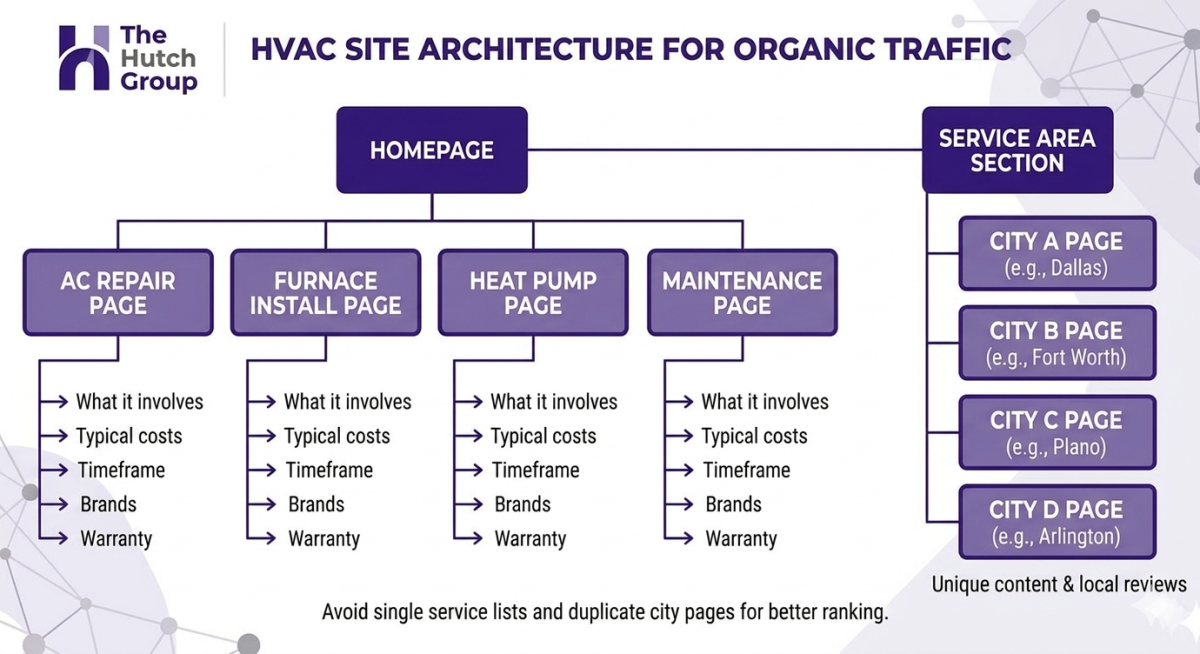
A single Services page listing AC repair, furnace installation, ductwork, heat pumps, indoor air quality, and maintenance plans will rank for approximately none of those things. Google needs a page that is clearly about one topic to rank it for that topic, and a searcher looking for “heat pump replacement” wants to land somewhere that talks about heat pump replacement.
Give each core service its own page with real content on it. Not 200 words of filler. What the job involves, what it typically costs in your market, how long it takes, what brands you work with, what the warranty covers.
The same logic extends to your service area, with a caveat. City pages work when they’re genuinely different from each other, built around jobs you’ve actually done in that town and reviews from people who live there. Spinning up 40 near-identical city pages with the town name swapped is the tactic that gets sites filtered out of local results, and we still find it on inherited sites regularly.
Proof beats polish, and it’s cheaper
The trust elements that actually change behavior on contractor sites are unglamorous.
Your Google review rating and count, pulled live rather than screenshotted a year ago. Your license number in the footer. Manufacturer certifications, because “Carrier Factory Authorized Dealer” carries weight with the exact homeowner comparing three quotes. Financing options, since a $9,000 system replacement is a financing decision as much as a contractor decision. Real photos of your actual crew and actual trucks.
That last one is worth more than it sounds. A homeowner deciding who to let into their house responds to seeing the people who’ll show up. Stock photography quietly signals the opposite.
Ask for less on the form
Every field you add costs you submissions. On home services forms, name, phone, ZIP, and a short “what’s going on” box is usually enough. You can qualify on the phone call, which you’re going to make anyway.
Two specific things we see going wrong. Required email fields on emergency service forms, when the person wants a callback in ten minutes and doesn’t care about email. And “preferred appointment time” dropdowns that make someone plan their week before they’ve talked to anybody.
Also, please test your forms after every site change. We have audited accounts where a form had been silently failing to deliver for weeks. The ads kept spending the whole time.
Build for the tracking you’ll want six months from now
Most HVAC sites get built, launched, and only then does somebody ask how many leads are coming from where. By that point you’ve lost the baseline.
Set it up during the build. Call tracking with dynamic number insertion so you can tell an organic call from a paid one. Form submissions firing as real GA4 events. Conversion actions wired into Google Ads before a single dollar runs, not after.
This is the part that lets you answer the only question that matters, which is which marketing dollar produced which booked job. It’s also the part everyone skips because nothing about it is visible on the finished site.
What HVAC website design costs, and what actually drives the number
Template-based builds land somewhere around $2,500 to $6,000 in most markets we work in. A custom WordPress build for an established contractor usually runs $8,000 to $20,000. Multi-location companies go up from there.
The variable that moves the price most isn’t design. It’s content and page count. A 12-page site with real service pages and photography from an actual shoot costs meaningfully more than a 5-page template. It’s also the version that ranks. [INTERNAL LINK: a line-by-line breakdown of what a website costs → /blog/how-much-does-a-website-cost]
Be careful with the free website bundled into a marketing retainer. You usually don’t own it, and leaving means starting over.
Steal this before your next redesign
Open your site on your phone right now and run through it.
Can you tap a phone number without scrolling? Does the page name your service area in text? Does it load in under three seconds on cell data? Does AC repair have its own page? Is your Google rating visible? Does your contact form ask for five things or eleven? Would you know, today, how many calls came from organic search last month?
If more than two of those are no, you don’t need a redesign. You need those seven fixes, and most of them are a week of work rather than a quarter.
Then go look at what your best-ranking local competitor is doing on the same list. That comparison tells you more than any gallery of award-winning HVAC websites will.
