
An HVAC company in the Southeast came to us last spring spending $2,800 a month on Facebook lead ads. They were getting 47 leads a month. They were also getting roughly two paying jobs a month from those leads. Cost per booked job worked out to over $1,400. By August, same budget, same platform, we had them at 23 leads a month and eleven booked jobs. Cost per booked job, $254.
The leads went down. The revenue went up. Here’s what changed, and what you can steal if your Facebook lead ads are producing the same kind of junk most service businesses get.
The reason most lead ads generate junk
Facebook lead ads work like this. Someone scrolling Instagram or Facebook taps your ad, a form pops up pre-filled with their name, email, and phone, and they hit submit. The whole thing takes about four seconds. That’s the appeal. That’s also exactly the problem.
Friction filters out unserious buyers. Lead ads remove almost all of it. You end up with four-second-old “leads” who don’t remember submitting and don’t want to pick up the phone when you call back. The HVAC client we mentioned was getting 47 of these a month. About 35 of them never answered the callback. Of the dozen who did, two booked.
If you’re seeing the same pattern, the answer isn’t to abandon lead ads. It’s to add the friction back in the right places.
The form questions that filter
The default Facebook lead form asks for name, email, and phone. That’s it. We rebuilt the HVAC client’s form with three additions, none of them long enough to scare off a real prospect.
A multiple-choice question on what they actually need (“system replacement”, “repair on existing unit”, “tune-up”, “not sure yet”). A free-text “what’s going on with your system?” field with a placeholder example. A multiple-choice on timing (“ASAP / today”, “this week”, “this month”, “just researching”).
Two things happen when you add these. First, the form takes 25 to 40 seconds to fill out instead of four. Tire-kickers bounce. Second, when a real lead comes through, your team already knows what they need and how urgently they want it. The first callback can be specific and useful instead of “hi, you filled out a form?”
Volume drops. We saw the HVAC client’s lead count fall from 47 to about 28 in the first two weeks. Cost per lead actually went up. Cost per booked job went down by more than half within six weeks. The economics are what matter, not the lead count.
Stop targeting “interests”
Most service business owners building a Facebook campaign reach for detailed targeting. They pick “interested in HVAC” or “interested in home improvement” thinking they’re being precise. They’re not. Meta’s interest categories are murky. Half the people listed under “home improvement” haven’t owned a home in years.
For the HVAC client we used a much broader audience. Geographic radius around the service area, age 30 to 65, that’s it. We let Meta’s algorithm find the buyers using the conversion signal from the form (specifically, leads that triggered the longer-form questions). After about three weeks of learning, the algorithm was finding genuinely better prospects than detailed targeting ever had.
This is counterintuitive if you’ve been running ads since 2019, when narrow targeting was the move. Apple’s privacy changes cratered Meta’s ability to do detailed audience matching, and the response from Meta’s side has been a smarter optimization layer that works best when you give it room. Trust the conversion signal, not your assumptions about who the buyer is.
Creative carried the campaign
Stock photos of smiling technicians don’t work. We tried. The HVAC client’s first round of creative was glossy product shots and lifestyle imagery. Cost per lead was around $59. Click-through rate was a quarter of a percent.
We replaced everything with three types of native-looking content. Phone-shot videos of a real tech walking around a unit explaining what was wrong. A simple Canva graphic with a clear before/after on a home utility bill. A cold-open Reel that started “if your AC sounds like this, your fan motor is going.” That last one ran for four months. Cost per lead under $20 the whole time.
Service businesses underestimate how much of Facebook ad performance is the creative. You can have perfect targeting and a perfect form and burn money if the ad itself looks like a billboard. It needs to look like something you’d see from a friend.
The five-minute callback rule
Here’s the part most agencies skip and most service businesses bungle. Facebook lead ads die without speed. The Lead Response Management Study from Inside Sales found that contacting a lead inside five minutes makes them 100 times more likely to be reached, and 21 times more likely to convert, than contacting them after thirty minutes. Twenty-one times.
The HVAC client’s leads were sitting in a Gmail inbox that the office manager checked twice a day. By the time anyone called, the lead had moved on, called three competitors, or forgotten they ever filled out a form. We routed the leads through Zapier into their CRM (CallRail), which auto-dialed the lead within sixty seconds and texted them too if no one picked up.
Booking rate doubled inside three weeks. Same leads, same form. Just speed.
If your team can’t answer a phone in five minutes during business hours, you have two options. Build a system that does it for them (auto-text with a “we got your request, calling you in 90 seconds” message buys you a few minutes), or pause the campaign during hours you can’t respond. Running lead ads while no one’s available to call is setting money on fire.
Send the real outcome back to Meta
Here’s what the HVAC team also wasn’t doing. Tracking what happened to leads after the call. They knew leads came in. They had no idea which ones turned into jobs, which were duplicates, which were existing customers, which were spam.
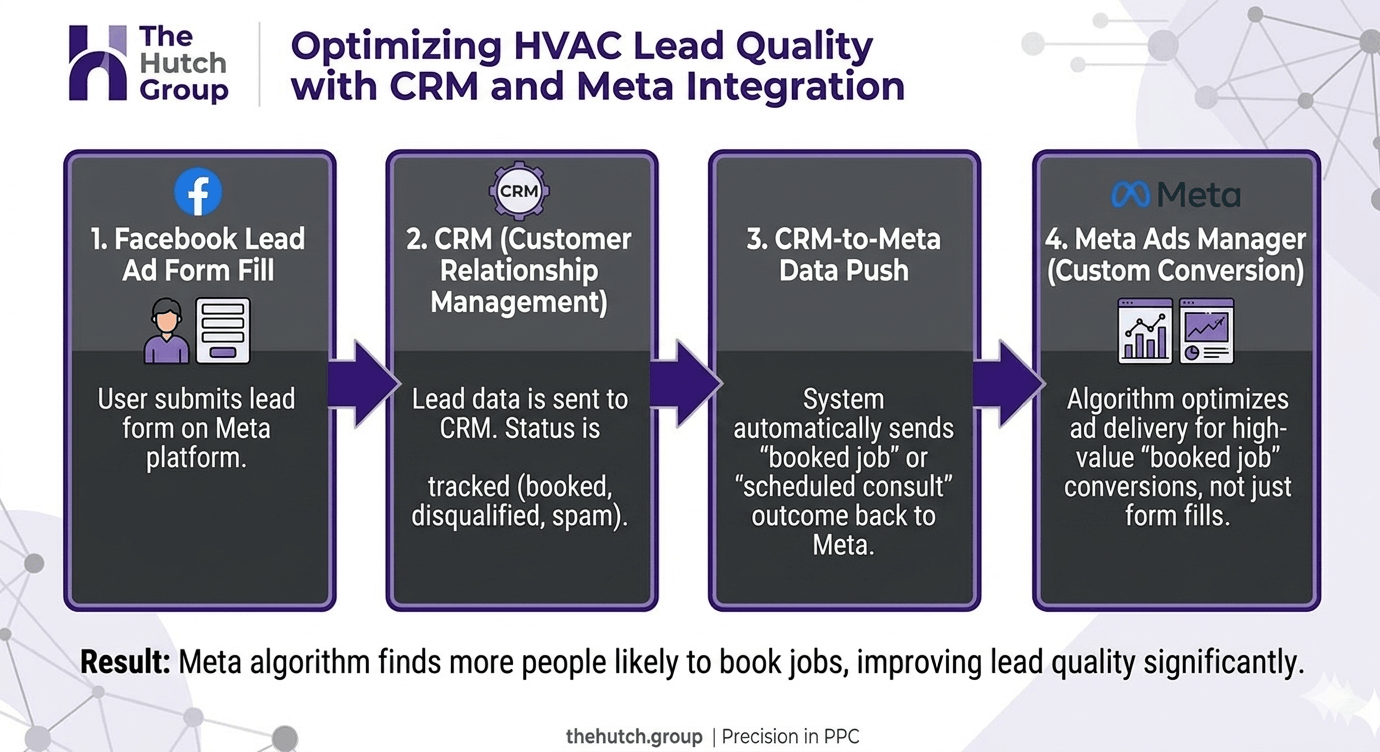
We hooked the form into their CRM with custom fields for booked, not booked, disqualified, and spam. Then we sent the booked-status data back to Meta as a custom conversion. Within thirty days, the algorithm was optimizing for “people who actually book”, not “people who fill out forms.” Lead quality went up another notch without us touching anything else.
This is the move almost no service business does. They send leads to Meta’s standard “lead” event and let the algorithm optimize for form fills, which is why the form fills are junk. Send the real outcome (closed jobs or scheduled consults) and Meta will find more of those people.
When lead ads aren’t the right tool
Lead ads are great for high-intent, low-consideration services where speed wins. HVAC repair, plumbing emergencies, urgent legal questions, dental pain. They’re not great for high-consideration services where the buyer needs to research first.
If you sell something where the buyer needs to compare options and read reviews before deciding, send them to a real landing page instead. Roofing replacements, $50K legal cases, elective surgery, custom remodels. Lead ads compress the decision-making window in a way that hurts you here. The buyer doesn’t get the time to convince themselves you’re the right call, so the booked rate stays low even if you fix everything else.
Quick test. If your average sales cycle from first contact to closed deal is more than two weeks, lead ads are probably not your best Facebook play. Run conversion ads to a real landing page with case studies and reviews instead.
What we’d try first if it were our account
If you’re running Facebook lead ads right now and they’re producing junk, here’s the order we’d attack it.
Add three qualifying questions to the lead form. Multiple-choice on what they need, free-text on the situation, multiple-choice on timing. Volume drops. Quality climbs. Do this even before you touch creative.
Set up an automated five-minute response. Zapier or Make connecting Facebook to your CRM, with auto-text and (if your team is small) auto-dial. Lead-to-call connection rate roughly doubles when you go from “twenty minute callback” to “two minute callback”.
Replace your stock-photo creative with phone-shot video and native-looking graphics. One Reel of your tech doing the work beats five glossy ads of generic happy customers.
Send booked jobs back to Meta as a custom conversion event. Stop optimizing for form fills. Optimize for the outcome you actually care about.
If you do all four of these and your Facebook lead ads are still producing junk, the platform genuinely isn’t right for your service. That’s worth knowing too.
The HVAC client’s account wasn’t fixed by clever bidding strategy or audience hacks. It was fixed by treating the lead ad like a sales tool and not like a vending machine. The ad delivers a person who’s mildly curious. Everything else, the form, the speed, the creative, the conversion signal, decides whether that person becomes a job.
What’s the first one of these you can try this week?
