
Search “ai for small business marketing” and you’ll get the same answer forty times over. A list of tools. Twenty-two of them, ranked, with a logo grid and an affiliate link under each one. We’ve read those posts too. The problem is that a tool list is the last thing a busy service business owner needs, and handing you one first is how most of this advice fails you before you’ve even started.
We run paid and organic campaigns for home services, legal, and healthcare businesses every day, and we use AI constantly to do it. So this isn’t an anti-AI post. It’s a post about where AI actually earns its keep for a small business, where it quietly wastes your afternoon, and the two or three places it can genuinely hurt you if you’re not careful.

The tool list is the wrong place to start
Here’s what happens when you start with tools. You sign up for six free trials in a weekend, you generate a pile of content you never publish, and three weeks later you’re paying for two subscriptions you forgot you had. Nothing about your actual marketing changed. Your phone isn’t ringing more.
That’s because the tool was never the constraint. Your time was. Or your ad budget. Or the fact that leads sit in your inbox for six hours before anyone replies. AI is good at exactly one thing for a small business, and it’s not “doing marketing.” It’s taking a task you already do and making it faster or cheaper. Start from the task. The tool is a detail you sort out at the end.
So before you compare a single AI marketing tool, do the boring thing. Write down the five marketing jobs that eat the most hours in your week. That list is your real starting point.
Start with the tasks that steal your week
For most of the service businesses we work with, the same handful of jobs show up on that list. Content nobody has time to write. Reviews that go unanswered. Ad copy that hasn’t changed in a year. Leads that don’t get called back fast enough. Google Business Profile posts that were supposed to be weekly and are now quarterly.
AI can put a real dent in every one of those. Here’s how we actually use it, and roughly what it’s worth.
First drafts, not final drafts
The single highest-value use of AI in marketing for a small business is killing the blank page. A blog post, a service page, an email to past customers, a set of GBP posts for the month. AI gets you to a rough draft in minutes instead of staring at a cursor for an hour.
The catch, and it’s a big one, is that a rough draft is all you’re getting. We’ll come back to why publishing raw AI output is a mistake later in this post. For now, treat it as a very fast intern who has never seen your business. Useful. Not trustworthy on its own.
Responding to reviews
If you get more than a few reviews a month and you’re answering each one from scratch, AI can cut that time by more than half. Feed it the review, tell it your tone, and it drafts a reply you edit and post. A roofing client of ours went from ignoring reviews entirely to responding to every one within a day, mostly because the friction dropped to almost nothing. Review response rate is a real local SEO signal, so this one pays off twice.
Ad copy variations
This is where AI marketing tools for small business owners quietly shine. Google Ads and Meta both reward you for feeding them more creative to test. Writing ten headline variations by hand is tedious. AI spits out thirty in a minute, you cull the weak ones, and you keep the four or five that don’t sound like a robot wrote them. We do this weekly across accounts, and it’s genuinely faster than the old way.
Speed to lead
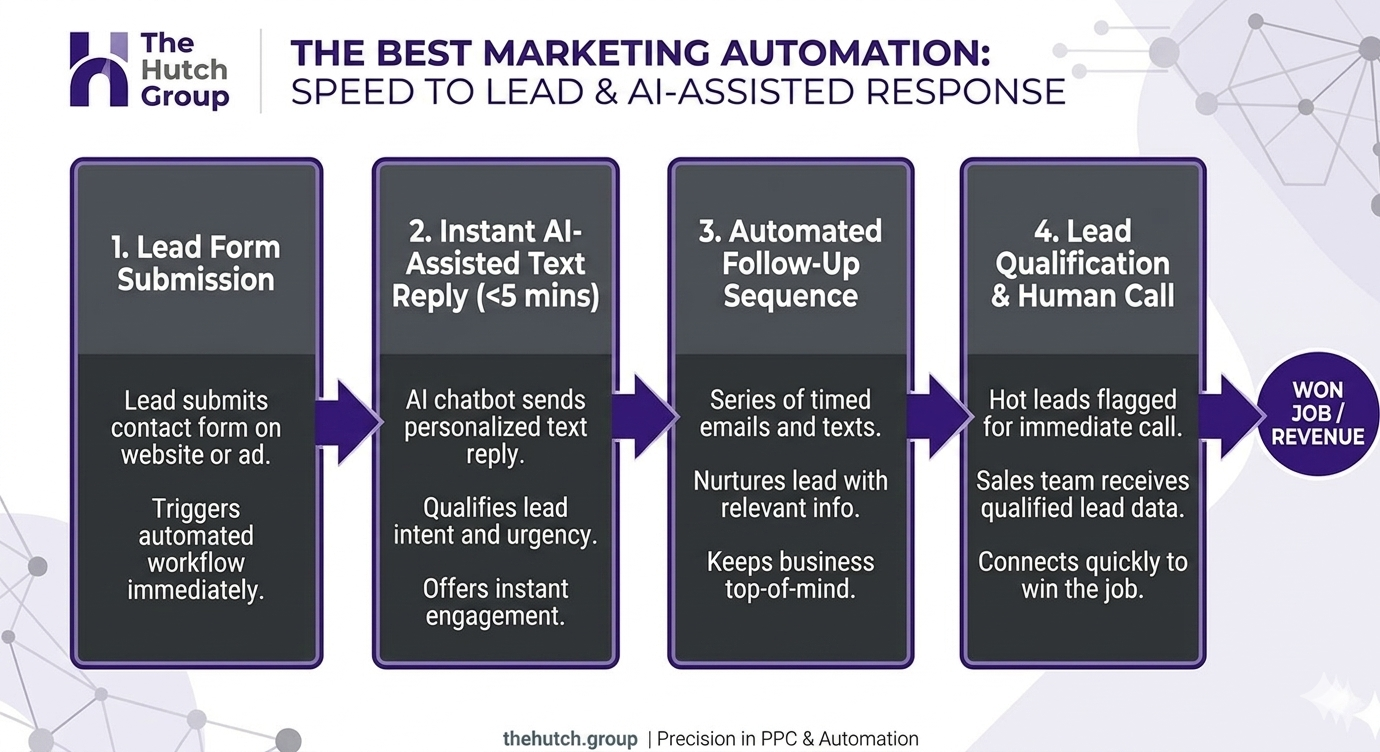
The best marketing automation you can set up has nothing to do with content. It’s making sure a new lead gets a response in under five minutes instead of five hours. AI-assisted auto-replies, chat widgets that qualify a lead before you pick up the phone, follow-up sequences that fire on their own. For a home services business where the first company to call back usually wins the job, this is worth more than any blog post you’ll ever publish.
The three things you should not hand to AI
Now the honest part, because most of these posts skip it.
There are places where reaching for AI creates risk that’s much bigger than the time you saved. If you run a healthcare practice, anything touching patient information runs straight into HIPAA. Most consumer AI tools are not set up for protected health information, and pasting a patient’s details into a chat window to draft a “personalized” follow-up is the kind of shortcut that gets a practice in real trouble. Legal is its own minefield. Attorney advertising rules vary by state, and AI does not know or care what your bar association allows. An AI-written ad that promises a result can cost you far more than it saved.
And then there’s the quieter risk that applies to everyone. Your customers can tell. A 2026 Forbes piece put a number on the gap most owners feel in their gut: small businesses trust AI with their marketing far more than their customers trust receiving it. Generic AI content reads as generic, and generic is the opposite of what a local service business sells. People hire the plumber, the lawyer, the dentist they believe is real and reachable. Flood your site and your emails with obvious AI filler and you erode the exact thing that made a local business worth choosing.
So keep three things human, or at least heavily human-edited. Anything with compliance exposure. Your actual brand voice on your core pages. And anything a customer will read one-to-one and expect to be personal.
How to use AI in marketing without sounding like AI
The fix here is simple and it’s the thing almost nobody does. Edit. Hard.
Take the AI draft and cut it by a third. Delete the throat-clearing opening sentence, the tidy summary at the end, and every phrase that could describe any business on earth. Add one specific detail only you would know. The neighborhood you serve, the price you actually charge, the mistake you see customers make. That single specific detail does more for trust than the whole polished draft it’s buried in.
Read it out loud before it goes live. If it sounds like a press release, it’s not done. If it sounds like you explaining something to a customer across the counter, ship it. This is the difference between AI that helps your marketing and AI that dilutes it, and it takes about five minutes per piece.
A realistic starter stack
Fine. You made your task list, you know what to keep human, and now you actually want to know which tools. Here’s the honest version, and it’s shorter than twenty-two.
You almost certainly already have most of what you need. A general assistant like ChatGPT, Claude, or Gemini covers first drafts, ad copy variations, and review replies for the vast majority of small businesses. That’s your workhorse and it’s a few dollars a month. For social scheduling with AI captions, the tool you already use to post probably added an AI feature this year. For the best AI tools for marketing that go deeper, the paid platforms mostly make sense once you’ve outgrown doing things by hand, not before.
The one place we tell clients to spend real money earlier is AI marketing automation tied to lead response. A CRM or lead tool that texts a new lead instantly and keeps following up will out-earn a stack of content tools every time for a service business. If you buy one paid thing this quarter, buy the thing that shortens the gap between “lead comes in” and “lead hears from you.”
Whatever you pick, tie it back to a number. We attribute every marketing dollar we manage to actual revenue, and AI tools deserve the same scrutiny. If a tool isn’t saving you measurable hours or producing leads you can trace, cancel it.
The one line to remember
Next time someone hands you a ranked list of twenty-two AI marketing tools, close the tab. Pull up your calendar instead and find the marketing work that’s actually falling through the cracks. AI for small business marketing works when it removes a specific bottleneck you can name. It fails when it becomes one more subscription and one more thing to manage.
Pick the single task that annoyed you most this week. Try AI on that one, edit the output like you mean it, and see if it gives you an hour back. If it does, add a second task next month. That’s the whole strategy.
If you want a second set of eyes on where AI actually fits in your marketing (and where it’s quietly costing you), we’re happy to take a look. No pitch.
