
Search “how much do Facebook ads cost” and you’ll get a tidy number back. Something like a dollar per click, or seven dollars per thousand impressions. Every agency blog and stat roundup quotes some version of it. We’ve managed Meta campaigns for home service companies, law firms, and healthcare practices for years, and that number will tell you almost nothing about what your ads will actually cost you.
Here’s the problem with the neat answer. Those averages get pulled from ecommerce advertisers, app installs, and national brands running massive budgets. You’re a roofer, a personal injury firm, a dental practice. Your math is different, your goal is different, and the cost that matters to you isn’t the one being reported.
So let’s throw out the average and talk about what a Facebook ad really costs a service business, and what makes that cost go up or down.
The number you were quoted online is basically useless
The most commonly cited “Facebook ads cost” figure is cost per click, usually somewhere between $0.50 and $2.00. It’s a real metric. It’s just the wrong one to build a decision on.
Think about what a click actually buys you. Someone tapped your ad. That’s it. They might read your page and leave. They might fill out a form. They might be a competitor being nosy. A cheap click on a bad audience with a weak offer is more expensive than an expensive click that turns into a booked job, because you paid money and got nothing back.
We’ve watched businesses celebrate a $0.40 cost per click and quietly lose money for three months. And we’ve had clients pay $3 a click on a tightly targeted campaign and book more work than they could handle. The click price told you the wrong story both times.
That’s why “how much are Facebook ads” is a question with no useful single answer. The honest version is “it depends,” and the rest of this post is the part where we make “it depends” specific enough to act on.
So what does a Facebook ad actually cost?
Fine, you want ranges. Here are the ones that hold up for local service businesses in the US, based on what we see across accounts.
Cost per thousand impressions (CPM) usually lands between $8 and $20 for local audiences. Cost per click runs roughly $0.70 to $3.00 depending on your industry and how good your creative is. Legal and healthcare sit at the high end because the audiences are competitive and expensive. Home services tend to run cheaper on the click, though not always on the lead.
But the number to build a budget around is cost per lead. For most local service businesses we work with, a qualified lead from Meta costs somewhere between $15 and $90. A plumber might pull leads at $20. A personal injury firm chasing signed cases might pay $150 or more per lead and still come out far ahead, because one case can be worth tens of thousands.
Notice how wide that range is. Same platform, same ad tools, a 7x spread in what a lead costs. The platform isn’t the variable. Everything you bring to it is.
Cost per lead is the number that matters
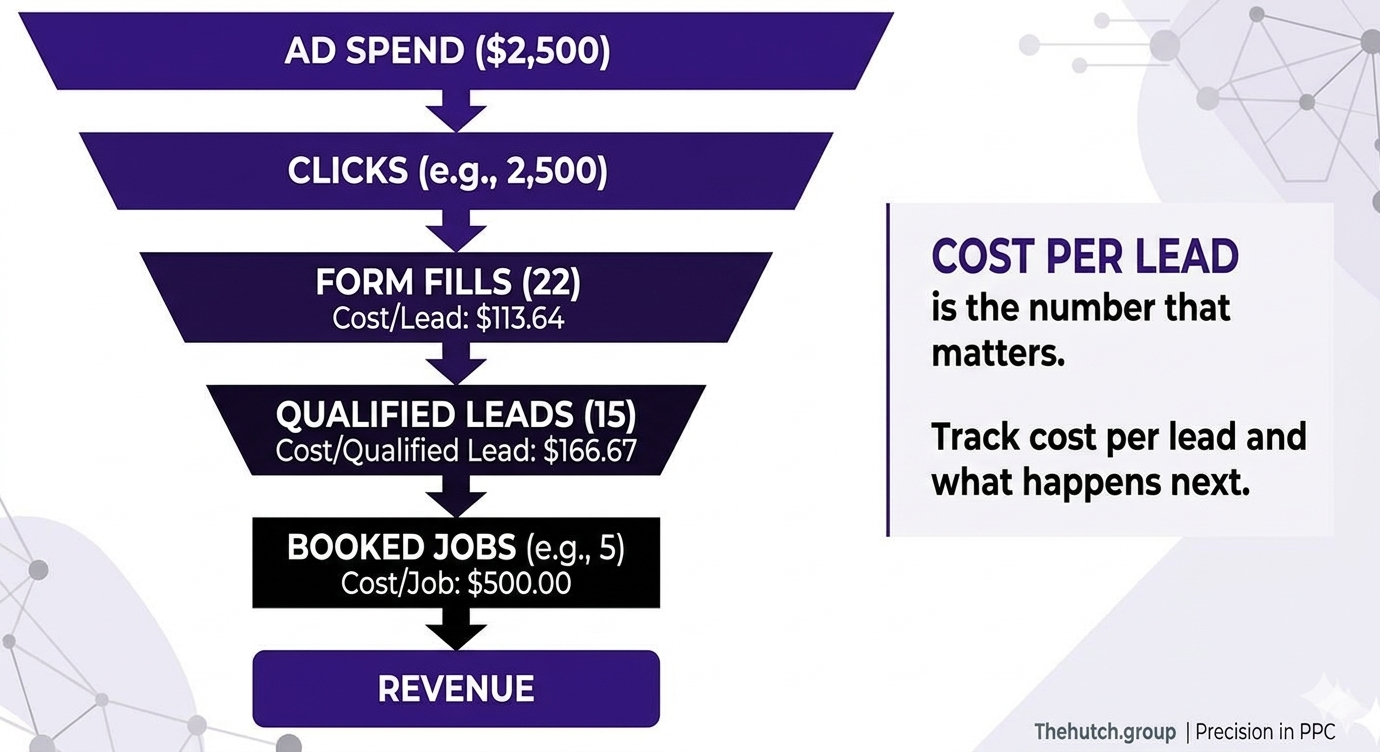
If you only track one thing, track cost per lead, and then track what happens to those leads after.
Here’s a real pattern, anonymized. A remodeling company came to us spending about $2,500 a month on Meta and generating around 30 form fills. On paper that’s a great cost per lead, roughly $80. The catch was that most of those form fills were junk. Tire kickers, wrong service area, people who wanted a $500 job the company didn’t take. Of 30 “leads,” maybe 6 were real.
Their true cost per qualified lead was over $400, and nobody had done that math.
We tightened the audience, rewrote the offer to filter out the bargain hunters, and added better tracking so we could see which ads produced actual booked estimates instead of form submissions. Spend stayed flat. Form fills dropped to 22. Qualified leads went from 6 to 15. The cost per real lead fell from $400-plus to about $165, and the company could finally tell whether the ads were making money.
That last part is the whole game. Once you can tie ad spend to booked revenue, “how much do Facebook ads cost” stops being scary and becomes a math problem.
Is $5 a day enough? Is $500 a month?
These two questions come up constantly, so here are direct answers.
Five dollars a day (about $150 a month) is enough to test a single ad to a single audience with a single offer. It is not enough to run a real lead-generation program. At that budget, Meta’s algorithm barely has room to learn who converts, and you’ll get thin, slow, inconsistent results. Use it to validate that an offer resonates, not to fill your calendar.
Is $500 a month enough? For a lot of local service businesses, that’s the practical floor for a campaign that can actually optimize. It won’t make you the biggest advertiser in your market, but it gives the algorithm enough conversions to find a pattern. If your average job is worth a few hundred dollars or more, $500 to $1,500 a month is a reasonable starting range, and you scale up once the cost per qualified lead proves out.
Below roughly $500 a month, we usually tell people to fix their Google Business Profile and referral engine first, then come back to paid social once there’s budget to run it properly. Spreading $200 across Meta rarely beats putting that effort somewhere with less overhead.
Four things that actually move your cost up or down
The platform sets the auction. You control almost everything that decides where you land in it. Four levers matter most.
Your offer does the heaviest lifting. “Free inspection” pulls leads at a completely different cost than “call for a quote.” A specific, low-friction offer can cut your cost per lead in half without touching anything else.
Your creative is next. A native-looking video or a real photo of your actual crew beats a stock image and a logo almost every time. Weak creative drives your click cost up because Meta charges more to show ads people ignore. Good creative is the cheapest cost reduction available to you.
Audience targeting is the third lever, and the trap here is going too narrow. For local service businesses, a broad radius around your service area with a strong offer usually beats a hyper-specific interest stack. Let the offer and the creative do the filtering.
The fourth is competition and season, which you don’t control but should plan for. HVAC costs spike in the first heat wave. Roofing climbs after storms. Legal stays expensive year round. If you know your busy season, budget for the auction to get pricier right when demand peaks.
Where service businesses quietly waste money
A few mistakes show up over and over, and every one of them inflates what your ads “cost” without you seeing why.
Running traffic campaigns instead of lead or conversion campaigns is the big one. Meta will happily send you cheap clicks if you ask for clicks. Ask for leads. The objective you pick changes who the algorithm shows your ad to, and it’s the difference between busywork and booked jobs.
Boosting posts is another money pit. The boost button is not the same tool as a real campaign in Ads Manager, and it gives you a fraction of the targeting and reporting. It feels cheap because the entry price is low. It’s expensive per actual result.
The last one is invisible, and it’s the worst. No conversion tracking. If you can’t see which ad produced which lead, you’re optimizing blind and Meta is optimizing for whatever’s easiest, not whatever makes you money. Getting the pixel and lead events set up correctly is unglamorous and it’s usually the single highest-return hour of work on the whole account. The same principle carried our approach in Facebook ads for small business.
Are Facebook ads worth it for your business?
Honest answer: sometimes not, and we’ll say so.
If your service is something people search for the moment they need it, like an emergency plumber or a lawyer after an accident, Google Ads or Local Services Ads often deserve your first dollar, because you’re catching demand that already exists. Meta is better at creating demand and staying in front of people before they’re ready. For a lot of service businesses the right answer is both, in sequence, not one instead of the other.
Facebook ads are worth it when three conditions line up. You have a clear offer, you can handle the leads when they come, and you can track what happens after the click. Miss any of those and the platform will still take your money, it just won’t give you much back.
If you’ve got all three and you’re still not sure, run a small test. Five hundred dollars over a month, one solid offer, proper conversion tracking, and look at cost per qualified lead, not cost per click. That single test will tell you more than any average you’ll ever read online, including this one.
If you only remember one thing from this post, make it this. Stop asking what a click costs and start asking what a booked customer costs. That number is the only one that decides whether Facebook ads are cheap or expensive for you.
Want a second set of eyes on your Meta account or your tracking setup? We’re happy to take a look. No pitch.
