
We talk to lawyers about local SEO almost every week. Personal injury, family law, criminal defense, estate planning. Different practice areas, same questions. Most of them have been pitched by three agencies already, and most of those pitches sounded like a Mad Lib of citations, GBP posts, and “high-DA backlinks.” If you’re skeptical, you should be. A lot of law firm local SEO is theatre.
But local SEO isn’t a scam. It just gets sold badly. So we put together the questions we hear most often from lawyers, and answered them the way we’d answer them on a discovery call.
Is local SEO actually worth doing for a small law firm?
Short answer, yes. For most practice areas. A bit complicated for some.
The reason is geographic intent. When someone types “personal injury attorney near me” or “divorce lawyer Atlanta,” Google shows local pack results before organic blue links. If your firm isn’t in that three-pack, you’re invisible to the highest-intent searches in your market. That’s not a vanity problem. That’s a pipeline problem.
The complication is practice area. A boutique appellate firm doing federal work doesn’t live in the local pack. Neither does a high-end M&A practice. For those, search behavior is referral-driven and content-driven, and local SEO is a lower priority than authoritative content and brand SEO. But if you handle anything where a normal person Googles “lawyer near me” before calling, local SEO sits at or near the top of the marketing list.
Here’s the honest framing. Local SEO for law firms is one of the highest-ROI channels available, but only if you also run paid search alongside it. The local pack and the paid ads at the top of the page work together. Treating them as separate budgets is one of the most common mistakes we see.
How much should I spend on local SEO, and where does the money go?
For a small firm, $1,500 to $4,000 per month is the realistic range to do this well. Below $1,500 you’re paying for someone to manage a Google Business Profile and not much else. Above $4,000 you’re either in a brutally competitive PI market or your agency is padding.
Here’s where the money actually goes, when it’s done right.
- Google Business Profile work. Real GBP work is weekly, not monthly. Photo uploads, Q&A monitoring, post scheduling, review responses, category audits, service area updates, and watching for suspicious edits or competitor reports. Most firms get GBP “managed” once a month, which is almost the same as not managed.
- On-page SEO for practice area and location pages. Title tags, schema, internal linking structure, content depth on each service-and-city page. This is usually the work that produces the most measurable ranking movement.
- Local citations and directory cleanup. Real cleanup, not “submitting to 200 directories.” Auditing your existing listings for inconsistent name, address, phone (NAP), fixing the broken ones, and adding citations on the high-quality legal directories that actually carry weight (Justia, Avvo, FindLaw, Martindale, Super Lawyers, state bar listings).
- Reviews. A reliable system for asking the right clients at the right time, and responding to every review in a way that doesn’t violate ABA rules.
- Local content. Practice-area-specific blog posts that target the questions clients actually search for. Not “Top 10 Tips for Hiring a Divorce Lawyer.” More like “How Long Does an Uncontested Divorce Take in Fulton County?”
If your invoice doesn’t break out roughly along those lines, ask where the money is going. A reasonable agency will tell you.
What’s the difference between my Google Business Profile and my website ranking?
A lot of lawyers are confused about this, and it matters because the two have different levers.
Your Google Business Profile is what controls your appearance in the local pack (the map results with three businesses) and on Google Maps. Ranking factors are heavily proximity-based, GBP-specific signals (categories, reviews, photos, posts, hours), and your linked website’s quality.
Your website organic ranking is what controls your appearance in the regular blue-link results below the local pack. Different ranking signals matter there. Content depth, backlinks, technical SEO, internal linking, search intent matching.
You need both. Local pack visibility gets you in front of “find me a lawyer right now” searchers. Organic ranking gets you in front of researchers, comparison shoppers, and people two or three clicks deeper into their decision. The work overlaps but isn’t identical. An agency that only focuses on one side is leaving half the pipeline on the table.
Why are directories ranking above my firm’s site, and should I care?
The first time a lawyer notices this, it stings. You search your own name or your firm’s name and Justia, Avvo, and FindLaw rank above your own site.
Yes, that’s annoying. No, it’s not a disaster. Those directories have domain authority in the 80s and 90s, decades of backlinks, and SEO teams larger than your entire firm. You’re not going to outrank Justia for “personal injury lawyer Houston” by next quarter no matter what an agency promises.
The play is to make those directory listings work for you instead of against you. Claim every profile. Fill them out completely. Get reviews on the ones that allow them. Add detailed practice area descriptions. Link them back to your site. A well-optimized Avvo profile or Super Lawyers listing is a referral funnel, not a competitor. Treat it that way.
The directories you should genuinely worry about are the spammy ones. If you see “Top10AttorneysNear.com” outranking you, that’s an authority gap on your own domain, and that’s the actual problem to solve, not the directory itself.
How long until I see results, and when should I fire my SEO agency?
The honest timeline.
- Months 1-2: Almost no measurable ranking change. The agency is doing audits, fixing technical issues, cleaning up citations, and getting GBP up to standard. If you’re seeing ranking jumps in week one, something is either being faked or being done in a way that will bite you later.
- Months 3-4: First real movement. Long-tail keywords and lower-competition local queries start to show up. Calls and form fills usually tick up here, even if vanity ranking metrics don’t.
- Months 6-9: The big keywords start moving if the foundation work was done right. This is also where you can fairly evaluate the agency.
- Months 12+: Compounding. Each new piece of content and each new citation builds on the existing authority. This is when the channel gets cheap.
When should you fire them? If month six rolls around and you can’t see any of the following, get out.
- Ranking improvements on at least some non-branded keywords.
- A meaningful change in the volume or quality of qualified leads.
- A monthly report that talks about what they did, what changed, and what’s next, rather than just listing positions.
- Responsive communication when you have a question.
We’ve seen a lot of firms hold on to a bad agency for eighteen months because they keep being told “SEO takes time.” It does. But there’s a difference between SEO taking time and an agency burning your retainer.
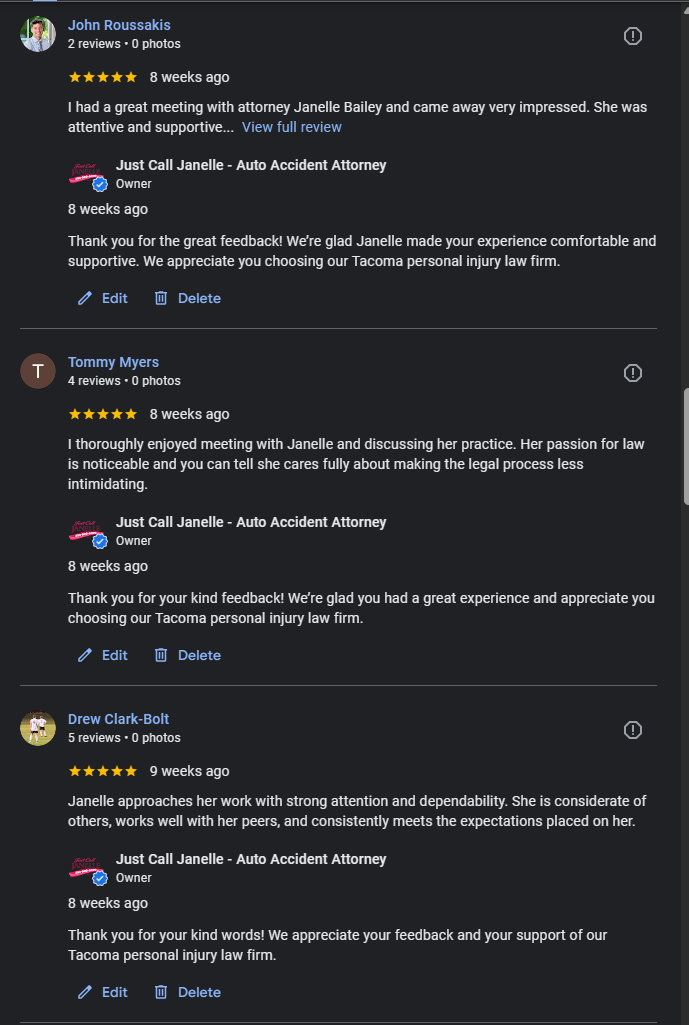
What about reviews? Are they really worth the trouble of asking?
Reviews are probably the single highest-impact thing most law firms ignore.
Volume and recency both matter. A firm with 200 reviews from the last three years outranks a firm with 60 reviews from five years ago, even with everything else equal. Review velocity (new reviews coming in regularly) is itself a ranking signal in the local pack.
The trouble is the ethics. The ABA Model Rules and most state bar rules prohibit incentivizing reviews and have specific language about endorsements and testimonials. We’ve seen firms get into trouble for offering a “thank you gift card” to clients who leave reviews. Don’t do that. The play is simpler.
Build a habit. At case conclusion, when a client expresses gratitude, the intake coordinator or attorney sends a follow-up email with a direct link to the firm’s Google review page. No incentive. No coaching. Just a soft ask. The clients who would naturally leave a positive review do. The clients who wouldn’t, don’t. That’s compliant, sustainable, and produces 10-20 reviews a month for an active firm.
Respond to every review. Positive ones get a short thank-you. Negative ones get a careful, ABA-compliant response that addresses the concern without confirming or denying any details that could violate confidentiality. (This is one of the hardest things to get right, and it’s worth running by a partner before posting.)
Do I need a separate page for every practice area and every city I serve?
The answer is usually yes for practice areas, sometimes for cities, and almost never for both at full scale.
Each practice area should have its own dedicated landing page. Personal injury, family law, criminal defense, estate planning, each gets its own URL with depth, FAQs, attorney credentials, and intent-matched content. Google needs a clear page to rank for each practice area query, and one general “Our Services” page won’t do that work.
City pages get trickier. The temptation is to spin up 40 city-and-practice combination pages (“Personal Injury Lawyer in Marietta,” “Personal Injury Lawyer in Sandy Springs,” and so on). If those pages all say the same thing with the city name swapped in, Google will treat them as doorway pages and either ignore them or hurt the site. We’ve seen firms tank their entire domain doing this.
The version that works is pickier. Pick the three to five cities or counties where you genuinely take cases. Build a real page for each one, with local context, courthouse information, attorney photos at recognizable locations, testimonials from clients in that area, and content that’s actually different per page. A page for each one done well beats forty thin pages done badly. Every single time.
What does ethical local SEO look like under the ABA rules?
This is the question that doesn’t get asked enough, and it’s the one that should.
A few rules to keep in mind, recognizing that state bar variations exist and your state’s specific rules govern.
- No false or misleading claims. “Best personal injury lawyer in Texas” is a problem. So is implying past results predict future outcomes. SEO copy on landing pages needs to be reviewed with the same care as TV advertising copy.
- No improperly handled testimonials. Most states allow client testimonials with disclaimers, but the specifics vary. Schema markup for reviews on your site needs to honor the same rules as the testimonials themselves.
- Specialization claims. In most states, you can’t call yourself a “specialist” in a practice area unless you’re certified by an approved board. SEO copy that uses “specialist” loosely is a real risk.
- Advertising disclaimers. “Advertising material” disclaimers may be required depending on the state and format. SEO-optimized landing pages count as advertising.
A good agency will know to ask about your state bar rules and adjust content accordingly. If they don’t bring it up, you have to. We’ve seen sites pulled into bar complaints because an SEO copywriter didn’t know what they didn’t know.
If you only remember one thing
The work that moves the needle for law firm local SEO isn’t exotic. Honest GBP management, real on-page work, careful review systems, and ethical content. It’s just rarely done well, because it’s slow and unglamorous, and because the agencies selling it have to make it sound more complicated than it is to justify the retainer.
If you want to know whether your current SEO is working, do this today. Open an incognito window. Search the two or three phrases you’d most want to rank for, with your city name added. Note where you appear in the local pack, and where you appear in the blue links. Do that again in 30 days. Do it again in 90. If the numbers haven’t moved in either direction, you have your answer.
