
Local SEO for Dentists: What Actually Moves the Needle in 2026
Our team reviewed the local SEO setup of 24 independent dental practices over the last six months. Some were already paying agencies. Some were doing it themselves. The split between the practices showing up in the local pack and the ones invisible on a “dentist near me” search came down to maybe five things, and most of them are not what dental marketing companies are selling on their pricing pages.
Local SEO for dentists is not a mystery. It is a stack of unglamorous fundamentals that almost nobody executes in the right order. Here is what we found, in order of how much it actually mattered.
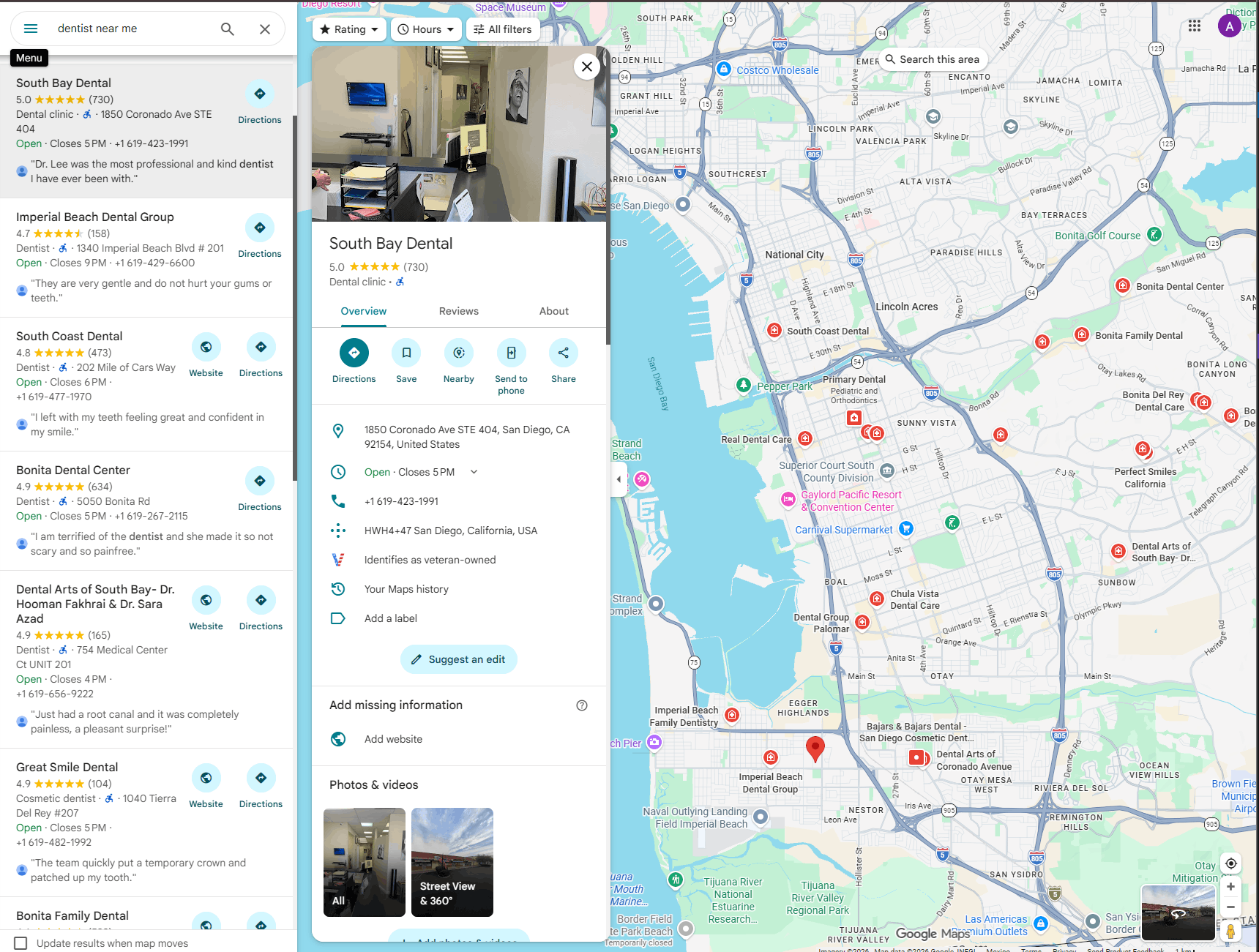
The Google Business Profile is 70% of the work (and most dentists treat it like a yellow pages listing)
If you only do one thing this year for your practice’s local visibility, it is fixing your Google Business Profile. Not your website. Not your blog. The profile.
Of the 24 practices we audited, 19 had at least one Google Business Profile problem big enough to be costing them rankings. The most common one was not what you would guess. It was not photos or hours or even reviews. It was the categories.
Categories matter more than they look
Google lets you pick a primary category and up to nine secondary categories on a Business Profile. The primary category is the heaviest ranking signal in the local pack. For a general dentist, “Dentist” is correct. For a practice that does mostly cosmetic or implants, “Cosmetic Dentist” or “Dental Implants Periodontist” might be a better primary, depending on what you actually want to rank for and what local competitors look like.
The mistake we see constantly: a practice picks “Dentist” as primary because it sounds right, then never adds the secondaries that signal their real services. Sedation dentistry, pediatric dentistry, orthodontics, emergency dental service. These are all separate categories Google offers, and each one helps you rank for queries that match it.
Open your profile. Look at your categories. If there are fewer than three, you are leaving rankings on the table.
Photos, posts, and the parts most dentists ignore
Photos are easy and most dentists upload three of them. Add 30. Real photos of the office, the team, the operatories, equipment. Avoid stock. Google can tell. So can patients.
Then there are Google Posts, which 90% of practices treat as if they don’t exist. A weekly post (even a short one) sends a freshness signal and shows up in your profile when someone clicks through. Practice updates, a new hygienist starting, a holiday schedule, a quick tip about cleanings before insurance year-end. None of it has to be heroic. It just has to be there.
Q&A is the other piece nobody runs. Patients ask questions on your profile. If you don’t answer them, a random person on the internet will, and Google will show their answer as a ranking factor. Go answer your own Q&A. Seed it with questions you wish patients would ask, like “Do you accept Delta Dental?” or “Do you take walk-in emergencies?”
Reviews don’t just build trust, they move the local pack
There are three review levers that move local rankings. The first is volume. The second is recency. The third is what is actually being said in those reviews. Most practices we audit are weak on at least two of them.
Most dental practices we see have one of two review situations. Either they have 40 reviews from 2019 with a 4.9 average and have not gotten a new one in eight months. Or they have 200 reviews and a 3.7 because nothing is being managed and the unhappy patients are louder than the happy ones. Both situations bleed rankings.
The fix is not complicated, but it has to be systematic. Every patient who leaves the office happy should get a review request within 24 hours. Text works better than email by a wide margin (we see roughly 5x the conversion). The link should go directly to your Google review page, not to a landing page that asks them to pick a platform first. Every step you add cuts your response rate in half.
A note for HIPAA. You cannot publicly respond to a review in a way that confirms someone is your patient or references their care. That sounds obvious until you read replies on dental practice profiles, where staff thank patients by name for a specific procedure. A safe response template is “Thanks for the kind words, we appreciate you,” or “We’re sorry to hear about your experience and would like to make this right. Please reach out to our office manager directly.” Generic, warm, never confirming the medical relationship.
A homepage and a contact page are not enough
When we audit a dental practice’s website, the first question we ask is how many service-specific pages exist. Often the answer is one or two. Sometimes it is zero, and the homepage is doing all the work for every search.
A practice that wants to rank for “Invisalign [city]” needs an actual Invisalign page. Not a paragraph on the homepage. Not a section under “Services.” A standalone URL with maybe 700-1,200 words covering what Invisalign is, who it works for, what it costs at your practice, what the process looks like, FAQs, and photos of real cases (with patient permission). Then the same exercise for veneers, implants, sedation, emergency care, pediatric. Whatever your practice actually does.
This sounds like a content project, and it is. But it is also the highest-impact SEO work most dental practices can do. A single well-built service page can rank for 30-80 long-tail variations, all of which signal high commercial intent.
City pages work, if you actually serve the city
The temptation when a dental practice has one office in one city is to spin up pages for every surrounding suburb. “Dentist in [Suburb 1],” “Dentist in [Suburb 2],” and so on. Sometimes it works. More often it gets the site filtered by Google as doorway content, especially if every page is the same template with the city name swapped in.
Here is the test. If a patient drove from that suburb to your office, would the experience be different in any meaningful way? Different parking, different highway exit, different demographic mix, different insurance landscape? If the answer is yes and you can write 600+ words of unique content for that page, build it. If the answer is no, skip it. A few well-built city pages beat 15 thin ones.
Schema markup is still doing real work
Schema is the invisible markup that tells Google what kind of business you are, what you offer, and what your reviews look like. For dentists, the relevant types are LocalBusiness, Dentist (a subtype), and FAQPage if you have an FAQ section.
Most WordPress sites running a dental theme have some schema by default, but it is usually generic LocalBusiness with no Dentist subtype, no opening hours, no specific service offerings. Adding the Dentist type with proper service definitions is a one-time setup that takes a couple of hours and gives you eligibility for richer search results, including the price ranges and service tags that show up under your listing.
If you don’t know what your site has, run it through Google’s Rich Results Test. If it shows nothing, that is the project for next week.
{
  "@context": "https://schema.org",
  "@type": "Dentist",
  "name": "Bright Smile Dental Clinic",
  "description": "Comprehensive dental care including preventive, cosmetic, and restorative dentistry for the whole family.",
  "url": "https://www.brightsmileclinic.com",
  "logo": "https://www.brightsmileclinic.com/images/logo.png",
  "image": "https://www.brightsmileclinic.com/images/clinic.jpg",
  "telephone": "+1-555-123-4567",
  "email": "info@brightsmileclinic.com",
  "priceRange": "$$",
  "address": {
    "@type": "PostalAddress",
    "streetAddress": "123 Main Street, Suite 200",
    "addressLocality": "San Diego",
    "addressRegion": "CA",
    "postalCode": "92101",
    "addressCountry": "US"
  },
  "geo": {
    "@type": "GeoCoordinates",
    "latitude": 32.7157,
    "longitude": -117.1611
  },
  "openingHoursSpecification": [
    {
      "@type": "OpeningHoursSpecification",
      "dayOfWeek": ["Monday", "Tuesday", "Wednesday", "Thursday"],
      "opens": "08:00",
      "closes": "18:00"
    },
    {
      "@type": "OpeningHoursSpecification",
      "dayOfWeek": "Friday",
      "opens": "08:00",
      "closes": "16:00"
    },
    {
      "@type": "OpeningHoursSpecification",
      "dayOfWeek": "Saturday",
      "opens": "09:00",
      "closes": "13:00"
    }
  ],
  "hasOfferCatalog": {
    "@type": "OfferCatalog",
    "name": "Dental Services",
    "itemListElement": [
      {
        "@type": "Offer",
        "itemOffered": {
          "@type": "MedicalProcedure",
          "name": "Routine Cleaning & Exam",
          "procedureType": "https://schema.org/PhysicalExam",
          "description": "Comprehensive dental cleaning, examination, and X-rays."
        },
        "price": "150.00",
        "priceCurrency": "USD"
      },
      {
        "@type": "Offer",
        "itemOffered": {
          "@type": "MedicalProcedure",
          "name": "Teeth Whitening",
          "procedureType": "https://schema.org/TherapeuticProcedure",
          "description": "Professional in-office teeth whitening treatment."
        },
        "price": "350.00",
        "priceCurrency": "USD"
      },
      {
        "@type": "Offer",
        "itemOffered": {
          "@type": "MedicalProcedure",
          "name": "Dental Implant",
          "procedureType": "https://schema.org/SurgicalProcedure",
          "description": "Single tooth dental implant including crown."
        },
        "price": "3500.00",
        "priceCurrency": "USD"
      },
      {
        "@type": "Offer",
        "itemOffered": {
          "@type": "MedicalProcedure",
          "name": "Composite Filling",
          "procedureType": "https://schema.org/TherapeuticProcedure",
          "description": "Tooth-colored resin filling for cavities."
        },
        "price": "200.00",
        "priceCurrency": "USD"
      },
      {
        "@type": "Offer",
        "itemOffered": {
          "@type": "MedicalProcedure",
          "name": "Invisalign Treatment",
          "procedureType": "https://schema.org/TherapeuticProcedure",
          "description": "Clear aligner orthodontic treatment, full course."
        },
        "price": "4500.00",
        "priceCurrency": "USD"
      }
    ]
  },
  "medicalSpecialty": "Dentistry",
  "availableService": [
    { "@type": "MedicalTherapy", "name": "Preventive Dentistry" },
    { "@type": "MedicalTherapy", "name": "Cosmetic Dentistry" },
    { "@type": "MedicalTherapy", "name": "Restorative Dentistry" },
    { "@type": "MedicalTherapy", "name": "Orthodontics" },
    { "@type": "MedicalTherapy", "name": "Oral Surgery" },
    { "@type": "MedicalTherapy", "name": "Emergency Dental Care" }
  ],
  "currenciesAccepted": "USD",
  "paymentAccepted": "Cash, Credit Card, Dental Insurance, CareCredit",
  "sameAs": [
    "https://www.facebook.com/brightsmileclinic",
    "https://www.instagram.com/brightsmileclinic",
    "https://www.yelp.com/biz/bright-smile-dental-clinic"
  ]
}
How long does this take to actually work?
The honest answer most dental marketing pitches will not give you. Local SEO is faster than national SEO, but it is not instant.
For a practice starting from a clean Google Business Profile and a basic website, expect to see local pack movement in 30-60 days from the moment you start systematically working on it. Major ranking shifts (page 2 to local pack, or local pack to top 3) usually happen in 90-120 days. New service pages take longer because they need to accumulate signals, often 4-6 months before they pull meaningful traffic.
If someone tells you they can get you to the top of the local pack in two weeks, they are either lying or planning to do something that will get the listing suspended.
Budget reality for a dental practice
We get asked this enough that it is worth saying out loud. A solo or small dental practice trying to win in a competitive city should expect to spend somewhere between $1,500 and $3,000 a month on local SEO if they are working with an outside team. That covers the GBP management, content production for 1-2 service or city pages a month, on-page optimization, citation cleanup, and basic link building.
DIY can work for a practice in a less competitive market. The trade is your time. We have seen dentists with a system in place for review requests, monthly Google Posts, and one new service page a quarter outrank agency-managed competitors. It is not magic. It is just consistency.
If your ad spend on Google Ads is already $5,000+ a month and your local SEO is unmanaged, you are buying expensive clicks for keywords you could be ranking for organically. That is the math nobody at the agency you are paying wants to walk you through.
The mistake that quietly kills your rankings
Inconsistent NAP. Name, address, phone. If your practice name appears as “Smile Family Dental” on Google, “Smile Family Dentistry” on Yelp, and “Smile Family Dental, PC” on Healthgrades, Google sees that as ambiguity, and it pulls back trust. Same with phone numbers (a tracking number on the GBP that doesn’t match the website is a common one) and address formatting (Suite vs. Ste vs. nothing).
Run your business name, address, and phone through a citation audit tool, or just Google your practice name and start clicking. Within 15 minutes you will find at least three listings that disagree with each other. Get them aligned. This is boring infrastructure work. It is also the thing that makes everything else above work harder.
What to check today
Before you do anything else, open your Google Business Profile. Look at three things.
How many categories do you have? If it’s fewer than three, that’s the first fix.
When was your last Google Post? If it was more than two weeks ago, that’s the second.
How many reviews have come in over the past 30 days? If it’s fewer than three, the review system is not running, and that’s the third.
Local SEO for dentists is rarely about doing something brilliant. It is about doing the unglamorous things consistently while your competitors don’t. If you want a second pair of eyes on your setup, we audit dental practice profiles regularly and we are happy to flag the gaps without a sales pitch.
