
Marketing attribution is the process of figuring out which of your marketing efforts actually earned a sale. If a customer saw your Instagram ad on Monday, Googled your brand on Wednesday, and finally converted after clicking an email on Friday, attribution is how you decide which of those three touches gets the credit and how much.
That sounds like an accounting exercise. It is not. It is the single most important decision most businesses refuse to make, and the cost of getting it wrong is paying for the same customer twice while starving the channel that really brought them in.
This guide covers what marketing attribution is, the six models that matter, how to pick one for your business, and how to set it up without buying an enterprise platform. We run this playbook for home services, legal, and healthcare clients every day, so the examples come from real accounts, not a vendor whitepaper.
What marketing attribution actually means
Strip away the jargon and attribution is one sentence: the rules you use to assign credit for a conversion to the marketing touchpoints that led to it.
A touchpoint is any interaction between a customer and your marketing a Google Ads click, an organic search visit, a YouTube pre-roll, a direct mail piece, a phone call from your Google Business Profile. A conversion is whatever you sell: a form fill, a booked call, a closed deal, a product purchase.
Attribution sits in the middle. It is the math that says “this channel gets 100% of the credit,” or “these four channels each get 25%,” or “the first and last touch split 80% and the middle touches share the rest.” Different rules give wildly different answers about which channel is earning its budget.
Why attribution matters (and why most businesses get it wrong)
When a business tells us their Facebook ads are not working, roughly half the time the real problem is their attribution model. Meta reports every conversion its ads touched. Google Ads reports every conversion its ads touched. Your email platform reports every conversion its emails touched. Add them up and you are “responsible” for 260% of your actual sales.
Without a single attribution model, three things happen:
- You cut the wrong channels. The channel that introduced the customer often looks weakest because the last-click tool gets the credit.
- You double-pay for work. Agencies running two platforms both claim the same conversion, so the spend keeps climbing with no real lift.
- You make budget decisions on vibes. Without a shared source of truth, whichever platform has the loudest report wins the budget argument.
Attribution is not a reporting nicety. It is the filter between what happened and what you decide to do next.
The 6 marketing attribution models you should actually know
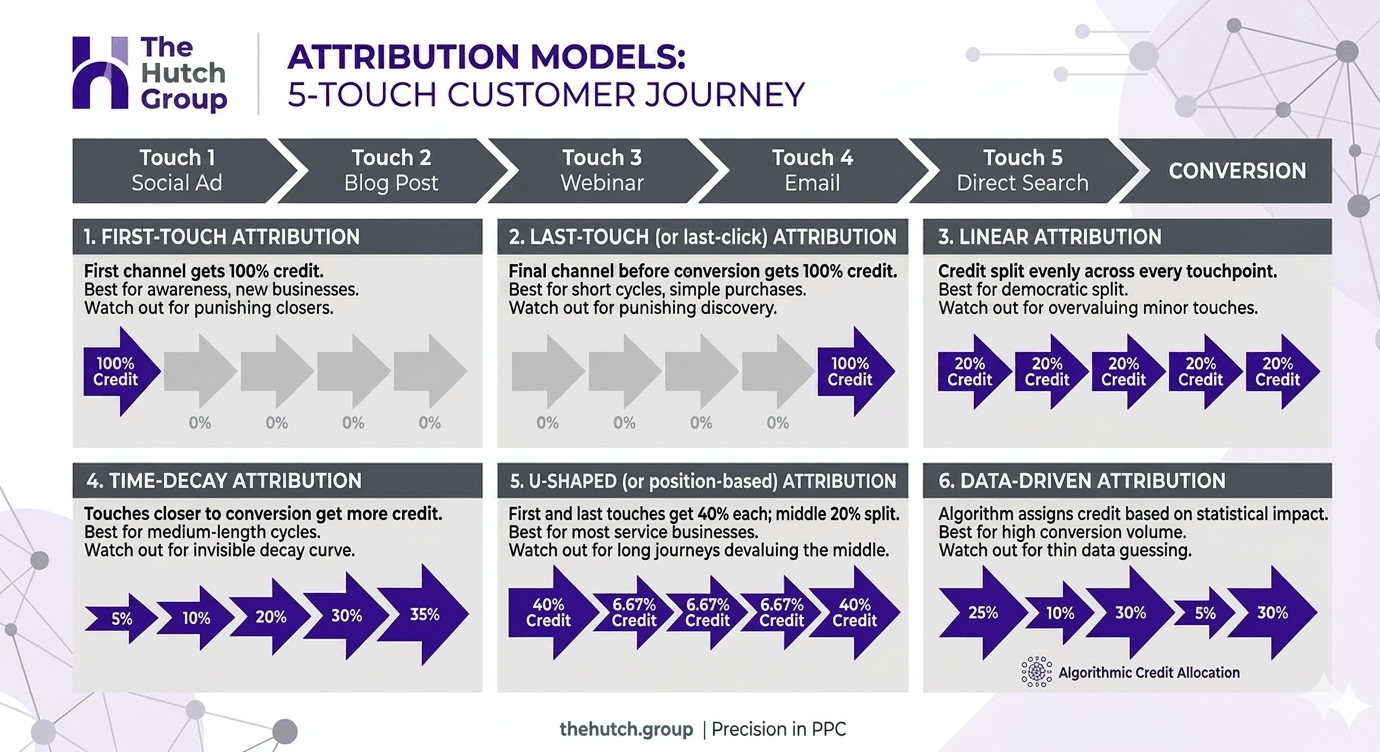
There are a lot of models floating around, but six cover 95% of real-world decisions. Here is what each one does, in plain terms.
1. First-touch attribution
The first channel a customer interacted with gets 100% of the credit. If they found you through a Facebook ad and bought two weeks later after nine more touches, Facebook still gets the whole conversion.
Best for: Awareness-heavy businesses where the big challenge is getting someone to know you exist new local businesses, product launches, brand campaigns.
Watch out for: It punishes the channels that close the deal.
2. Last-touch (or last-click) attribution
The final channel before the conversion gets 100% of the credit. This is the default in Google Analytics for most of its history and the reason last-click is still the lazy standard.
Best for: Short-cycle decisions, a $75 service call, a $20 takeout order. If the buying journey is a day or two, last-touch is close enough.
Watch out for: In any considered purchase, last-touch punishes every channel that did the discovery work and rewards the channel someone would have used anyway (usually branded search).
3. Linear attribution
Credit is split evenly across every touchpoint. Four touches, each one gets 25%. Ten touches, each gets 10%.
Best for: Businesses where you genuinely believe every touch contributed, and you just want a simple democratic split.
Watch out for: It treats a throwaway retargeting impression the same as a 12-minute sales page read. That is rarely accurate.
4. Time-decay attribution
Touches closer to the conversion get more credit, touches further away get less, on a sliding scale. An email opened an hour before purchase gets more weight than a display ad seen three weeks earlier.
Best for: Medium-length sales cycles 2 to 8 weeks where you want to weight the finisher channels without fully ignoring the discovery ones.
Watch out for: The exact decay curve is usually invisible inside your reporting tool, so comparing reports across platforms can be messy.
5. U-shaped (or position-based) attribution
The first touch and the last touch each get 40% of the credit. The remaining 20% is split evenly across every touch in between. The logic: finding you and converting you are the two hardest moments.
Best for: Most service businesses we run paid media for. It respects both the channel that started the conversation and the one that closed it, without making the middle a black hole.
Watch out for: On long journeys with 10+ touches, the middle 20% becomes almost meaningless so do not use it to justify micro-channel budgets.
6. Data-driven attribution
An algorithm looks at every converting and non-converting path in your account and assigns credit based on which touches statistically moved the needle. Google Ads and GA4 both offer this as the default now.
Best for: Accounts with enough conversion volume for the math to stabilize Google recommends at least 300 conversions a month, and honestly it wants more.
Watch out for: With thin data, the model is guessing. If you have 40 form fills a month, data-driven attribution is a confident-sounding coin flip.
How to pick the right attribution model for your business
The right model depends on three things: how long the sale takes, how many channels you run, and how much conversion volume you have.
A quick decision framework:
- Short sales cycle, 1-2 channels: Last-touch is fine. You are not losing much signal.
- Medium sales cycle, 3-5 channels, under 300 conversions a month: U-shaped. It gives you directional truth without requiring enterprise math.
- Long sales cycle, 6+ channels, 300+ conversions a month: Data-driven. You have the volume and the complexity to make it work.
- Brand-new business trying to figure out what’s working at the top of the funnel: First-touch as a supplement to whatever else you are running. Use it as a second lens, not your only one.
Two rules we use with our clients. First, pick one primary model and commit to it for at least 90 days. Hopping between models every month guarantees you never learn anything. Second, always compare your chosen model against last-touch at least once a quarter. The gap between the two is where the actual insights live that is where you see which channels are doing real work that last-click is burying.
How to set up marketing attribution without enterprise tools
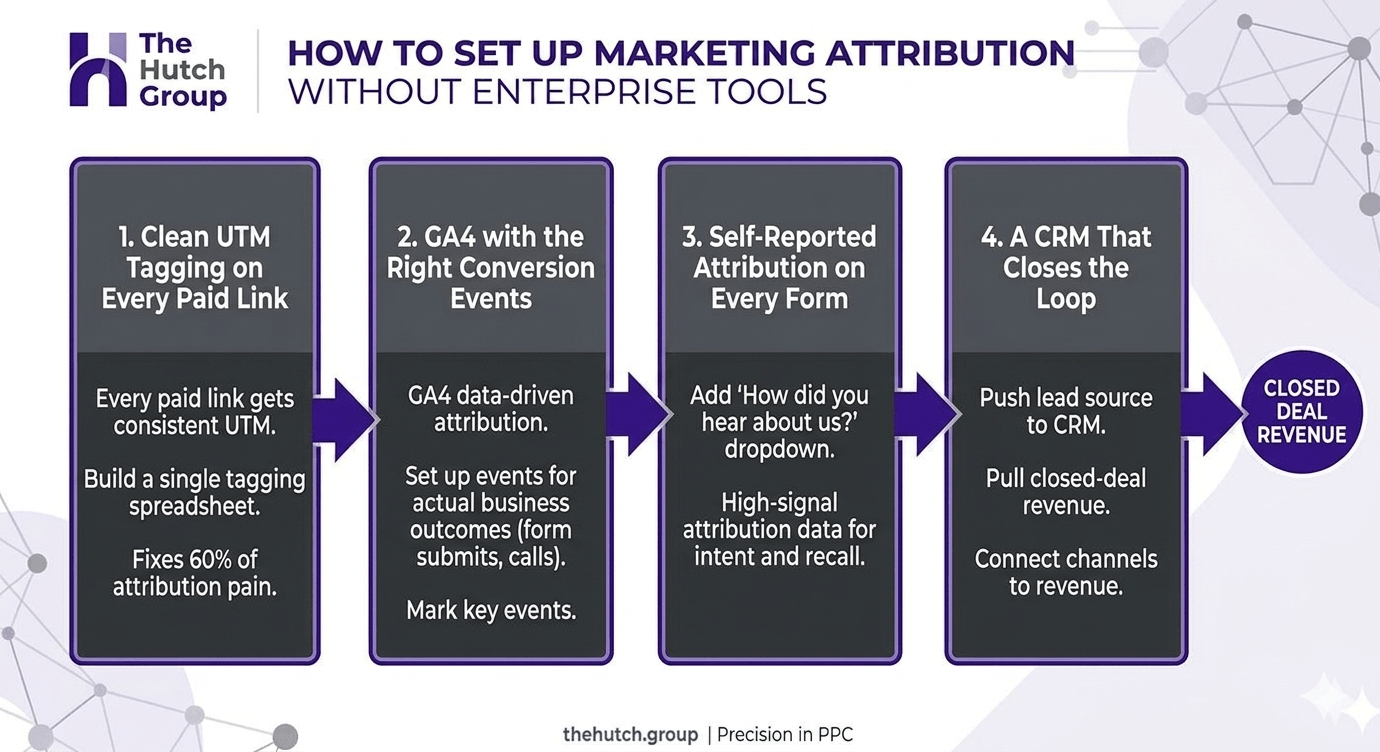
You do not need HubSpot Enterprise or a $24,000/year attribution platform to run this well. A workable setup for most small and mid-sized businesses has four parts.
1. Clean UTM tagging on every paid link
Every paid link Google, Meta, LinkedIn, YouTube, display, email gets a consistent UTM. At minimum: utm_source, utm_medium, utm_campaign. Build a single tagging spreadsheet and make it the only way anyone creates a new link. This alone fixes 60% of attribution pain.
2. GA4 with the right conversion events
GA4 is free and has data-driven attribution built in. The catch is that it only works if your conversion events are clean. “Page view of thank-you page” is rarely enough. Set up events for actual business outcomes form submits, phone clicks, scheduled calls and mark the ones that matter as key events.
3. Self-reported attribution on every form
Add a “How did you hear about us?” dropdown to your intake forms. It sounds low-tech and it is the single highest-signal attribution data most businesses will ever collect. Platforms see clicks; this question sees intent and recall. Use it to check your analytics tool, not replace it.
4. A CRM that closes the loop
Attribution ends when the deal closes, not when the form submits. Push the lead source from your forms into your CRM, then pull closed-deal revenue back out by source. This is how you move from “which channel drives leads” to “which channel drives revenue” and those two lists are almost never the same.
The most common attribution mistakes we see
After running attribution for dozens of accounts, the same handful of mistakes keep showing up.
- Trusting each platform’s native report. Meta’s number and Google’s number cannot both be right. Pick one source of truth (GA4 is the usual answer) and report from it.
- Ignoring branded search. Branded search is mostly a last-touch effect of every other channel doing its job. If branded traffic is “up” when you cut Facebook, it is not you just moved the credit.
- Forgetting offline and phone conversions. For service businesses, most conversions still happen on the phone. If your call tracking is not feeding back into GA4 or your CRM, a huge chunk of your attribution picture is invisible.
- Changing the model right before a review. Switching from last-touch to data-driven the week before a board meeting will make every channel look different, and none of it is because anything actually changed.
- Treating attribution as “set it and forget it.” Revisit the model every quarter. Your channel mix and sales cycle change; your model should change with them.
When to bring in help
If you are spending more than about $10,000 a month across two or more paid channels, attribution stops being optional. The math on a wrong model at that spend level runs into real money fast usually tens of thousands in wasted budget per quarter.
We do this work for clients across home services, legal, and healthcare. If you want a second set of eyes on whether your attribution model is hiding spend problems or false wins, that is exactly what a paid media audit is built to catch.
Marketing attribution FAQ
What is an example of marketing attribution?
A plumbing customer clicks a Facebook ad, visits your site, leaves, searches your brand on Google two days later, clicks your Google Ad, and books a call. Under last-touch attribution, Google Ads gets 100% credit. Under U-shaped, Facebook and Google split 80% and the direct visit gets the other 20%. Same customer, very different stories.
How do you measure marketing attribution?
You need three things: a source of truth for conversions (usually GA4 or your CRM), a consistent tagging system (UTMs on every paid link), and an attribution model you commit to. Then you compare spend by channel against credited conversions and revenue in that model.
What is the difference between attribution and multi-touch attribution?
“Attribution” is the umbrella term. “Multi-touch attribution” specifically means any model that gives credit to more than one touchpoint in the journey so linear, time-decay, U-shaped, and data-driven are all multi-touch. First-touch and last-touch are single-touch.
Is attribution the same as ROI?
No. Attribution tells you which channel gets credit for a sale. ROI tells you whether the sale was worth the spend. You need attribution to calculate channel-level ROI accurately, but they answer two different questions.
What’s the best attribution model for small businesses?
For most small businesses running 2 to 4 channels with a sales cycle under 60 days, U-shaped is a strong default. It gives the introducing channel and the closing channel the credit they deserve without requiring the conversion volume that data-driven attribution needs.
The bottom line on marketing attribution
Marketing attribution is not about perfect measurement. No model is perfect, and anyone selling you one is selling you software. It is about picking a defensible way to assign credit, committing to it long enough to learn from it, and using it to make smarter budget decisions than the person who is still adding up duplicate platform reports.
Get a model picked this week. Get your UTMs clean this month. Get your CRM feeding closed-deal revenue back into your reporting by next quarter. That sequence alone will out-perform 90% of the businesses you compete with.
