
Most of the PPC-for-lawyers content online reads like it was written by a software vendor trying to sound useful. Nine bullet points. Tips like “write strong ad copy” and “use negative keywords.” Nothing that actually helps a managing partner decide whether to spend $8,000 a month on Google Ads, how to split that across platforms, or whether PPC is the right play at all for their firm.
This post takes the other approach. Four real decisions, in the order they matter. Get these four right and the rest of PPC for lawyers is execution. Get them wrong and no amount of A/B-tested ad copy will save you.
Some context before the decisions. Our team has managed paid search campaigns across legal, healthcare, and home services for years, and legal is the one where the stakes per click are the highest. Intent is usually good (someone searching “car accident lawyer Austin” is almost certainly in the market). But CPCs run ten to eighty dollars depending on practice area and geography. A single wasted week of bad targeting can burn through what it would cost to pay an associate for a month. Bad PPC for a law firm isn’t just inefficient. It’s actively expensive.
With that said, here are the four decisions.
Decision 1: Do You Actually Belong on PPC Right Now?
This is the question nobody selling you PPC will ask. So we’ll ask it.
PPC works well for law firms when three things are true. You have enough monthly budget to collect statistically meaningful data (more on numbers in a minute). You can handle the lead volume a good campaign produces, meaning you answer calls within five minutes, screen and disposition every lead, and actually sign clients. And you have conversion tracking set up well enough to know which ad spend turned into signed cases, not just form fills.
If any one of those is missing, PPC is usually the wrong first move. We’ve seen firms spend $4,500 a month for six months with broken tracking and miss the fact that their ad agency was reporting “89 leads” while the firm had signed exactly three of them. The campaign wasn’t broken. The feedback loop was.
A quick test. Ask yourself this one with real numbers. Of the 10 most recent leads from Google last month, how many became signed cases, and what was the total fee value? If you can answer, you’re ready for PPC. If you can’t, fix that before you spend another dollar. [INTERNAL LINK: proper conversion tracking → /blog/google-ads-conversion-tracking] is the foundation, and skipping it is how firms end up six months deep with nothing useful to show.
One more honest filter. PPC is rarely the right answer for firms with a signed-case value under $2,000 unless the lead-to-client conversion rate is unusually high. The math doesn’t work at low CPCs and high CPLs. Uncontested divorces, estate planning, and simple bankruptcy filings can still make PPC work, but the campaign has to be dialed in from day one.
Decision 2: Google Ads, Local Services Ads, or Both?
This is where most of the bad advice lives. Generic PPC guides for lawyers treat Google Ads as synonymous with PPC and skip the single biggest product shift in legal paid search over the last five years, Local Services Ads (LSA).
The short version. Google Ads is a traditional auction model. Bid per click, land on your website, pay whether they become a client or not. LSA is a lead-based model. Pay per qualified phone call, Google screens your firm before you can run ads, and leads often come with a “Google Screened” badge that boosts trust. The two products live in different parts of the SERP and they behave very differently.
The decision comes down to three factors.
What practice area are you in. Personal injury, criminal defense, family law, immigration, and estate planning all have solid LSA traction as of early 2026. Niche practice areas (admiralty, aviation, tax controversy) often have no LSA coverage at all. Check before you plan.
How local is your client base. LSA is hyperlocal by design. It’s phenomenal for a personal injury firm serving one metro. It’s less useful for a regional employment law boutique serving four states from one office.
How much budget you have. LSA tends to produce lower cost-per-lead than Google Ads in legal, but volume is capped by the number of searchers in your local area and how many competitors are also running LSA. A firm with a $6,000/month PPC budget may hit the LSA volume ceiling at $3,500 and need Google Ads to absorb the rest.
For firms at $5,000+ monthly PPC budget, we usually run both. LSA gets first dollar until volume plateaus. Google Ads then picks up the remaining budget, focused on the searches LSA doesn’t cover well (higher-funnel research queries, practice-area comparison searches, referral-friendly long-tails).
Below $5,000/month, we run LSA only and keep it simple until there’s enough data to justify adding Google Ads on top. And don’t forget that [INTERNAL LINK: your Google Business Profile → /blog/google-business-profile-optimization] is the organic analog to LSA. A well-optimized GBP lifts LSA performance because Google uses some of the same signals.
Decision 3: Where the Budget Number Actually Comes From
Every PPC-for-lawyers article we’ve read punts on this question. “It depends.” “Start small and scale.” That’s not useful when you’re trying to set a line item in your budget.
Here’s how to size it honestly.
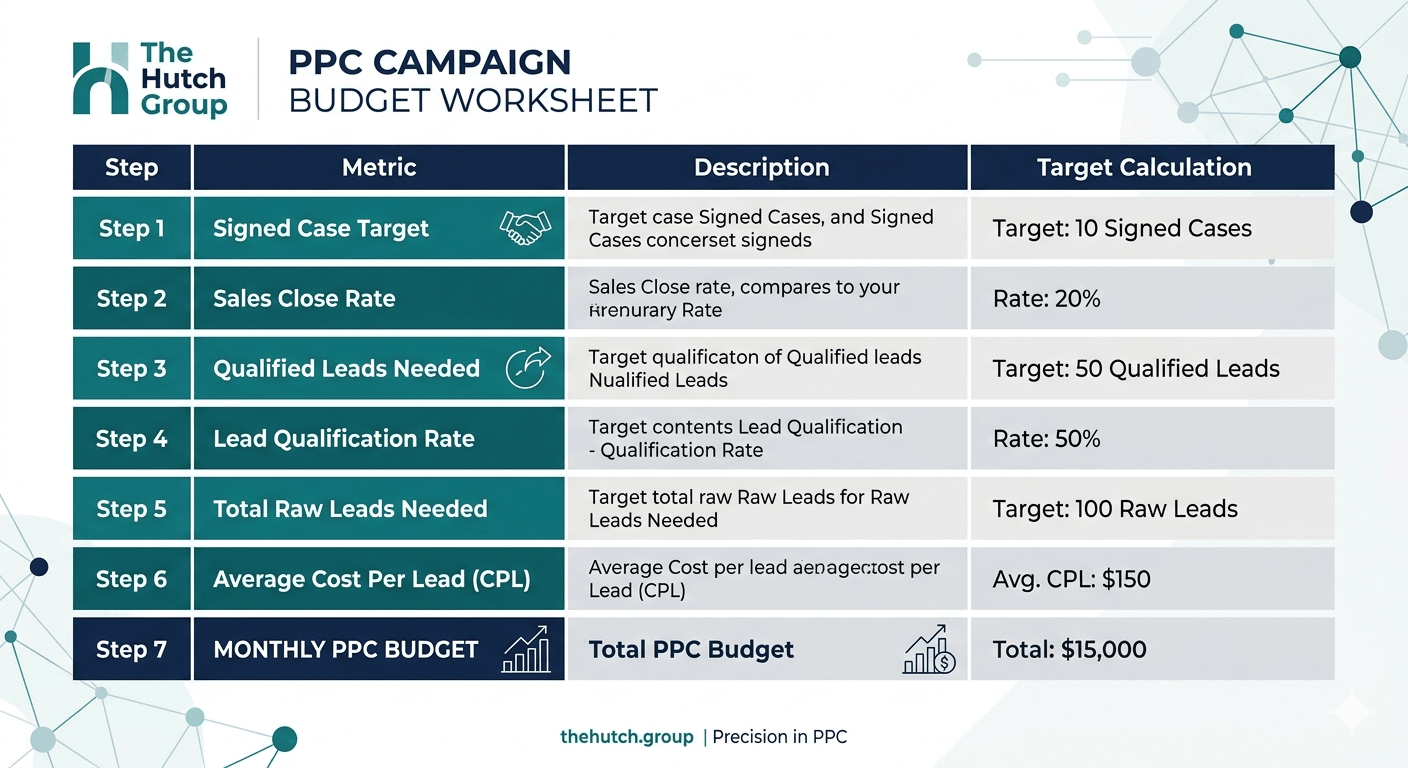
Start with your target signed-case count. Say you want 10 new signed PI cases per month. Work backward through your historical conversion funnel. If your current lead-to-signed-case rate is 20%, you need 50 leads per month to produce 10 signed cases. That’s your lead target.
Then the cost-per-lead. Legal PPC cost-per-lead ranges widely by practice area and market. A rough 2026 snapshot from the accounts we’ve seen recently:
- Personal injury (major metros): $200 to $400 per qualified lead via Google Ads, $150 to $300 via LSA
- Criminal defense: $150 to $300 per qualified lead
- Family law: $80 to $180 per qualified lead
- Estate planning: $40 to $120 per qualified lead
- Immigration: $60 to $140 per qualified lead
Multiply your lead target by your CPL estimate and you have a budget floor. 50 leads × $300 CPL = $15,000/month. Add a buffer for testing (we usually add 20%) and you land around $18,000/month as a realistic starting budget for a PI firm wanting 10 new cases a month.
This math is ugly in a different way than most firms expect. The problem isn’t that PPC is too expensive. The problem is that at honest CPLs, the budget needed to actually move the firm’s revenue is bigger than what most marketing-budget line items are set at. We’ve had firms walk into a planning meeting thinking they could get serious traction for $2,500/month and walk out realizing the real number is closer to $10,000. That’s a legitimate business decision. But it’s better to know before you spend.
Decision 4: What You’re Actually Measuring and Reporting On
The single most common pattern we see in underperforming law firm PPC accounts has nothing to do with bids or ad copy. It’s this. The firm is measuring form fills and phone calls, calling those “leads,” and never tying them back to signed cases.
Form fills are not leads. They’re form fills. Some are qualified potential clients. Some are tire-kickers. Some are current clients asking administrative questions. Some are spam. Some are opposing-counsel investigators (this happens more than you’d think in family law).
If your PPC reports stop at “we got 42 leads this month” and don’t get to “we got 42 leads, 31 were qualified, 19 had intake calls, 7 became signed clients, total fee value $84,000,” you’re flying blind. Worse, you’re handing your agency a feedback loop that rewards volume over quality, and those two don’t always move together in legal PPC.
Here is what good measurement looks like for a law firm running PPC. Every lead is tagged with its source down to the campaign, ad group, and search query. Most of our clients use CallRail for phone-call tracking and HubSpot or a practice-management CRM for form tracking. Every lead gets a disposition in intake. Qualified, not qualified, qualified-but-conflict, qualified-but-declined-retainer, signed, or signed-and-fee-projected. And every signed case has a fee value attached, even if it’s an estimate.
Roll that up monthly and you can calculate the metric that matters. Cost per signed case, not to be confused with cost per click. That’s the number that determines whether your PPC is profitable.
A real anonymized example. A workers’ comp firm in the Southeast came to us with a pitch deck from their previous agency showing “leads at $42 per lead, 66% lower than industry average.” Sounded great. When we tied the data back through their intake, three out of four of those leads were wage-and-hour claims the firm didn’t handle. Their real cost per qualified lead was $170, and their cost per signed case was over $4,000, roughly double what they should have been paying for their practice mix. The cheap CPLs were a vanity metric dressed up as a result.
A Pattern We Keep Seeing
Firms that succeed with PPC treat it as one discipline of three. Paid (Google Ads, LSA, sometimes Meta). Organic (SEO, content, Google Business Profile). Intake (the human systems that turn a call into a signed client). When any one of the three is broken, PPC results either look bad or look artificially great in a way that doesn’t translate to revenue.
Firms that struggle with PPC tend to treat it as a one-variable equation. More budget and lower CPL. That’s like trying to cook a meal by only adjusting oven temperature.
[IMAGE: Three-legged stool diagram labeled “Paid,” “Organic,” and “Intake” with PPC sitting on top | Alt text: Diagram showing how law firm PPC performance depends on paid, organic, and intake systems working together]
A Few Questions We Get All the Time
How much does PPC for lawyers actually cost per month, realistically?
For personal injury, $10,000 to $50,000 a month is a serious budget range. For family law, criminal defense, or estate planning, $3,000 to $10,000 can make sense. Under $2,000, you’re usually better off on LSA alone or reallocating to local SEO and organic content.
Should our firm hire an agency or run PPC in-house?
Honest answer. If your firm’s monthly PPC budget is under $3,000, you probably can’t justify agency fees on top of ad spend, and the math pushes you toward running it in-house and keeping it simple. Above $8,000, a specialist legal PPC agency usually pays for itself in waste reduction and strategic oversight. Between $3,000 and $8,000 it’s a closer call and depends on whether anyone on your team has time to manage the account week to week.
What’s the biggest mistake law firms make with PPC?
Reporting clicks, impressions, or form fills as the success metric. The only number that tells you whether your PPC is working is cost per signed case (or cost per qualified consultation, if you measure further upstream). Everything else is noise.
How long until we see results?
First signal in 4 to 6 weeks. Stable CPL numbers usually take 8 to 12 weeks. A reliable read on cost per signed case takes a full quarter minimum, and longer for practice areas with long sales cycles (complex PI cases, estate planning).
What to Do This Week
If you’re considering starting PPC, do this before you spend a dollar on ads. Audit your intake tracking. Pull your last 30 days of leads (from any source) and, for each one, write down source, qualified yes/no, signed yes/no, and estimated fee if signed. If you can’t do this in an afternoon, fix that before you run anything.
If you’re already running PPC and something feels off, do the same exercise for your PPC leads specifically. Compare cost per signed case to your average fee per case. If the ratio is worse than 1:5, something is broken in the campaign, the intake, or both.
PPC for lawyers works. It works very well when the three legs (paid, organic, intake) are all functioning. It just doesn’t work the way most of the industry pitches it.
